
Mungo National Park
For tens of thousands of years, the people of this Country have known their ancestors were here. When the lake that filled this basin was still brimming with fresh water - long before the last Ice Age drained it - the Paakantyi, Ngiyampaa and Mutthi Mutthi peoples fished its shallows, gathered along its shores, and laid their dead to rest in the sandy ridge above the water. Their descendants never left. What scientists would later call one of the most important archaeological landscapes on the planet, the Aboriginal custodians of Mungo simply call home - a place where the connection to ancestors stretches back unbroken across more than 40,000 years.
The Walls of China
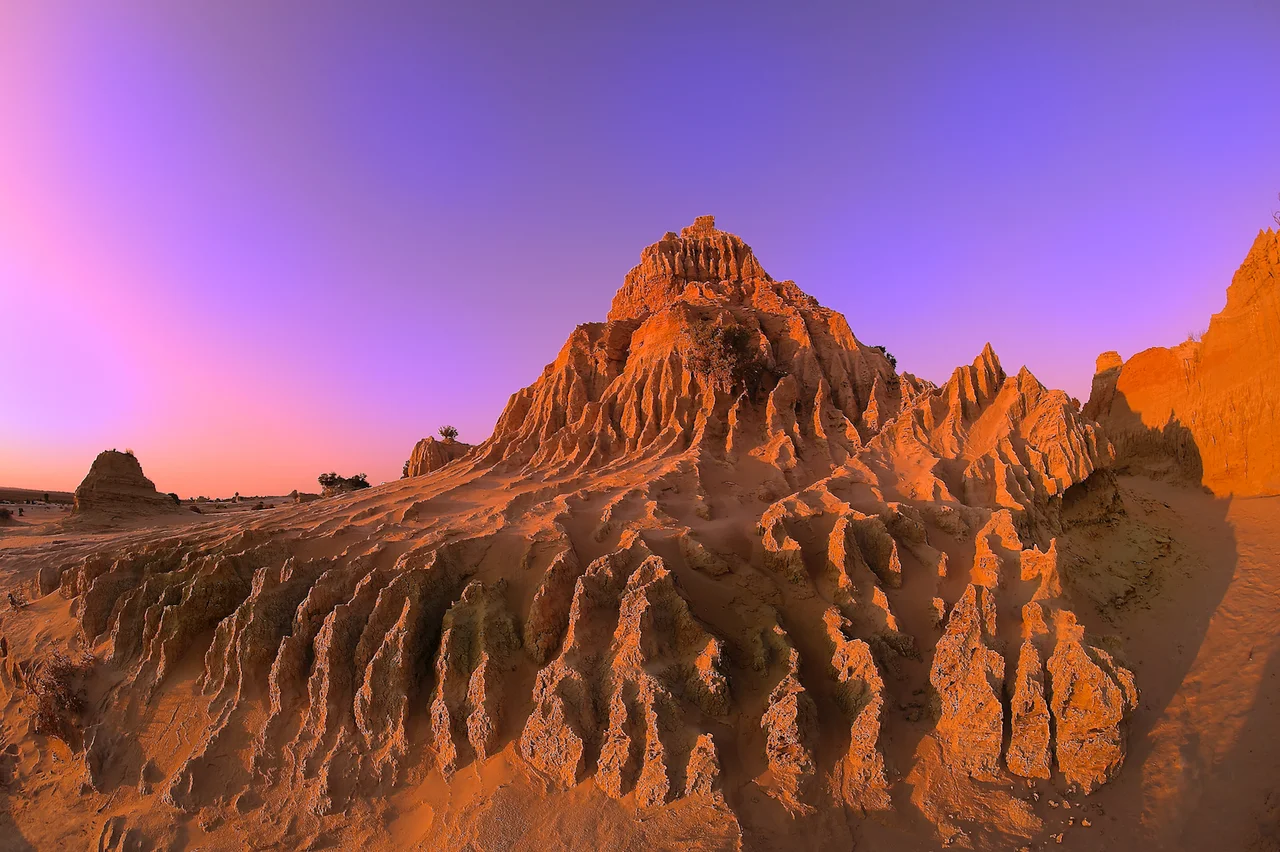
There is no water at Lake Mungo now. The lake dried out at the end of the last Ice Age, and what remains is a vast pale floor of clay and grass, rimmed on its eastern edge by a crescent of bone-coloured dunes the early Chinese station workers nicknamed the Walls of China. Wind and rain have carved the lunette into ridges, pinnacles and ravines that glow gold at dawn and burn orange at sunset. The alkaline soil that the vanished lake left behind has done something remarkable: it has preserved the past. Layer upon layer of sediment, built up over more than 120,000 years, holds ancient hearths, the bones of long-extinct megafauna, stone tools, and the traces of the people who lived here when the lake was full.
Mungo Lady and Mungo Man
In 1968, geologist Jim Bowler noticed burnt bone weathering out of the lunette. The remains were those of a young woman - Mungo Lady - who had died perhaps 42,000 years ago. Her body had been cremated, the bones then crushed and buried with care. It is the oldest known cremation anywhere in the world. Six years later, in 1974, Bowler found a second burial nearby: Mungo Man, an elder of around fifty, laid on his back with his hands folded and his body dusted with red ochre carried from many kilometres away. These were not curiosities to be catalogued. They were a grandmother and a grandfather, buried by people who grieved them and honoured them with ceremony - evidence that the spiritual life of this continent's first peoples runs as deep as humanity itself.
A Long Journey Home
The discoveries reshaped the world's understanding of how long Aboriginal people have lived in Australia, pushing the timeline back tens of thousands of years. But that knowledge came at a cost the science of the day rarely acknowledged: the ancestors were removed from Country and taken away for study. Winning them back took decades of patient, determined campaigning by Aboriginal elders. Mungo Lady was returned in 1992. Mungo Man's road home was longer - he was held at the Australian National University until 2017, when traditional owners brought him back across New South Wales in a vintage hearse, stopping for Welcome to Country smoking ceremonies in Wagga Wagga, Hay, Balranald and Mildura along the way. The reburial of the ancestors in 2022 was painful and contested, opposed by some traditional owners who felt the decision was made without proper consent. The grief and the disagreement are part of this story too, and they deserve to be heard.
Country, Cared For
Mungo is now jointly managed by the New South Wales National Parks and Wildlife Service together with the elders of the three traditional owner groups - the Paakantyi, Ngiyampaa and Mutthi Mutthi - whose voices guide how this place is protected and shared. Visitors can walk the foreshore of the dry lake, drive the 70-kilometre loop track that winds anticlockwise from the visitor centre, and stand at the lookouts as the Walls of China shift colour with the falling light. The dunes themselves may only be entered with an Aboriginal guide, and rightly so: this is a cemetery and a cathedral. Emus and kangaroos cross the grasslands at dusk, the silence is enormous, and the sky at night is thick with stars. To come here is to be a guest on Country that has been lived in, and loved, since the dawn of human memory.
From the Air
Mungo National Park sits in the Willandra Lakes World Heritage Area of far western New South Wales, centred near 33.73°S, 143.00°E, at a low elevation of roughly 60-100 m. The standout visual landmark is the Walls of China - a 30 km arc of pale eroded lunette dunes along the eastern edge of the flat, dry Lake Mungo basin, most striking in the low-angle light of early morning and late afternoon. The park is remote, reached only by unsealed roads. The nearest airport with scheduled flights is Mildura Airport (YMIA), about 110 km southwest; Balranald and Pooncarie are the nearest small centres. Skies are typically clear with very high visibility; summer dust storms are the main hazard.
Nearby Stories
- PS Rodney 20 km away
- Pooncarie 32 km away
- Mossgiel 95 km away
- Ivanhoe 117 km away
- Kinchega National Park 130 km away
- Warangesda Aboriginal Mission 248 km away
- Echuca 297 km away
- Mount Arapiles 318 km away