.jpg)
Warangesda Aboriginal Mission
The name was chosen by firelight, and it meant mercy. Warang, the Wiradjuri word for camp, joined to esda, from the scriptural Bethesda, house of mercy. The mission rose beside the Murrumbidgee River in the Riverina in 1880, built by Aboriginal hands on Wiradjuri land. For a time it offered shelter to people whose world was being dismantled around them. But the institution that promised mercy also held a dormitory where girls were separated from their families, and that dormitory became the blueprint for one of the cruellest policies in Australian history. To stand at Warangesda today is to stand at the place where, for many Aboriginal families, the Stolen Generations began.
Wiradjuri Country
Long before the mission, this stretch of the Riverina belonged to the Wiradjuri, who moved across the grasslands gathering native grains and fruits and hunting along the river. Wiradjuri women carried small grindstones with them as they travelled, their babies and young children alongside. The land near Warangesda was a place of seasonal foraging and ceremony rather than permanent camp. As recently as the 1870s, it hosted what is remembered as the last great inter-group burbung, the initiation ceremony that marked young people's passage into adulthood. The arrival of colonial farmers shattered this world: land was fenced and subdivided, food sources vanished, and disease and dispossession devastated the Wiradjuri population. The mission was founded into the wreckage of that catastrophe.
The Reverend and the Mission
Warangesda was the work of the Reverend John Brown Gribble, who built it with Aboriginal labour between 1879 and 1884. Gribble saw the mission as a refuge, a place to shield Aboriginal women from the violence and exploitation of the frontier, and he was hated by some local settlers for it. One station hand rode in waving a stirrup iron and threatening to kill anyone who came near; on another occasion someone sent in a case of gin, hoping to get the women drunk. Yet Gribble built his mission on the standard model of his era, one that kept authority firmly in white hands, pressed Christianity and English schooling on residents, and removed children to dormitories away from their parents. Worn down after four years, Gribble suffered a breakdown and left. His tombstone calls him the Blackfellows' Friend, a phrase that holds all the era's tangled contradictions.
A Community That Endured
Whatever the intentions of those who ran it, Warangesda became something its managers never designed: a community. Over forty-five years, the Wiradjuri people there wove enduring family networks, and beneath the surface of mission life their own culture quietly persisted. When the mission ran short of meat, it was Aboriginal men whose hunting knowledge filled the gap, returning with kangaroo. Traditional fishing methods once took, in Gribble's own words, half a ton of fish from a downstream pool. In photographs from the era, Wiradjuri families gaze steadily into the camera, dressed with dignity and self-possession. By the turn of the century the community had earned a reputation among local Europeans as the aristocrats of the region's Aboriginal settlements, a confident people holding their world together under impossible pressure.
Where the Stolen Generations Began
The dormitory at the heart of Warangesda carries a terrible legacy. Girls were brought there from many places and kept under the supervision of matrons, trained for domestic service and held apart from their families. The historian Peter Read estimates that 300 girls were sent out to service from Warangesda before 1909. That dormitory became the prototype for the Cootamundra Aboriginal Girls Home, the central destination for Aboriginal girls removed from their families across the whole of New South Wales, the children we now call the Stolen Generations. Behind every statistic stands a child taken from a mother's arms and a family left with an empty place at the fire. After Gribble's departure, control of the mission passed to the NSW Aborigines Protection Board, the government authority that wielded ever-tightening power over Aboriginal people's lives. As the years passed the mission grew harsher still; by 1916 its manager was requesting a pistol and handcuffs, and within a decade the NSW Aborigines Protection Board expelled the Wiradjuri community of Warangesda, auctioned their belongings, and handed their land to new settlers.
A Heartland That Remains
When the Board closed Warangesda in 1924, its people did not scatter into nothing. They carried their connections with them, founding and strengthening communities at Darlington Point, at the Narrandera Sandhills, at Griffith and Cowra and beyond. Warangesda remains a heartland for some of the most important Aboriginal family networks in south-eastern Australia, names like Bamblett, Naden, Atkinson, Kirby, Murray, Charles, Little, and Perry, and it is held dear by thousands of descendants. From these families came figures woven into the nation's life: the political activist William Ferguson, the beloved musician Jimmy Little. The ruined buildings beside the Murrumbidgee, listed on the New South Wales State Heritage Register in 2010, are not just relics. For the Wiradjuri descendants who have never let go of this place, they are sacred ground, a site of grief and survival both.
From the Air
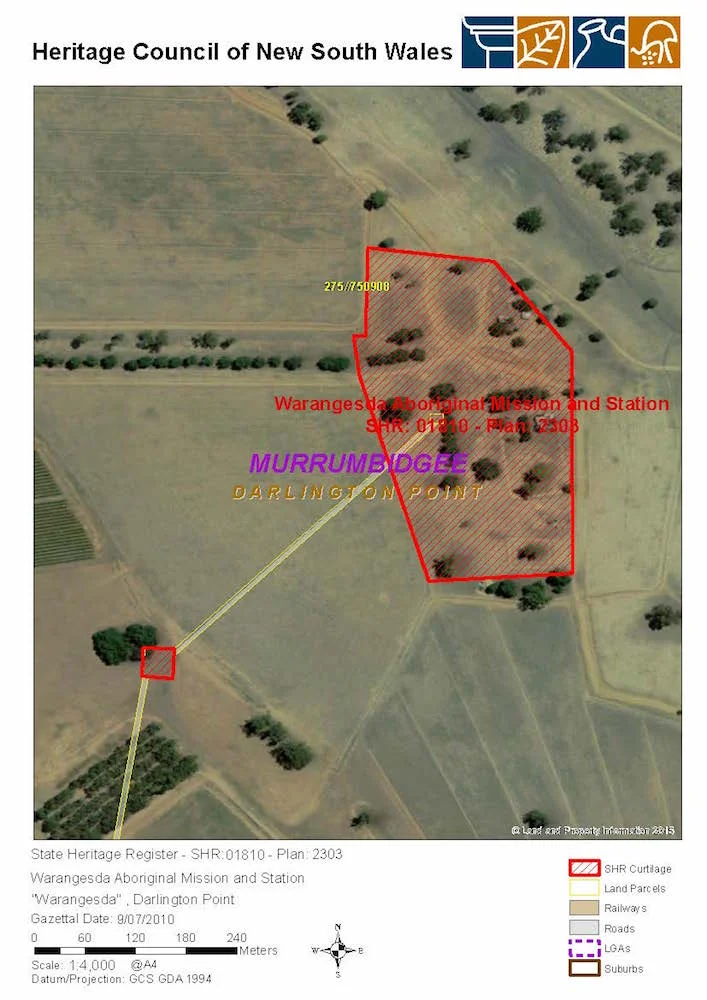
Warangesda lies at approximately 34.60 degrees south, 146.01 degrees east, near Darlington Point on the Murrumbidgee River in the Riverina region of southern New South Wales. From the air, look for the dark, winding corridor of the Murrumbidgee threading through the flat irrigated plains of the Riverina, with the small town of Darlington Point nearby; the former mission site sits on farmland a short distance from the river. Griffith Airport (ICAO YGTH) is the nearest regional airfield, to the northwest, with Narrandera Airport (YNAR) to the east. The terrain is low and open, and the river and its fringing trees are the clearest landmarks against the surrounding wheat and pasture. This is a place best approached with quiet respect for the families whose history is written into the land below.
Nearby Stories
- Willandra National Park 87 km away
- Echuca 164 km away
- Mossgiel 169 km away
- Mount Hope, New South Wales 170 km away
- Beechworth 173 km away
- Glenrowan, Victoria 185 km away
- Lake Burley Griffin 244 km away
- Eora 406 km away