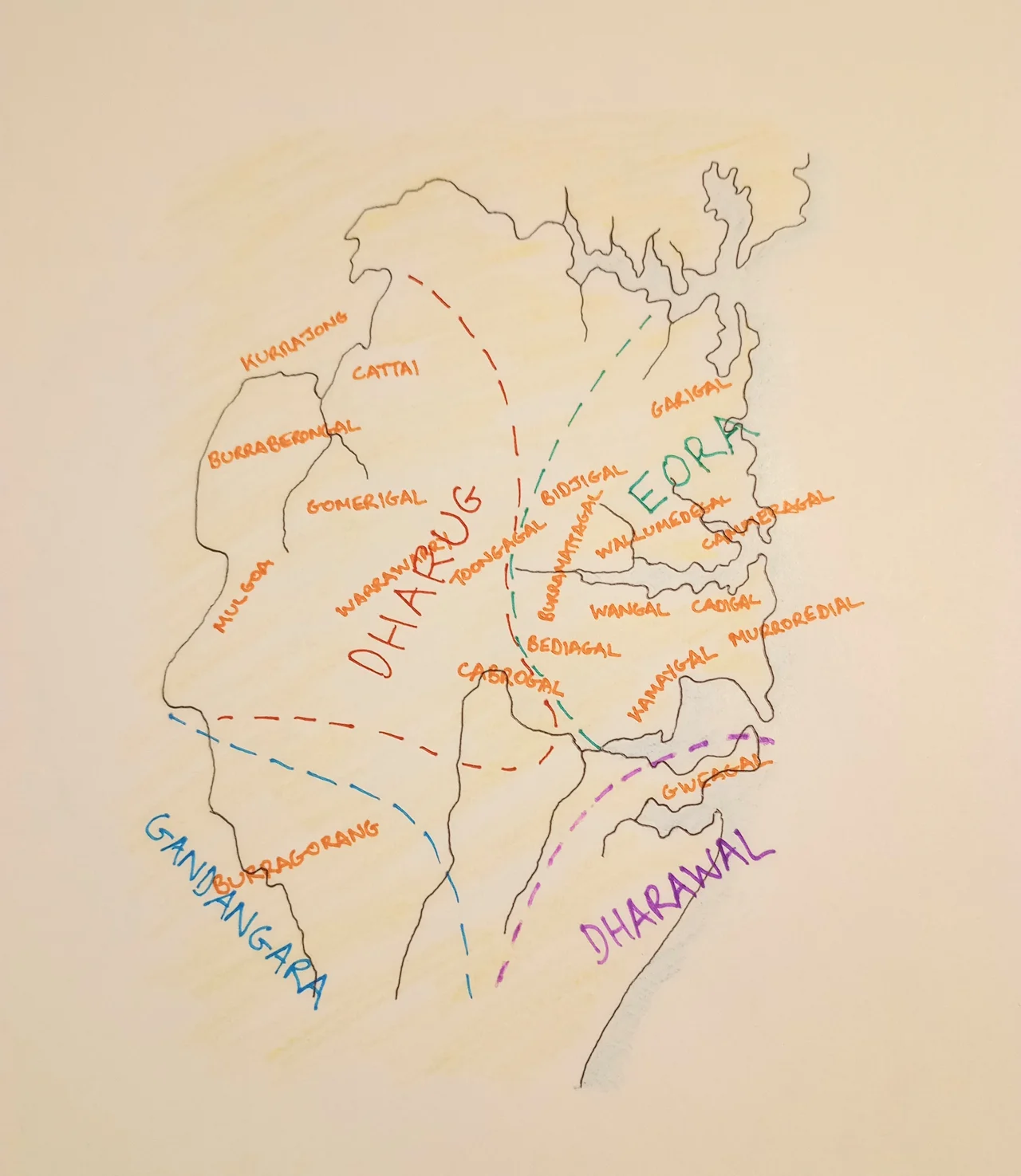

Eora
Before there were sails on the horizon, there were canoes on the water. They threaded the coves and inlets of the great harbour the British would call Port Jackson, lit by small fires burning on beds of clay where women cooked the morning catch. The people who lived here were expert in everything the coast could offer: where the mullet ran, how the oysters clustered on the rock ledges, when the turtles came close enough to take. They were not one tribe but many clans, each tied to its own stretch of sandstone and saltwater. The British, struggling to understand, latched onto a single word from the local language and made it stand for all of them: Eora, which simply meant the people.
The Saltwater Country
Eora country runs along sandstone ridges and tidal lagoons from the northern shores of the harbour to Botany Bay and the Georges River, reaching inland as far as Parramatta. The land shaped the lives lived on it. These were coastal people who took most of what they needed from the sea, navigating close to shore in canoes of stringybark, fishing with lines and spears, managing the wetlands at places like Curl Curl and Dee Why so they yielded food season after season. Clan names told you where someone belonged. The Gadigal held the south side of the harbour, the Cammeraygal the north, the Wallumettagal took their name from the snapper. At the head of the Parramatta River, where the water turned fresh, the Burramattagal were the eel-place people. Each clan numbered perhaps fifty, and loyalty to your own clan ran deeper than any shared identity with the rest.
Ghosts on the Shore
When the First Fleet anchored in January 1788, roughly fifteen hundred Eora watched newcomers begin tearing into trees and earth with a violence that made no sense. At first the people wondered whether these pale strangers were spirits of the dead, their very sex uncertain, until a sailor settled at least one question by dropping his trousers. There were seventeen recorded encounters in the first month alone as the Eora defended their fishing grounds and country. Misreadings ran both ways. Governor Phillip saw the scarring on women's faces and assumed cruelty by their men, never grasping it was the mark of grief. Determined to bridge the gap, the British simply seized people. Arabanoo, captured at Manly Cove, was the first taken to be trained as a go-between. He would not live long enough to serve.
The Coming of Gai-galla
In April 1789, a little more than a year after the ships arrived, a sickness swept the harbour with terrible speed. The Eora called it gai-galla. The British recognised it as smallpox. By early that year, settlers and sailors were stumbling on the dead in coves and on beaches; the canoes that had always crowded the water simply vanished. Bennelong, who lived through it, believed half the Eora of the Sydney district were gone. Some estimates put the loss between half and ninety percent of local clans within three years. Tellingly, no settler child fell ill, which raised hard questions that have never fully closed about how the disease reached people who had no contact with its source. The Cadigal clan of the harbour peninsula was all but wiped out. A way of life thirty thousand years deep was unravelling in a single season.
The Ones Who Endured
Even in catastrophe, the Eora left names that still echo across Sydney. Bennelong learned the colony's manners and weaknesses better than the British ever learned his, lived in a brick hut on the point where the Opera House now stands, and sailed to England and back. Barangaroo, his wife and a formidable Cammeraygal woman, lends her name today to a stretch of harbourside city. Patyegarang, a young woman, taught the marine officer William Dawes her language, and his notebooks are now among the only records of words otherwise lost. And Pemulwuy of the Bidjigal led armed resistance for a decade, surviving a head wound at the Battle of Parramatta in 1797 before being shot dead in 1802 — after which his head was sent to a collector in England. Their descendants live on. The languages and old ways were largely broken, but in 2020 a singer named Olivia Fox performed the national anthem in the Eora tongue before a stadium crowd, and the harbour heard those words again.
From the Air
The heart of Eora country sits around Sydney Harbour at approximately 33.85 degrees south, 151.21 degrees east, with the broader territory reaching south to Botany Bay near 34.0 degrees south and west to Parramatta. From the air the country reads as a deeply indented coastline of sandstone headlands, drowned river valleys, and tidal bays — the same geography that made canoe culture flourish. Bennelong Point and the Opera House mark the harbour's southern shore. Sydney Airport (Kingsford Smith, ICAO YSSY) lies on the northern edge of Botany Bay; Bankstown (YSBK) sits inland to the west. Clear coastal mornings give the sharpest view of the harbour's branching coves; afternoon sea breezes can build cloud over the ranges to the west.
Nearby Stories
- Wollongong 20 km away
- Australian War Memorial 164 km away
- Canberra 188 km away
- Apsley Falls 301 km away
- Walcha, New South Wales 313 km away
- Smoky Cape Lighthouse 374 km away
- Mount Hope, New South Wales 435 km away
- 2003 Fiordland Earthquake 1781 km away