.jpg)
Wollongong
There is barely room for Wollongong to exist. The city is squeezed onto a thin coastal shelf with the Pacific Ocean on one side and the Illawarra Escarpment, a rainforested wall of sandstone, rising steeply on the other. In places the gap is so tight that the coast road simply gives up on land. South of the city, where falling rock made the old clifftop route too dangerous, engineers built the Sea Cliff Bridge out over the water in 2005, a 665-metre curve of concrete that arcs around the base of the cliffs above the breaking surf. The Dharawal people called this country Woolyungah, and the name of the city is thought to carry meanings like sound of the sea, or ground near water. Both still fit.
Five Islands, Many Names
George Bass and Matthew Flinders, the navigators who would later prove Tasmania an island, landed at Lake Illawarra in 1796, and Bass documented the region's coal deposits the following year. That coal would define everything. But the deeper history runs far longer: the Dharawal had lived along this coast for thousands of years before any European keel touched the lake. Just offshore near Port Kembla lie the Five Islands, a wildlife refuge that may be the root of the city's name, one proposed meaning of Wollongong being five islands or five clouds. Today the city of more than 300,000 people is the third-largest in New South Wales, strung along the shore from Helensburgh in the north to the lake and beyond in the south, a chain of surf beaches backed always by the green cliffline.
The Black Seam
Coal made Wollongong, and coal also gave it its darkest day. The escarpment is laced with the entrances of old mines, their tunnels following the seams into the mountain. On 31 July 1902, an explosion tore through the Mount Kembla colliery and killed 96 men and boys, the youngest just 14, the oldest 69. It remains the worst mining disaster in Australian history, a wound the community has never forgotten and still commemorates. The men who died were the fathers, sons, and brothers of an entire district, and their loss is woven into the identity of the towns that cling to the escarpment's lower slopes. The mine is now listed on the State Heritage Register, its story preserved as a memorial rather than a curiosity.
City of Steel and Migrants
In 1928 a steelworks opened at Port Kembla, a few kilometres south, and it grew into the largest single concentration of heavy industry in Australia, eventually a world-class flat-rolled steel producer turning out millions of tonnes a year. The works needed workers, and after the Second World War they came from more than a hundred countries. By 1966 around 60 percent of the wage earners at the Australian Iron and Steel plant had been born overseas, and they settled in suburbs like Cringila and Warrawong, giving Wollongong a deeply multicultural character it carries still. You can hear it in the streets, where Macedonian, Italian, Arabic, and Mandarin are spoken alongside English, and the place names of the industrial age sit beside the food and faith of the people who came to build it.
The Lotus on the Lion's Flank
The city that grew up around smokestacks has spent recent decades reinventing itself, and one of its most striking landmarks is a temple. The Nan Tien Temple, completed in 1995 at Berkeley, is among the largest Buddhist temples in the Southern Hemisphere. Its founder is said to have chosen the site for its nearness to Mount Kembla, whose long ridgeline was thought to resemble a reclining lion, an auspicious shape in the tradition. The temple's sweeping tiled roofs sit in deliberate contrast to the heavy industry a short drive away, a measure of how far the city has travelled. The University of Wollongong, twice named Australian University of the Year, draws students from around the world, and the economy now leans on education, the arts, and tourism as much as on the steel that still defines the skyline.
A Hill, a Lighthouse, a Bridge
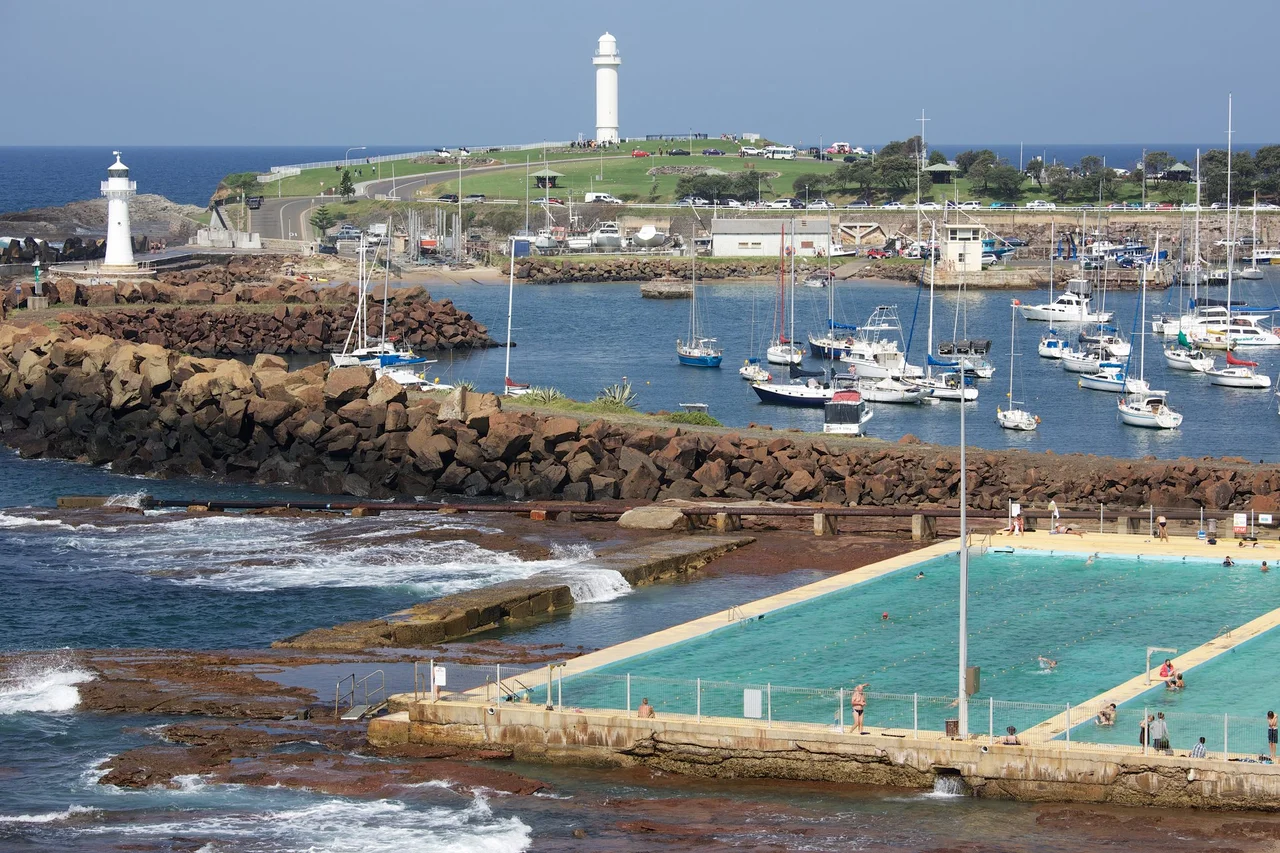
To the east of the centre, Flagstaff Point juts into the sea, a grassy headland with a colonial fort, restored cannons, and not one but two lighthouses, a doubling peculiar to this stretch of the Australian coast. The older Wollongong Breakwater Lighthouse, built of wrought-iron plates in 1871, has become an emblem of the city; the newer Wollongong Head Lighthouse went up on the hill in 1936 and still works. Below the point, convict labour once carved out Belmore Basin, now home to the fishing fleet. North and south, the beaches run in long pale-gold arcs, broken by rocky headlands, until the land pinches in again at the cliffs where the Sea Cliff Bridge carries traffic out over the waves and back, the most photographed stretch of road in the Illawarra.
From the Air
Wollongong lies at roughly 34.43 degrees south, 150.89 degrees east, on the New South Wales coast about 85 km south of Sydney. From the air the setting is the story: a narrow built-up strip pinned between the long green wall of the Illawarra Escarpment and the Pacific, with Lake Illawarra a large lagoon to the south and the heavy industry of Port Kembla marked by its harbour and stacks. The Sea Cliff Bridge to the north and the twin lighthouses on Flagstaff Point are useful visual landmarks. Recommended viewing altitude is 2,000 to 4,000 feet to take in the escarpment-and-coast geometry. Shellharbour Airport (Illawarra Regional, ICAO YWOL) sits about 18 km south near Albion Park; Sydney's airspace lies to the north, so expect controlled airspace and check restrictions. Winds funnel hard off the escarpment in July and August, gusting over 100 km/h, so calm, clear days are best for low-level coastal flying.
Nearby Stories
- Eora 11 km away
- Jervis Bay 53 km away
- Australian War Memorial 141 km away
- National Gallery of Australia 160 km away
- Apsley Falls 340 km away
- Walcha, New South Wales 376 km away
- Mount Hope, New South Wales 446 km away
- 2003 Fiordland Earthquake 1753 km away