
National Gallery of Australia
In 1973 the Australian government paid A$1.3 million for a painting most of its citizens thought a child could have made. Jackson Pollock's Blue Poles - a vast, dripped tangle of colour - cost more than any contemporary American work had ever fetched, and because the gallery's director could not authorise a purchase that large, Prime Minister Gough Whitlam approved it himself and let the public know the price. The country erupted. Newspapers raged about waste; the painting became a symbol of everything people loved or loathed about the Whitlam years. Half a century on, Blue Poles has been valued near half a billion dollars, and the howls of 1973 sound like the best art investment the nation ever made.
Eighty Years in the Waiting
The gallery took a remarkably long time to arrive. The painter Tom Roberts had lobbied prime ministers for a national collection as far back as the federation era, and a committee began gathering portraits in 1911. But governments always found more urgent priorities - the building of Canberra itself, two wars, a depression - and the dream of a permanent home kept slipping. Robert Menzies finally set the wheels turning in 1965, and in 1967 Prime Minister Harold Holt announced the building would be built. Even then the site was thrown into doubt by the unresolved question of where the new Parliament House would stand. The architect Colin Madigan was chosen in 1968 for a building whose location nobody could yet fix.
A Temple of Raw Concrete
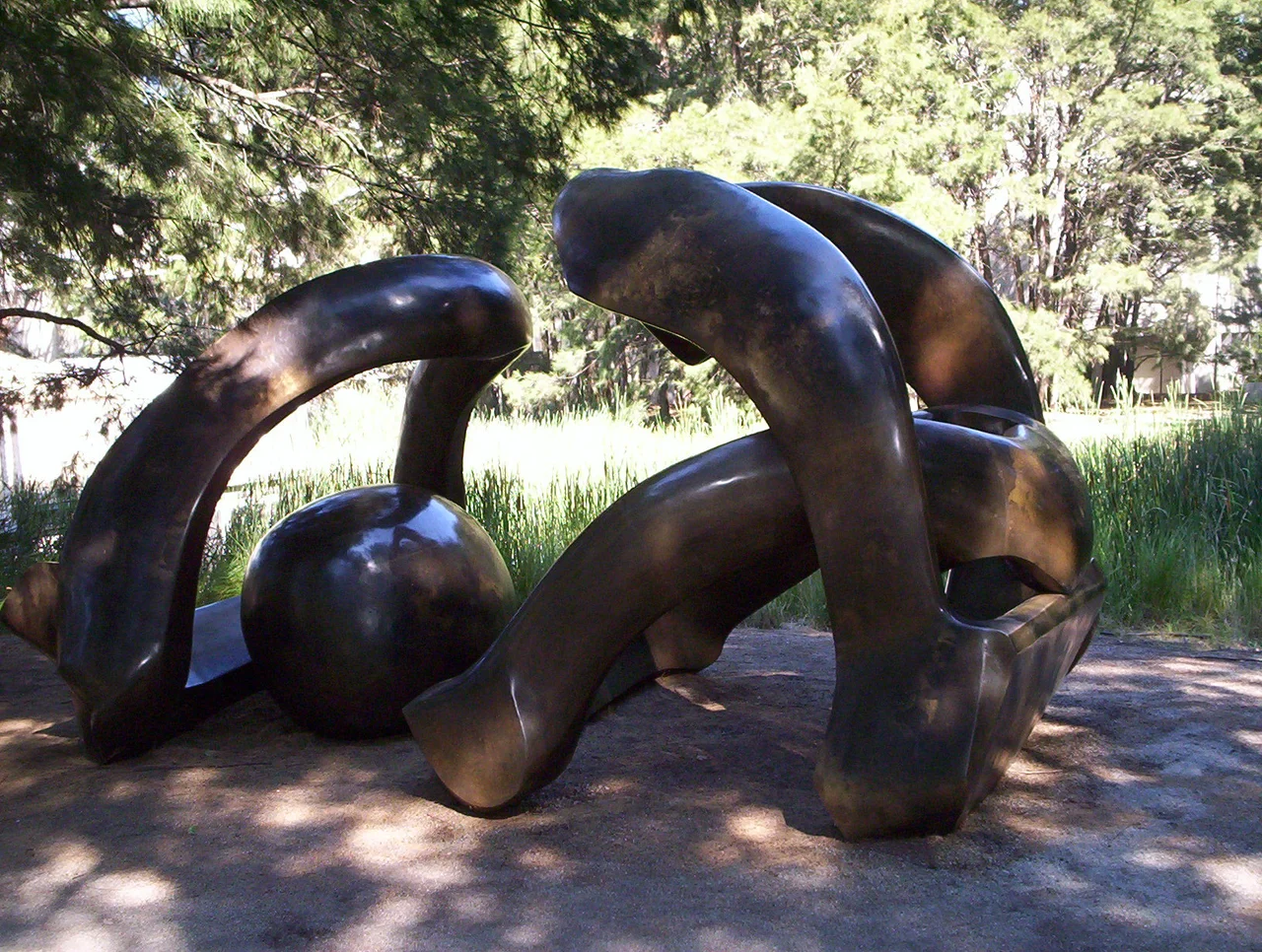
When it opened in 1982, the gallery was a statement in concrete. Madigan built in the late Brutalist style, all angular masses and rough bush-hammered surfaces, the whole structure governed by the geometry of the triangle - you see it in the coffered ceilings, the stair towers, the columns. He wove that triangular grammar through the building so it could grow and change yet always declare its purpose. Galleries spiral across three levels, lit so the daylight never competes with the art. Outside, sculpture gardens planted with native trees hold works by Rodin and Henry Moore, and a fog sculpture by Fujiko Nakaya that breathes mist across the lawn at midday. In 2024 a towering bronze ouroboros by Lindy Lee - a snake devouring its tail, the gallery's most expensive commission - took its place near the entrance.
Two Hundred Hollow Logs
The most powerful work in the building is also the quietest. The Aboriginal Memorial is an installation of 200 hollow log coffins - dupun - the traditional bone vessels of Arnhem Land. Conceived by the curator Djon Mundine and made by 43 artists from Ramingining, the number is no accident: one log for each year between 1788, when British settlement began, and 1988, the bicentenary the rest of the country was busy celebrating. Together the poles stand as a memorial to all the Aboriginal and Torres Strait Islander people who died defending their land across those two centuries. A pathway winds through them, tracing the course of the Glyde River through Central Arnhem Land. First shown at the 1988 Biennale of Sydney, it has stood in the gallery ever since - a sombre, unflinching reproach woven into the nation's proudest collection.
The Largest Collection of Australian Art on Earth
Beyond its famous foreigners, the gallery holds the finest collection of Australian art in existence - more than 166,000 works in all. Its first director, James Mollison, built it from almost nothing, securing Sidney Nolan's haunting Ned Kelly series, thousands of works donated by Arthur Boyd, and the icons of the Heidelberg School. The walls carry Tom Roberts and Arthur Streeton's golden landscapes, Albert Namatjira's watercolours, the work of Emily Kame Kngwarreye and Grace Cossington Smith. The Know My Name initiative, launched after the gallery realised only a quarter of its collection was made by women, has worked to redress that imbalance. It is a collection that argues, room by room, for what Australian art has been and who has been allowed to make it.
From the Air
The National Gallery of Australia sits on the southern shore of Lake Burley Griffin at about -35.3008, 149.1356, within Canberra's Parliamentary Triangle. From the air, look for the low angular concrete masses beside the lake's eastern Central Basin, linked to the round High Court building by an aerial bridge, with King Edward Terrace running in front and Parliament House on Capital Hill rising to the south. Best viewed at 1,500-2,500 ft AGL. This lies inside the restricted airspace over the Parliamentary Triangle - check NOTAMs and the Canberra control zone before approaching. Canberra Airport (YSCB / CBR) is roughly 5 km east. The Kings Avenue and Commonwealth Avenue bridges and the Captain Cook Memorial Jet are nearby visual references on the lake.
Nearby Stories
- Mount Kosciuszko summit trails 69 km away
- Hive shipwreck 79 km away
- Snowy Mountains Scheme 89 km away
- Wollongong 119 km away
- Murray River 179 km away
- Royal National Park 191 km away
- Warangesda Aboriginal Mission 250 km away
- 2003 Fiordland Earthquake 1800 km away