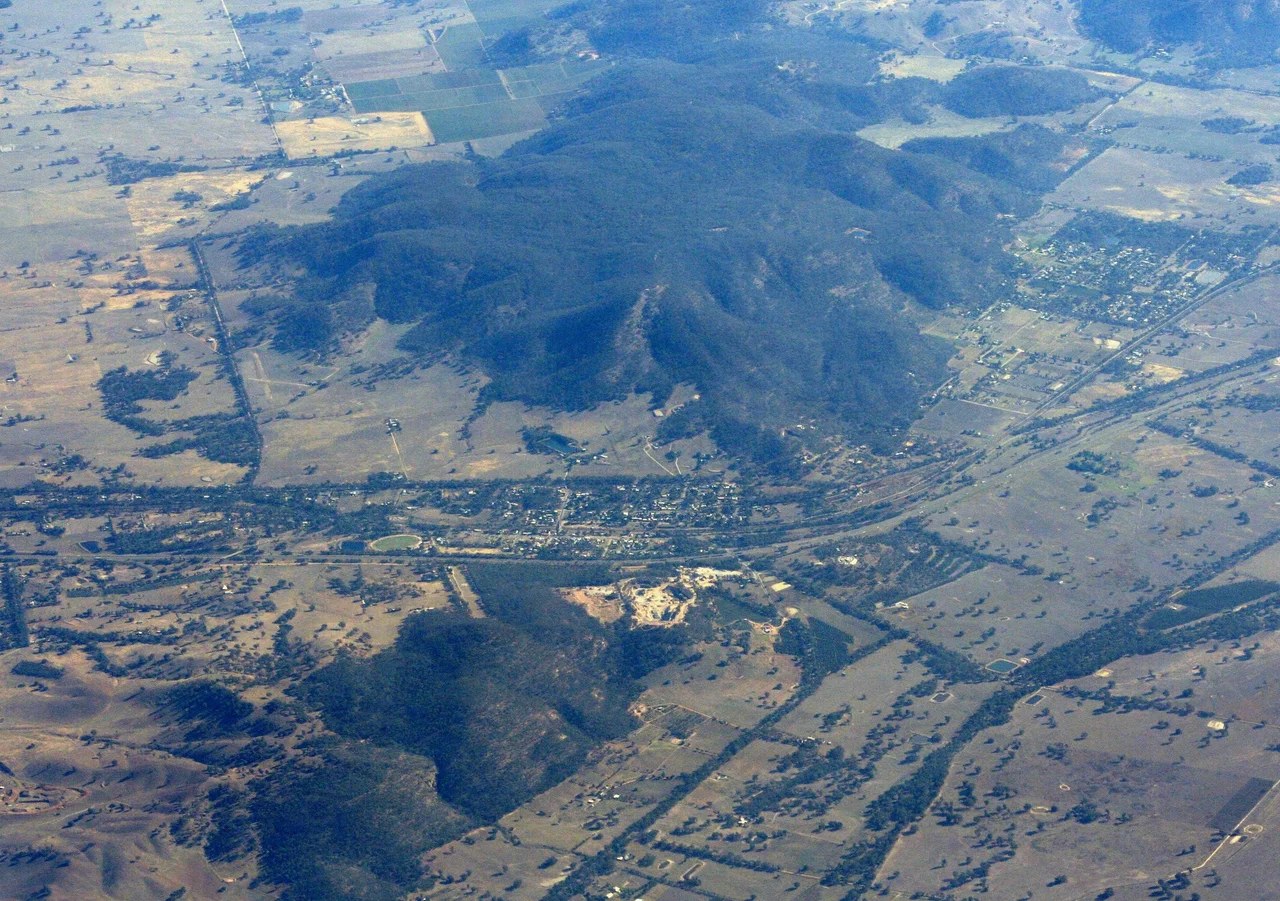

Glenrowan, Victoria
At dawn on 28 June 1880, a figure in iron walked out of the morning fog. Police who had spent the night besieging a small hotel could not at first make sense of what they were seeing: a tall man, upright and unhurried, advancing on them through the mist while their bullets clanged off his body and rang away into the dark. It was Ned Kelly, wearing armour his gang had beaten out of stolen plough mouldboards, each suit weighing around 36 kilograms. The helmet hid his face. For a few minutes the most wanted man in the colony seemed genuinely unkillable. Then the police aimed low, below the iron, and shot him in the legs. The siege of Glenrowan was over, and the legend was just beginning.
A Crossing in the Ranges
Before the siege, Glenrowan was barely a dot. It took its name from two brothers, James and George Rowan, who farmed the area between 1846 and 1858, in the rolling country near the Warby Ranges and Mount Glenrowan, northeast of Melbourne. The township proper was settled in the late 1860s, its post office opening in February 1870 and its railway station in 1874. It might have remained an unremarkable rail stop in Victoria's wine country, where the first grapevines had been planted in 1866, had the Kelly Gang not chosen it as the stage for their final, catastrophic plan.
The Plan That Failed
Kelly's scheme was audacious and grim. The gang intended to derail a special police train, tearing up the railway line outside Glenrowan and forcing the law into a massacre. To control the town in the meantime, they held dozens of locals hostage inside Ann Jones's hotel. But the plan unravelled. A captive schoolteacher, Thomas Curnow, talked his way free and ran up the line with a lantern and a red scarf, flagging down the train before it reached the broken tracks. The trap meant to spring on the police snapped shut instead on the gang. The siege that followed was not the ambush Kelly had imagined; it was a last stand he had not planned to make.
The Armour and the End
When the shooting began in the small hours, the gang pulled on their armour and prepared to die fighting. The iron was proof against bullets but brutally heavy, and it left their arms and legs exposed. Through the night, Kelly's companions fell inside the burning hotel. His brother Dan Kelly, along with Joe Byrne and Steve Hart, did not survive. Ned alone came out into the dawn, clad in iron, firing as he came, and it was the gap below his armour that finally brought him down. Captured and gravely wounded, he was carried away from Glenrowan to a fate the colony had already decided. He was tried in Melbourne that October and hanged in November 1880.
Hero, Villain, or Both
Why does a man who robbed banks and killed police remain, nearly a century and a half on, one of the most argued-over figures in the country? The answer lies in how Australia has never settled the question. To some he was a cold-blooded murderer; to others, a poor selector's son driven to outlawry by a corrupt and class-ridden justice system, a folk hero who stood up to authority. The sheer volume of books, films, and paintings devoted to him, from sober academic histories to Sidney Nolan's iconic black-helmet paintings, testifies to a story the nation keeps retelling because it cannot agree on what it means. Glenrowan is where the myth was forged in iron and gunfire, and where it still hangs in the air.
Walking the Siege Today
Glenrowan now is a town of around a thousand people, a popular pause for travellers on the Hume Freeway between Melbourne and the New South Wales border. But it has never let go of its single defining night. Off the highway, visitors can walk the marked Kelly siege sites where the hotel stood and the police took cover, and a large statue of Ned Kelly in his armour keeps watch over the main street. The Glenrowan Heritage Precinct is recognised on Australia's National Heritage List, an acknowledgement that what happened here in 1880 was not just a shootout in a country town but a turning point in the way a nation imagines itself.
From the Air
Glenrowan sits at approximately 36.46 degrees south, 146.22 degrees east in northeast Victoria, about 236 kilometres from Melbourne and 14 kilometres southwest of Wangaratta. From the air, look for the small township strung along the Hume Freeway, backed by the wooded slopes of Mount Glenrowan and the Warby Ranges to the west, with the patchwork of the Glenrowan and wider King Valley vineyards surrounding it. Wangaratta Airport (ICAO YWGT) is the closest airfield, a short hop to the northeast; Albury Airport (YMAY) lies further north near the state border. The undulating, vine-covered country and the clear ribbon of freeway make the town straightforward to pick out in fair weather.
Nearby Stories
- Beechworth 15 km away
- Echuca 72 km away
- Waterloo Plains massacre 106 km away
- Yarra River 108 km away
- Bendigo 118 km away
- Murray River 142 km away
- Warangesda Aboriginal Mission 179 km away
- Mount Kosciuszko summit trails 180 km away