.jpg)
Melbourne Cup
At three o'clock on the first Tuesday of November, a country of twenty-six million people goes quiet. Offices empty into tea rooms, pubs fill, and across Australia the talk stops for the three and a quarter minutes it takes a field of stayers to run two miles around Flemington Racecourse. They call it the race that stops a nation, and for once the slogan undersells it. The Melbourne Cup has been run every single year since 1861, through depressions and world wars; in Melbourne the day itself is a public holiday, and has been since the 1870s. It is the richest two-mile handicap on the planet. But this old race now runs through changed weather, and the same event that built a national tradition has become a place where the country argues about what that tradition costs.
A Sydney Outsider and a Race Is Born
The first Melbourne Cup, on Thursday 7 November 1861, was a rough and dramatic affair. Seventeen horses ran for a prize of 710 gold sovereigns and a hand-beaten gold watch, winner takes all. A horse bolted before the start; three of the runners fell during the race, and two of them died. Out of the chaos came Archer, a Sydney outsider the bookmakers had dismissed, who spread-eagled the field and beat the Victorian favourite by six lengths, then came back the next day and won again. Archer returned in 1862 to win a second Cup, fuelling a delicious interstate rivalry. Legend long held that he walked over five hundred miles to the race; the newspaper records show, more prosaically, that he came down from Sydney by steamboat.
Briseis, Phar Lap, and the Mare Who Won Three
The Cup's history is a gallery of horses that became legends. In 1876 the filly Briseis won the Derby, the Cup, and the Oaks in the space of six days, ridden in the Cup by a featherweight boy just eleven years old — eight days from his twelfth birthday — still the youngest jockey ever to win it. In 1930 Phar Lap started the shortest-priced favourite in the race's history, and won, despite an attempt to shoot him days earlier that forced his handlers to hide him away. And in the new century, the mare Makybe Diva did what no horse had ever done, winning three Cups in a row from 2003 to 2005. Her trainer Lee Freedman said afterwards to go and find the youngest child on the course, because that was the only person there with a chance of seeing it happen again.
Fascinators, Fortunes, and the Whole Country Betting
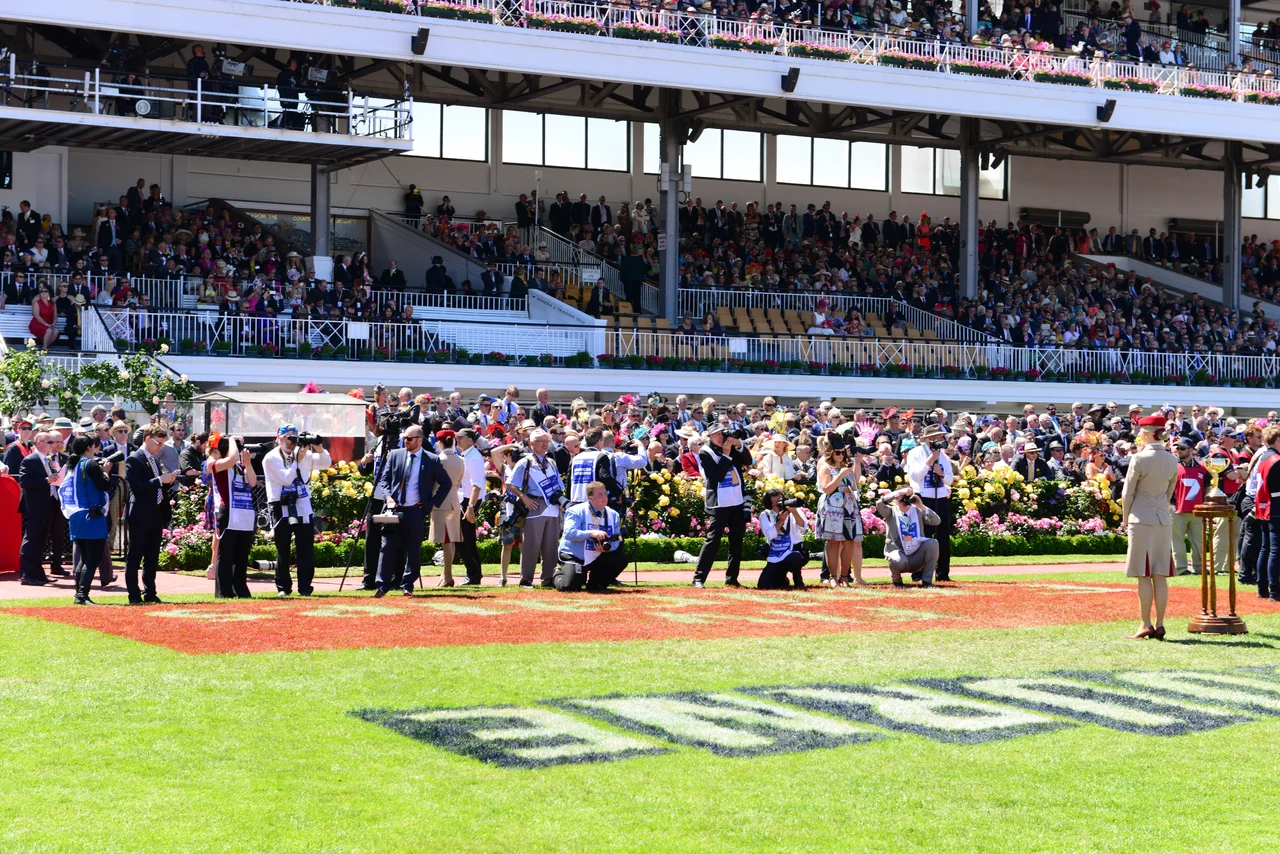
The Cup is as much a social event as a sporting one. Fashions on the Field draws nearly as much attention as the racing; the demand for elegant hats keeps Melbourne's milliners in business, and in 1965 the model Jean Shrimpton scandalised and electrified Flemington by appearing in a daringly short white shift dress. Flemington itself nurtures around twelve thousand roses, and the yellow rose is the official flower of Cup Day. The whole nation lays a wager, much of it through office sweepstakes drawn by people who bet on nothing else all year. Crowds of well over a hundred thousand once packed the course, and the day remains woven through Australian films, novels and poems, the rare sporting event that belongs to everyone, racing fan or not.
The Race That Divides a Nation
That universality is now contested, and honestly so. Since 2013, multiple horses have died during the Cup or on Cup Day, and many more have been injured. The deaths of horses such as the favourite Admire Rakti, who collapsed in his stall in 2014, and the much-loved Red Cadeaux, euthanised after breaking down in 2015, turned private grief into public reckoning. An ABC investigation into the fate of racehorses changed the conversation, and a Nup to the Cup movement has grown, with celebrities and ordinary Australians alike choosing to boycott the event. Attendances have fallen since 2015. Critics also point to spikes in family violence reported around the day, and to the way the Cup normalises heavy gambling and drinking. None of this is fringe noise; it is a genuine national argument about whether a beloved tradition can be reconciled with the welfare of the animals at its centre.
Three Minutes That Still Hold the Country
For all the controversy, the Cup has not let go of the Australian imagination. The trophy itself, a three-handled loving cup whose design dates to 1919, is struck anew each year from 1.65 kilograms of eighteen-carat gold and becomes the property of the winning owner. History keeps being made: Michelle Payne became the first woman to ride a Cup winner in 2015, aboard the hundred-to-one shot Prince of Penzance, and a decade later Jamie Melham became only the second. Whether you watch it as a sporting spectacle, a fashion parade, a flutter, or a question worth asking, the Melbourne Cup remains what it has been for more than a century and a half: three and a quarter minutes when an entire country looks the same direction at once.
From the Air
The Melbourne Cup is run at Flemington Racecourse, at roughly 37.79 degrees south, 144.91 degrees east, about 4 km northwest of central Melbourne on a bend of the Maribyrnong River. From the air the course is a striking sight: a broad green oval of turf, ringed by grandstands, with the long Flemington straight and extensive rose gardens laid out beside the river. The CBD towers rise to the southeast; the West Gate Bridge spans the lower Yarra to the south. Melbourne Airport (ICAO YMML) lies about 15 km to the north-northwest, and Essendon Fields (YMEN) only about 6 km north, so the racecourse sits beneath busy approach airspace. A sightseeing altitude of 1,500 to 2,500 feet AGL frames the track and grandstands. On Cup Day in early November the crowd and marquees make the oval unmistakable from above; spring weather brings a mix of clear skies and gusty fronts off Port Phillip Bay.
Nearby Stories
- Geelong 23 km away
- Waterloo Plains massacre 35 km away
- Yarra River 52 km away
- Eureka Rebellion 56 km away
- The Disappearance of Harold Holt: The Prime Minister Who Vanished Into the Sea 60 km away
- Bendigo 102 km away
- Glenrowan, Victoria 124 km away
- Bass Strait 229 km away