
Eureka Rebellion
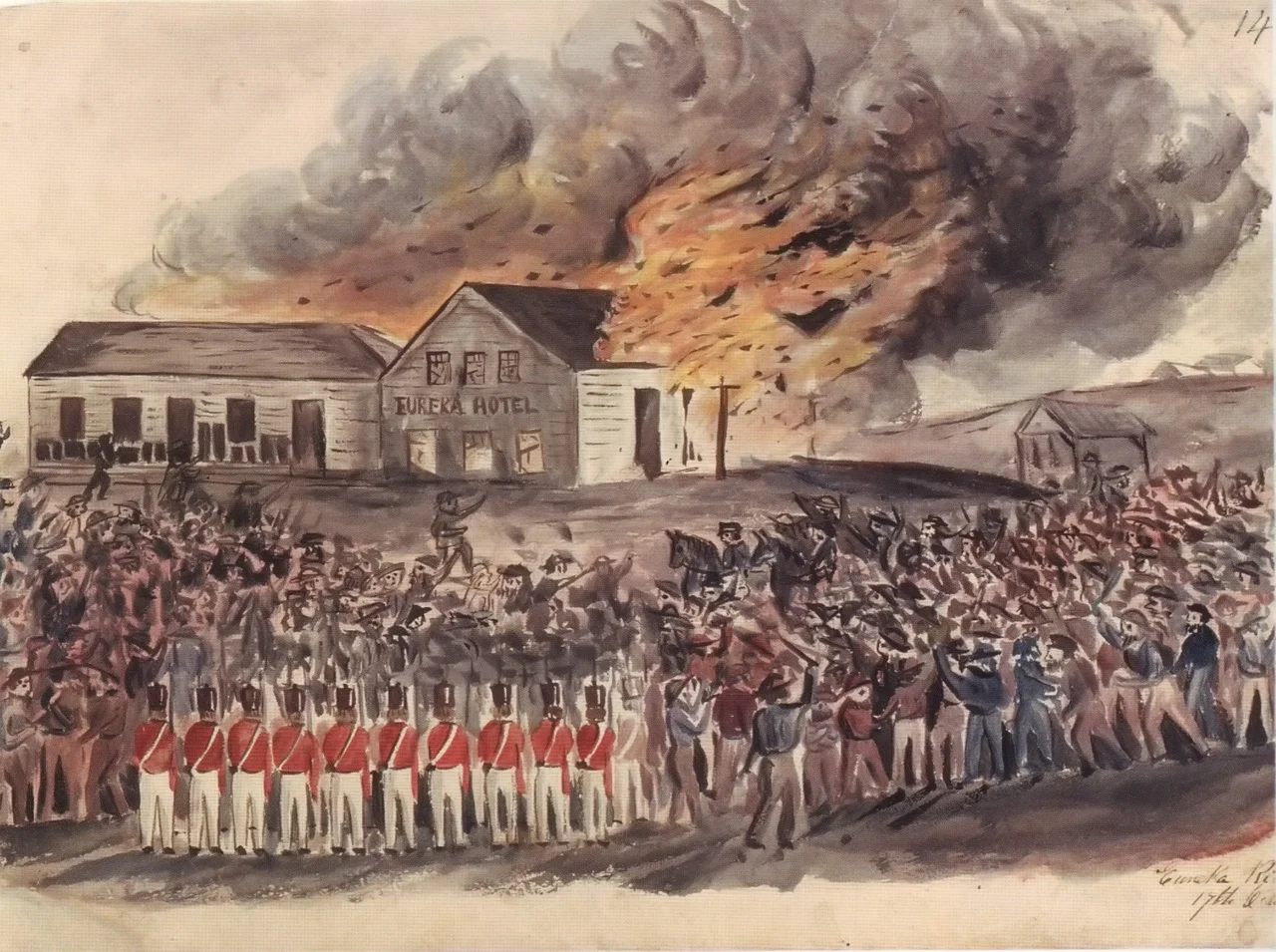
It was over in about fifteen minutes. At first light on Sunday, 3 December 1854, roughly 300 soldiers and police charged a rough barricade of timber and overturned carts on the Eureka goldfield at Ballarat. Behind it stood a few hundred miners, many of them exhausted, outnumbered, and asleep when the attack came; many more had drifted home the night before, never imagining the assault would fall on a Sunday morning. When the smoke cleared, at least twenty-two miners and five soldiers lay dead or dying. The miners lost the battle badly. And yet the Eureka Stockade is remembered as the moment Australian democracy was born.
A Grievance Dug from the Ground
The anger came out of the gold itself. To dig, a miner had to buy a licence, an expensive monthly fee charged whether or not he found any gold, and the police enforced it with humiliating 'licence hunts' — demanding papers, dragging men from their claims, chaining offenders to logs. The diggers had crossed oceans for a fair go and found instead a system that taxed the poor and answered to no one they had elected, for they had no vote at all. When a miner named James Scobie was killed near a Ballarat hotel and the case was bungled, the resentment boiled over. The miners organised. On 11 November 1854 more than ten thousand gathered at Bakery Hill, and out of that meeting came the Ballarat Reform League, chaired by the Chartist John Humffray, demanding the vote and an end to the licence.
Under the Southern Cross
On 29 November some twelve thousand met again at Bakery Hill, and a new flag rose above them: a white cross and five white stars on a deep blue field, the Southern Cross. It carried no crown and no empire, only the constellation that hung over the goldfields every night. The miners burned their licences in the fire. Their leader emerged in Peter Lalor, an Irish-born engineer who climbed onto a stump, and as the men knelt beneath the flag he led them in an oath that Australians still quote: 'We swear by the Southern Cross to stand truly by each other and fight to defend our rights and liberties.' They built a crude stockade on the Eureka lead, an acre of ground fenced with mining slabs, and they waited.
Fifteen Minutes at Dawn
The authorities did not wait long. They chose the early hours of Sunday, when the stockade was lightly held, and attacked before sunrise. The defenders, perhaps 120 men still inside, had pikes and a few firearms against trained troops; resistance collapsed almost at once. Soldiers bayoneted the wounded and burned the tents. Peter Lalor was shot in the arm and hidden by his comrades; the arm was later amputated to save his life, and a price was put on his head he never paid. The dead were mostly young diggers, a great many of them Irish, men like Edward Thonen, the lemonade-seller remembered in folk song. The exact toll has never been settled — official counts say at least twenty-two miners, but later tallies record more, and in 2022 a new memorial at Ballarat named thirty-five who lost their lives. The uncertainty is itself part of the story: some of the dead were carried away quietly by friends, and the government had every reason to keep the number low.
The Battle Lost, the Cause Won
The crackdown backfired completely. Thirteen captured miners were put on trial for high treason in Melbourne, and one after another, juries refused to convict them — the public was on the diggers' side. Within months the hated licence was abolished and replaced with a cheap miner's right that carried, crucially, the vote. By 1857 Victoria had granted the franchise to all white men, among the first places on Earth to do so, and Peter Lalor, the hunted rebel, took a seat in the very parliament his uprising had helped open. The Eureka Flag survives in fragments at the Eureka Centre Ballarat — owned by the Art Gallery of Ballarat but on long-term public display at the Eureka Stockade site — about two-thirds of the original. The Southern Cross has since been claimed by causes its makers never imagined, for good and for ill. But on the ground where the stockade stood, a monument has marked the rebel graves since 1884, and the diggers who died there at dawn are remembered not as rioters but as the people who taught a young country to demand a say in its own affairs.
From the Air
The Eureka Stockade Memorial Park sits in the Eureka district on the eastern side of Ballarat, at roughly 37.57 degrees S, 143.88 degrees E, about 105 km west-north-west of Melbourne on the Central Highlands plateau around 435 metres above sea level. There is no dramatic terrain to mark it from the air — this is gentle, undulating volcanic country — but the city of Ballarat itself is unmistakable, with Lake Wendouree to the west and the cones of Mount Buninyong and Mount Warrenheip to the south-east. Ballarat Airport (YBLT) lies about 7 km west of the city centre; Melbourne Airport (YMML) is the nearest major field, roughly 90 km east. Recommended viewing altitude is 2,500 to 4,500 feet. Expect strong winds, winter frost and morning fog typical of one of Australia's coldest, windiest cities.
Nearby Stories
- West Gate Bridge 36 km away
- Waterloo Plains massacre 46 km away
- Melbourne Cup 47 km away
- Geelong 53 km away
- Grampians National Park 92 km away
- The Twelve Apostles 100 km away
- Echuca 128 km away
- Loch Ard Gorge 128 km away