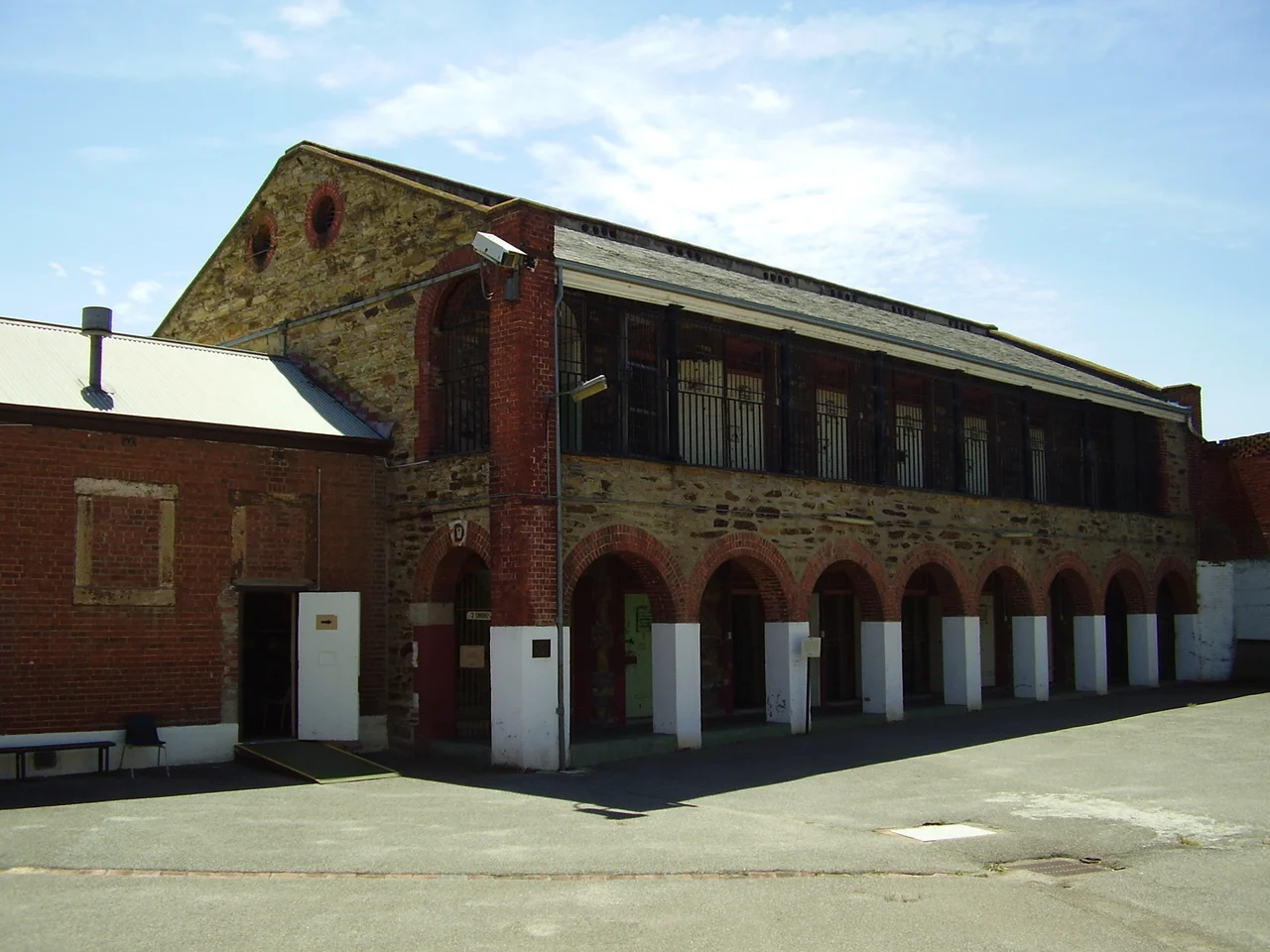

Adelaide Gaol
Forty-four men and one woman went to the gallows inside these walls, and the colony that built the place nearly went bankrupt doing it. Adelaide Gaol opened in 1841 as the first permanent prison in South Australia, a bluestone fortress in the parklands beside the River Torrens. Its cost overran so badly that the blowout helped trigger a statewide depression and bankrupted the builders. For the next century and a half, until it closed in 1988, roughly 300,000 people passed through its gates. The gaol still stands today, one of the two oldest buildings in the state, its yards open to anyone willing to walk where the condemned once spent their final nights.
The Prison That Broke the Colony
George Strickland Kingston designed the gaol in 1840 on the model of London's Pentonville, planning for 140 prisoners and four ornate turrets. Then Governor George Gawler began changing the plans. He halved the building, then added a gaoler's house, two more towers, and costlier ashlar stonework that ran fifty percent over the original. The original estimate of seventeen thousand pounds ballooned toward forty thousand, a fifth of the entire budget for establishing the colony. When the builders, Borrow and Goodiar, demanded payment, the dispute went to court and dragged on for years. Gawler had kept no documentation, so no one could prove who had authorised what. Gawler was recalled to England to explain his extravagance; the builders went bankrupt anyway. Of the four planned turrets, only two towers were ever finished, and only one of those got its ornamental crown.
Inside the Circle
The gaol was built on a radial plan, every cellblock and exercise yard reached from a single hub the staff called The Circle, named because wagons delivering supplies or prisoners had to turn a full loop to leave. Days followed a rigid clock. Breakfast came to the cell at seven, inspection at eight, then the toilet buckets were carried into the yards to be emptied, a chore that was somehow one of the best-paid jobs available. With almost no recreation, men paced the yards for hours or sat playing cards from worn decks. Lights went out at ten. Once a week, prisoners were handed paper and pen to write two letters, then had to return the writing materials. At its most crowded in the 1960s, the gaol held 440 inmates, many sleeping three to a cell built for one.
The Condemned Cells
In Yard Four, the last three cells facing the wall were the condemned cells, where men under sentence of death spent their final night. Forty-five people were executed at Adelaide Gaol over its working life. Among them was Elizabeth Woolcock, hanged in December 1873 for poisoning her husband, the only woman ever executed in South Australia, and a case still argued over by historians who believe she may have been more victim than murderer. The last was Glen Sabre Valance, hanged in November 1964 for murder, the final execution the state would ever carry out. These were real people meeting a deliberate, state-sanctioned death, and the gaol does not pretend otherwise. The New Building, raised by prison labour in 1878, housed a permanent gallows installed in 1886 that served until 1950.
What the Floorboards Hid
In 2007 a volunteer fell through rotting floorboards in an old tea room, and beneath them lay a buried history no one expected. A two-year archaeological dig uncovered five distinct layers of occupation. The deepest, from before 1836, held stone tools left by the Kaurna people who lived along the Torrens long before any colony. Above that came the tents and mud huts of the first European settlers, where excavators found buttons, ceramics, and a child's tooth. Higher still lay the camp of the two hundred labourers who built the gaol, then the original women's cells, where needles, thimbles, and pins had slipped into the cracks of the floor. The excavation has been left open for visitors, a cross-section of a city's beginnings hidden under one rotten floor.
Mercy in the Walls
The gaol was never only a place of punishment. From 1867, Sister Mary MacKillop, later canonised as Australia's first saint, regularly visited to tend both male and female prisoners alongside her order. More than a century later, the Dame Roma Mitchell Gardens still grow inside the walls where inmates once worked the soil. Now tended by volunteers, the garden's fruit, vegetables, and flowers are donated to feed the homeless and stock food hampers for those in need. Today the gaol runs daytime tours and ghost tours after dark, and schoolchildren file through the yards touching handcuffs and escape ropes. The bluestone that nearly bankrupted a colony has become a place to reckon with the harder chapters of its past.
From the Air
Adelaide Gaol sits at 34.918 degrees south, 138.585 degrees east, in the parklands on the western edge of central Adelaide beside the River Torrens, roughly one kilometre west of the Adelaide Oval and its distinctive scoreboard. The site lies just north of the Adelaide CBD grid, an easy visual reference from the air. Adelaide Airport (ICAO YPAD) is about six kilometres southwest, and Parafield Airport (YPPF), the general-aviation field, lies about fifteen kilometres north. Best viewed from two to three thousand feet on the clear, dry days common to Adelaide's Mediterranean climate, when the green ribbon of the parklands stands out sharply against the surrounding streets.
Nearby Stories
- Barossa Valley 26 km away
- Hindmarsh Island Bridge Controversy 40 km away
- Coorong National Park 104 km away
- Kangaroo Island 106 km away
- Baudin expedition to Australia 175 km away
- Avenue Range Station massacre 219 km away
- Port Augusta 240 km away
- Radium Hill 292 km away