
Barossa Valley
The name on the map is a mistake. A clerk misspelled Barrosa as Barossa, and the error stuck, so this valley northeast of Adelaide carries a garbled echo of a Spanish battlefield where Colonel William Light once fought. But the deeper story here is German. In the 1840s, Lutheran families fleeing religious persecution in Prussian Silesia settled this country and called it Neu-Schlesien, New Silesia. They planted vines, built bluestone churches, and baked their breads, and nearly two centuries later the Barossa Valley is Australia's most famous wine region, home to Shiraz vines so old they were rooted in the soil before most of the world had electric light.
New Silesia
The first to walk and farm this valley were the Peramangk people, whose thousands of years here survive in artefacts, scar trees, and shelter paintings across the ranges. European settlement arrived in the 1840s, and it arrived speaking German. Many of the newcomers were Lutherans escaping persecution in Prussian Silesia, in what is now Poland, and they brought their faith and language intact. They named the region New Silesia. The three main towns still wear that heritage differently. Tanunda is the most German of them, its traditions reaching back to those first arrivals. Angaston, by contrast, was settled largely by Cornish miners and other Britons, and is considered the English town. Nuriootpa, shaped by both, grew into the valley's commercial hub.
The Old Vines
The Barossa holds some of the oldest producing Shiraz vines on the planet. In 1847, a settler named Johann Frederick August Fiedler planted Shiraz on a block in what is now Tanunda. Those vines are still in commercial production today, worked by Turkey Flat Vineyards, fruit ripening on plants that predate the American Civil War. Old vines like these are part of what makes Barossa wine prized: gnarled, low-yielding, deep-rooted survivors that concentrate flavour. The valley is red-wine country first, and Shiraz is its signature. Large proportions of Barossa Shiraz go into Penfolds Grange, the most famous wine Australia produces. Riesling, Semillon, Grenache, and Cabernet Sauvignon grow here too, alongside the fortified wines the region has long made.
Faith on Every Corner
The Lutheran church did not just survive the crossing from Silesia; it multiplied. The valley's German heritage shows most plainly in its steeples. Tanunda alone has four Lutheran churches, Langmeil, St Paul's, Tabor, and St Johns. Nuriootpa has two, Angaston two more. Each major town runs its own Lutheran primary school. The faith threads through daily life and even into the wine: on the western ridge, the Gnadenfrei Lutheran church community has hosted a sub-regional wine show since 2004, the only competition of its kind in Australia, benchmarking the wines grown on that single slope. Language lingered too. Barossa German, a dialect carried from Prussia and bent by 180 years in Australia, is still spoken by some of the valley's older families.
Bread, Smallgoods, and Maggie Beer
Wine dominates, but it does not stand alone. The valley's German kitchens left a culinary tradition that thrives beside the vineyards. Bakeries turn out traditional German breads and pastries; butchers make smallgoods in the German style; artisan cheesemakers work the same hills. The valley's best-known cook, Maggie Beer, built a food empire here, her farm shop selling condiments under her name and her face familiar from Australian television. A weekly farmers market puts local produce directly in the hands of the people who grew it. This is a place where the table matters as much as the cellar, where a meal of valley bread, valley cheese, and valley wine is the whole point of coming.
The Oldest Festival
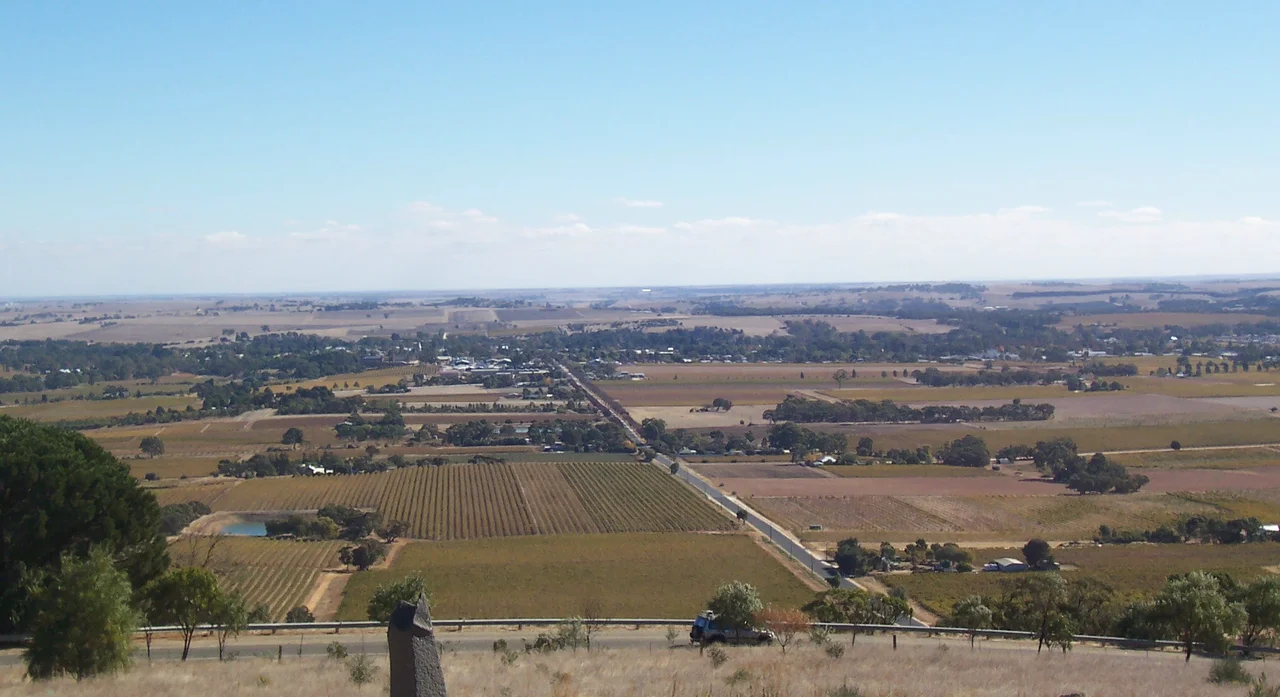
Every odd-numbered autumn, the Barossa throws the oldest wine festival in Australia. The Barossa Vintage Festival was first held in 1947, marking the centenary of the valley's first commercial vine plantings and celebrating the German settler heritage that shaped the region, and it has run continuously ever since. For about a week it fills the valley with tastings, competitions, concerts, gourmet dinners, balls, and a huge street parade, drawing visitors from around the world. From the Mengler Hill lookout on the Barossa Range, the reason for all the celebration spreads out below: hectares upon hectares of vineyards quilting the valley floor, the most distinctive sight in the region. In 2012, fearing the valley might be swallowed by Adelaide's sprawl, the state passed a law specifically to preserve its rural character. The Barossa, the legislators agreed, was too important to become a suburb.
From the Air
The Barossa Valley centres on roughly 34.53 degrees south, 138.95 degrees east, about 60 kilometres northeast of Adelaide. From the air the valley reads as a broad patchwork of vineyards on the floor, framed by the Barossa Range to the east, with the towns of Nuriootpa, Tanunda, Lyndoch, and Angaston strung along the North Para River and the Barossa Valley Way. The Mengler Hill lookout on the eastern ridge is a useful landmark. Parafield Airport (ICAO YPPF) lies about 35 kilometres southwest, and Adelaide Airport (YPAD) roughly 65 kilometres southwest; the small Truro and Gawler airfields sit nearer the valley itself. Best viewed at one to three thousand feet on the clear days common to the region, when the geometric rows of vines stand out vividly against the surrounding dry pasture.
Nearby Stories
- Hahndorf 31 km away
- Australian Cornish Mining Sites 68 km away
- Kangaroo Island 156 km away
- Port Augusta 210 km away
- Avenue Range Station massacre 219 km away
- Baudin expedition to Australia 225 km away
- Radium Hill 242 km away
- PS Rodney 297 km away