
The Beaumont Children
It was Australia Day, 26 January 1966, and Adelaide was sweltering. Jane Beaumont was nine, old enough to mind her sister Arnna, who was seven, and their little brother Grant, who was four. The three of them caught the morning bus from their home to Glenelg Beach, a five-minute ride to a place they knew well and loved. Their mother, Nancy, expected them back on the noon bus. When it came and went, then the two o'clock, she told herself they had simply lost track of the time on a long summer day. They never came home. What happened to the Beaumont children has never been answered, and the not-knowing has become one of the most haunting absences in Australian memory.
A Long Summer Day
Their father, Grant "Jim" Beaumont, was a former serviceman who made his living on the road as a travelling salesman, and that morning he had set off on a three-day trip. When he returned early, around three in the afternoon, and learned the children were not back, he drove straight to the crowded beach and searched the sand and the shallows. Witnesses pieced together fragments of the day. Several had seen the three children at nearby Colley Reserve in the company of a tall man in his mid-thirties, fair-haired, lean, sun-tanned, in swimming trunks. He played with them easily, naturally, as though they knew him. That detail unsettled the family most of all. Jane was a shy child, and the Beaumonts could not imagine her so comfortable with a stranger.
The Things That Didn't Add Up
Small, ordinary things turned strange in hindsight. Arnna had once mentioned to her mother that Jane had "got a boyfriend down the beach" - a remark that meant nothing at the time and everything afterward. The children had more money than they were given that morning; police came to believe someone had handed it to them. A man at the reserve had even asked a witness whether anyone had been near the children's belongings, claiming their money had gone missing. The investigation that followed was among the largest in Australian history, and over the decades it drew in psychics, hoax letters later proven false by improved fingerprint analysis, and a long line of suspects - factory owner Harry Phipps, convicted killers, men whose physical likeness to the unknown stranger raised hopes that always faded. Excavations as recent as 2025 turned up nothing. No trace of Jane, Arnna, or Grant has ever been found.
The Day Australia Locked Its Doors
To understand the grip this case still holds, you have to understand the country it happened in. In 1966, letting children travel alone to the beach was simply normal; no one suggested the Beaumonts had been careless, because the whole society took such freedom for granted. The disappearance, alongside other crimes of those years, broke that assumption. Parents began walking their children to school, watching them at the shops, calling them in before dark. Commentators have called it an end of innocence in post-war Australian life - the moment a nation quietly decided its children could no longer be assumed safe. A whole generation's childhood narrowed in the space of one missing afternoon.
An Open File
South Australia has never closed the case. The state maintains a standing one-million-dollar reward and a policy that no murder investigation is ever filed away as finished. New leads still surface, still make headlines more than sixty years on, still send detectives back to old ground with newer tools. Jane, Arnna, and Grant remain listed with the national missing persons register, three children frozen forever at nine, seven, and four. Their parents lived the rest of their lives without an answer; Nancy died in an Adelaide nursing home in 2019, aged 92, and Jim died in 2023, aged 97. Glenelg today is bright and busy, families on the jetty, ice creams melting in the heat. It is an ordinary, lovely beach, and that is exactly what makes the memory of one summer's day so hard to set down.
From the Air
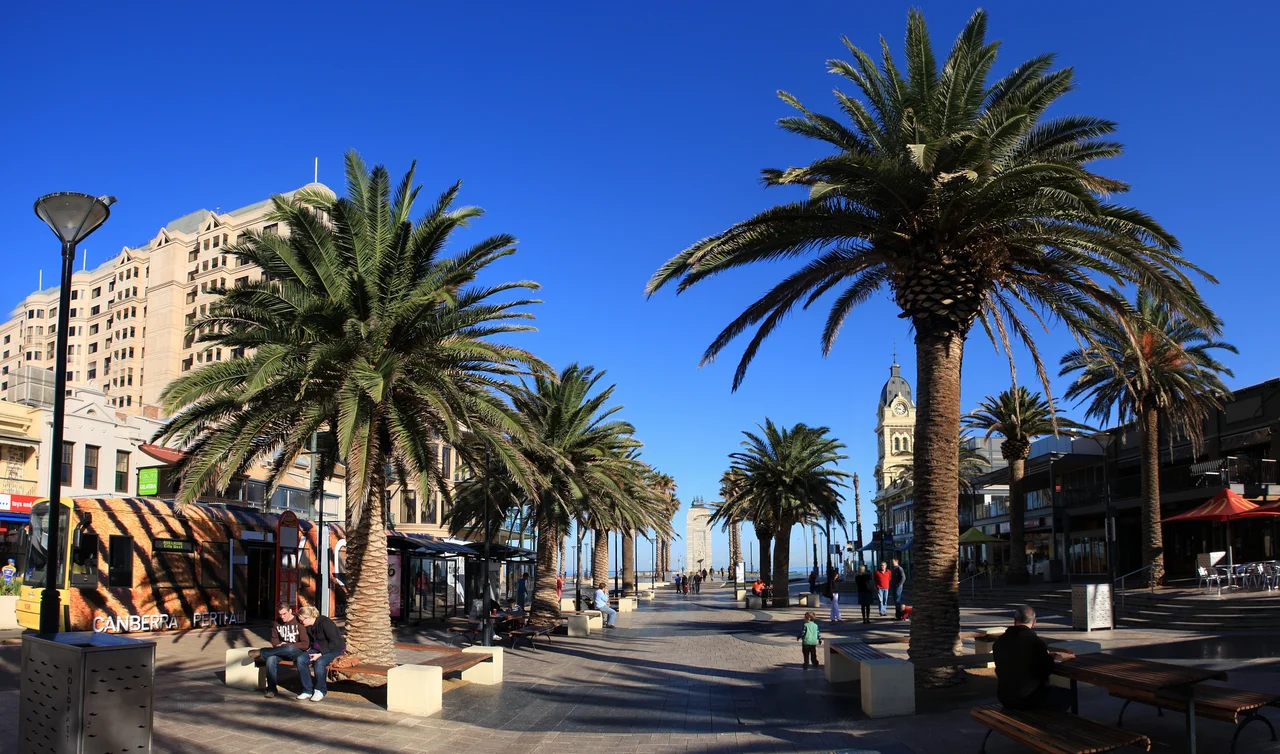
Glenelg Beach sits on the Gulf St Vincent coast at approximately 34.98 degrees south, 138.52 degrees east, a seaside suburb on the south-western edge of Adelaide, South Australia. From the air, the long jetty and the grid of Jetty Road point inland toward the city; Colley Reserve lies just behind the foreshore. Adelaide Airport (YPAD) is only about 5 km north, so this airspace is busy and controlled - any low flying here falls within Adelaide's terminal area and requires clearance. Best viewed from 2,000 to 3,000 feet in the clear, calm air of an Adelaide summer morning, with the Gulf stretching west and the Mount Lofty Ranges rising to the east.
Nearby Stories
- Hindmarsh Island Bridge Controversy 21 km away
- Barossa Valley 38 km away
- Coorong National Park 85 km away
- Kangaroo Island 94 km away
- Baudin expedition to Australia 165 km away
- Avenue Range Station massacre 202 km away
- Port Augusta 260 km away
- Radium Hill 309 km away