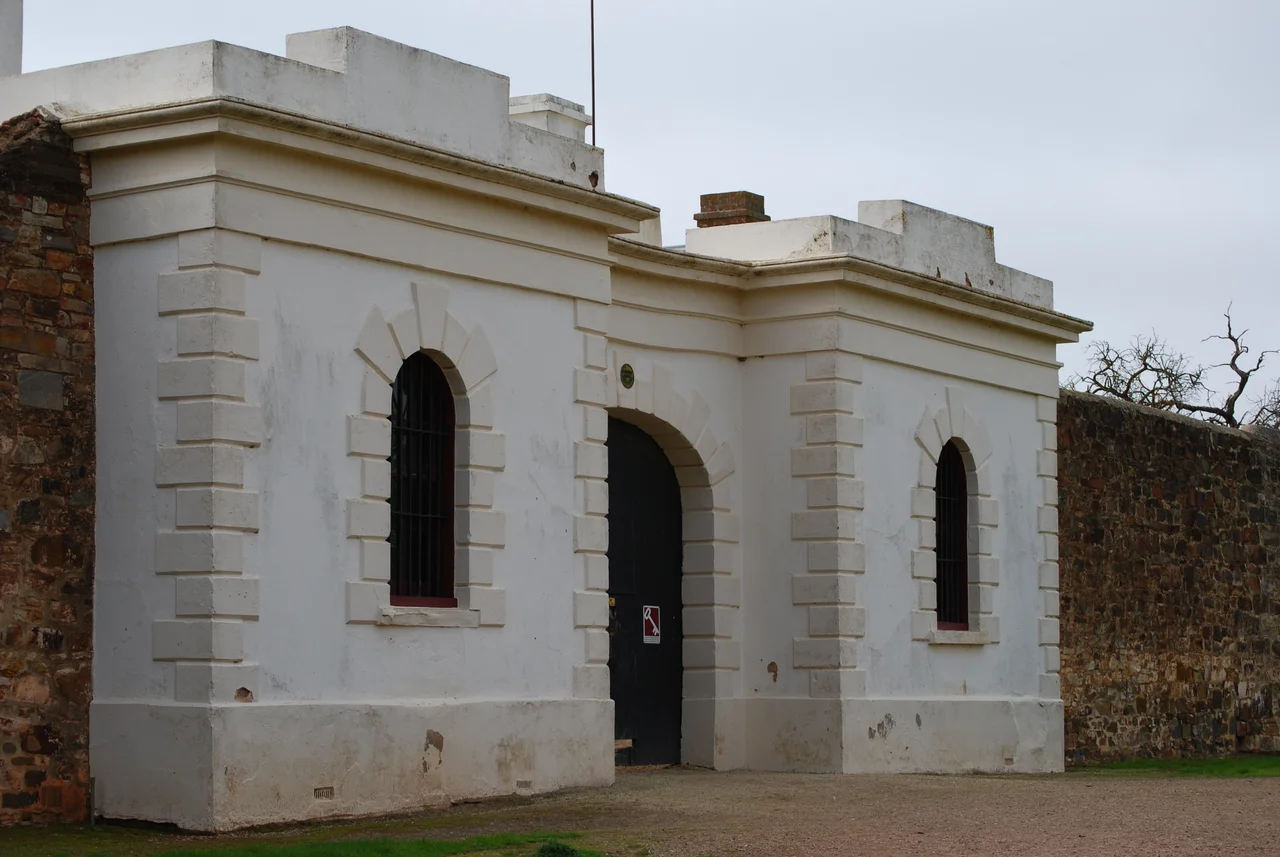

Redruth Gaol
In January 1866 a newspaper made a curious report about the gaol at Redruth: it held no prisoners at all, despite being a perfectly active prison. That small absurdity sets the tone for one of the more peculiar institutions in South Australian history. Built of local stone on the edge of the copper town of Burra in 1856, Redruth Gaol was the first prison the colony ever built outside Adelaide. For more than half a century it would swing between emptiness and overcrowding, change its purpose entirely, and eventually find an unlikely second fame on cinema screens.
A Prison for the Copper Country
Redruth took its name, like much of Burra, from the Cornish mining heritage that built the town, and it served the spread of small settlements across the mid-north. From 1871 it was gazetted as the official place of confinement for people arrested on warrants from the local courts of Redruth, Clare, Riverton and Auburn, with Georgetown added in 1874. For an institution often half-empty, it could fill alarmingly fast. By 1876 it was badly overcrowded, holding 22 prisoners in just eight cells. Three years later, as the larger Gladstone Gaol was being built, officials judged Redruth too small and too dilapidated to continue. By 1894 it had drifted into near-disuse again, costing 370 pounds a year to hold only three prisoners, and the colony finally closed it. Inmates were redistributed: those north of Burra to Gladstone, those south to Adelaide.
A Home for Wayward Girls
The stone walls did not stay quiet for long. In 1897 the old gaol reopened as a girls' reformatory, an institution meant to reform rather than punish, though life inside was hard and the arrangement uneasy. The reformatory became locally notorious for its escapes, as girls slipped over walls built to hold grown prisoners rather than determined teenagers. The final years were especially troubled. In 1920 the matron was formally reprimanded after complaints about how the place was run, and in February 1921 the inmates rioted. By July that year only thirteen girls remained. When Acting Premier John George Bice shut it down in 1922, he declared the reformatory "entirely inadequate for its purpose," and the residents were moved to a Salvation Army home in the Adelaide suburb of Enfield. These were children and young women caught in a system that frequently failed them, their names mostly lost to the record, their stories surviving only in the bare lines of official complaint.
Lights, Camera, Court Martial
Redruth's strangest chapter came decades after the last inmate left. In 1979 its weathered cells and stone yard stood in for a South African military prison in Bruce Beresford's Breaker Morant, the acclaimed 1980 film about three Australian soldiers court-martialled and, in two cases, executed during the Boer War. The austere, sun-bleached architecture that had once confined real prisoners now framed a celebrated drama about justice, scapegoating and the machinery of military law. It is a fitting echo: a building made to hold the accused, lending its bones to a story about men who believed they were wrongly condemned.
What Remains
By the late 1980s the gaol was restored as a project for the Australian Bicentenary, jointly funded by the National Trust of Australia and the Commonwealth Bank. The renovation turned the decaying complex on Tregony Street into a museum of historical displays, and today it opens to visitors as part of the Burra Heritage Passport, a self-guided trail that hands travellers an actual key to the town's locked historic sites and lets them explore at their own pace. Run by the National Trust, Redruth now offers something its inmates never had: an open gate. Walk the yard and the cell rows, and the layered past presses close, copper-era prison, reformatory, film set and museum all held within the same patient stone, the whole strange arc of the place readable in a single quiet afternoon.
From the Air
Redruth Gaol stands at roughly 33.66 degrees south, 138.93 degrees east, on the eastern edge of Burra in South Australia's mid-north, a few hundred metres from the town's historic copper-mine workings. From the air, Burra reads as a compact stone township set in dry, open pastoral country, with the old mine scars and mullock heaps the most obvious landmarks; the gaol itself is a small walled rectangle on the settlement's fringe. The nearest local airfield is the Burra aerodrome, with Adelaide Airport (YPAD) the closest major facility roughly 150 kilometres to the south. Clear, calm conditions and low sun best reveal the stonework and the surrounding patchwork of paddocks.
Nearby Stories
- Barossa Valley 68 km away
- Port Augusta 123 km away
- Pichi Richi Railway 150 km away
- Radium Hill 159 km away
- Kangaroo Island 236 km away
- Honeymoon Uranium Mine 237 km away
- Baudin expedition to Australia 296 km away
- Avenue Range Station massacre 314 km away