_Alexander_Roberts_(6151871374).jpg)
Paakantyi
Their name says exactly who they are. Paaka means river, and the suffix -ntyi means belonging to, so Paakantyi means, simply, the people who belong to the river. The river is the Darling, which the Paakantyi call the Baaka, and for thousands of years it has been the spine of their world, threading life through the brick-red sandhills and grey clay flats of Far West New South Wales. They are also known as the Barkindji or Barkandji, and they are not a people of the past tense. They are here, the river people still, and their story is one of holding on.
Belonging to the River
The Paakantyi homeland follows the Baaka from around Wilcannia downstream, reaching some twenty to thirty miles inland on either bank, and stretching out to the country around the Paroo River and Broken Hill. In their own language they call themselves wiimpatya. The land is generous along the water and hard away from it; drought is no stranger here. When the country dried, people would withdraw to the few permanent springs in the backcountry and hunt the animals that came to drink. To live well in such a place demands deep knowledge, passed down over countless generations: where the water hides, when the fish run, how to read a sky that so rarely gives rain.
The Serpent in the Waterholes
In Paakantyi understanding, the river and its country were shaped by Ngatji, the Rainbow Serpent of the Dreaming. Ngatji is not a story finished long ago but a presence that endures, believed to travel underground from waterhole to waterhole, and not to be disturbed. When a sudden whirly breeze stirs the surface of the Baaka, that is Ngatji, moving. This is the heart of why the river matters so completely. It is not only water and fish and a route through the desert. It is a living being, and the people belong to it as much as it belongs to them. To care for the river is to care for the serpent, and for the law that binds them together.
When the River Was Taken
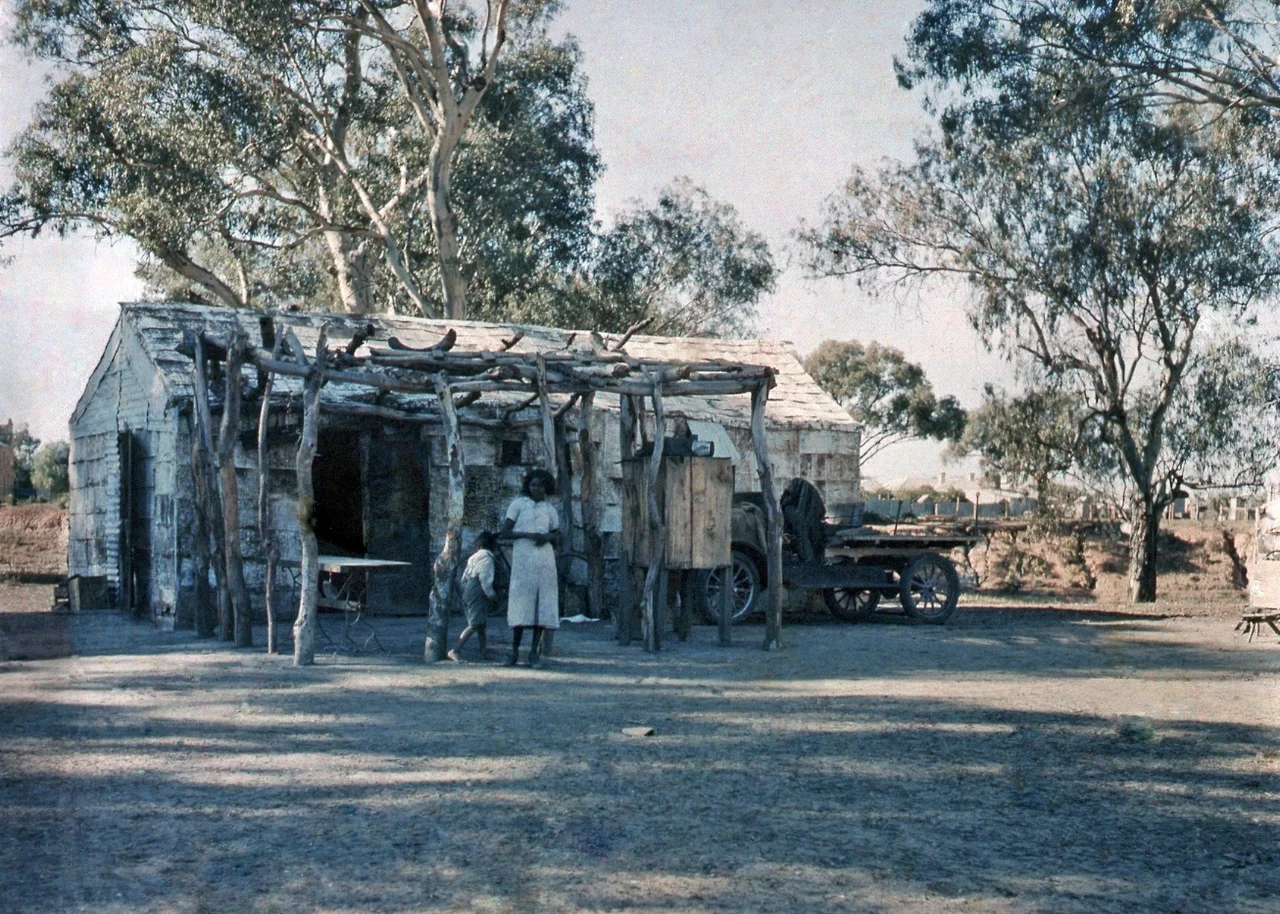
Colonisation came hard to the Baaka. Cattle and sheep stripped the banks, rabbits arrived in the 1890s, and drought and introduced fish damaged a river system that had sustained people for millennia. Disease cut through the communities; an epidemic around 1850 is remembered by elders as killing a third of the Paakantyi and their neighbours. Many survivors ended up working on the very stations that had taken their land. Even sympathetic settlers like Frederic Bonney, who photographed Paakantyi families at Momba Station and wrote of their honesty, courtesy and kindness, were part of a wave of dispossession. Yet through all of it the people endured. In recent times their descendants are concentrated in Wilcannia, where, by conservative estimate, more than two-thirds of residents are of Paakantyi descent.
A Sleeping Language, Waking
By the mid-twentieth century outsiders were calling the Paakantyi a vanishing people, and their language was down to a handful of fluent speakers. But a language is not gone while anyone is willing to fight for it. Community members describe their tongue not as dead but as sleeping, and they are waking it: in 2014 Paakantyi entered the core curriculum of schools across the region, and elders, teachers and young people now carry the words forward. Figures like the elder and teacher Elsie Rose Jones, who recorded Paakantyi stories and alphabet books, and the modern hip-hop artist Barkaa, who raps in language, are links in an unbroken chain.
Recognised at Last
The fight reached a milestone in court. The Barkindji first lodged their native title claim in 1997, gathering testimony from traditional owners alongside the work of anthropologists, historians and linguists. Eighteen years later, on 16 June 2015, Federal Court judge Jayne Jagot handed down a determination recognising their native title across roughly 128,000 square kilometres, from the South Australian border eastwards to Tilpa, south to Wentworth and north to Wanaaring. It was the largest such recognition in the state's history. For a people whose very name means belonging to the river, it was the law of the newcomers finally acknowledging what the Paakantyi had always known: this is, and has always been, their country.
From the Air
Paakantyi country follows the Darling River, the Baaka, through Far West New South Wales; this entry is anchored near Mutawintji at 31.147 degrees south, 142.381 degrees east, with the community centre of Wilcannia about 130 km to the south-east and Broken Hill to the south-west. From the air the defining feature is the river itself: a sinuous green corridor of red gums winding across vast plains of red sandhill and pale clay flat, with billabongs and waterholes catching the light along its bends. The nearest airports are Broken Hill Airport (ICAO YBHI) and the airstrip at Wilcannia. Recommended viewing altitude is 3,000 to 6,000 feet AGL to trace the river's path. This is living cultural country deserving of respect from above as well as below. Visibility is usually excellent, with summer dust and heat haze the main exception.
Nearby Stories
- Mount Gipps Station 21 km away
- White Cliffs, New South Wales 35 km away
- Wilcannia 61 km away
- Wilcannia Athenaeum 73 km away
- Day Dream Smelter 75 km away
- Broken Hill Mosque 87 km away
- Albert Goldfield Ruins 153 km away
- Lake Pinaroo 209 km away