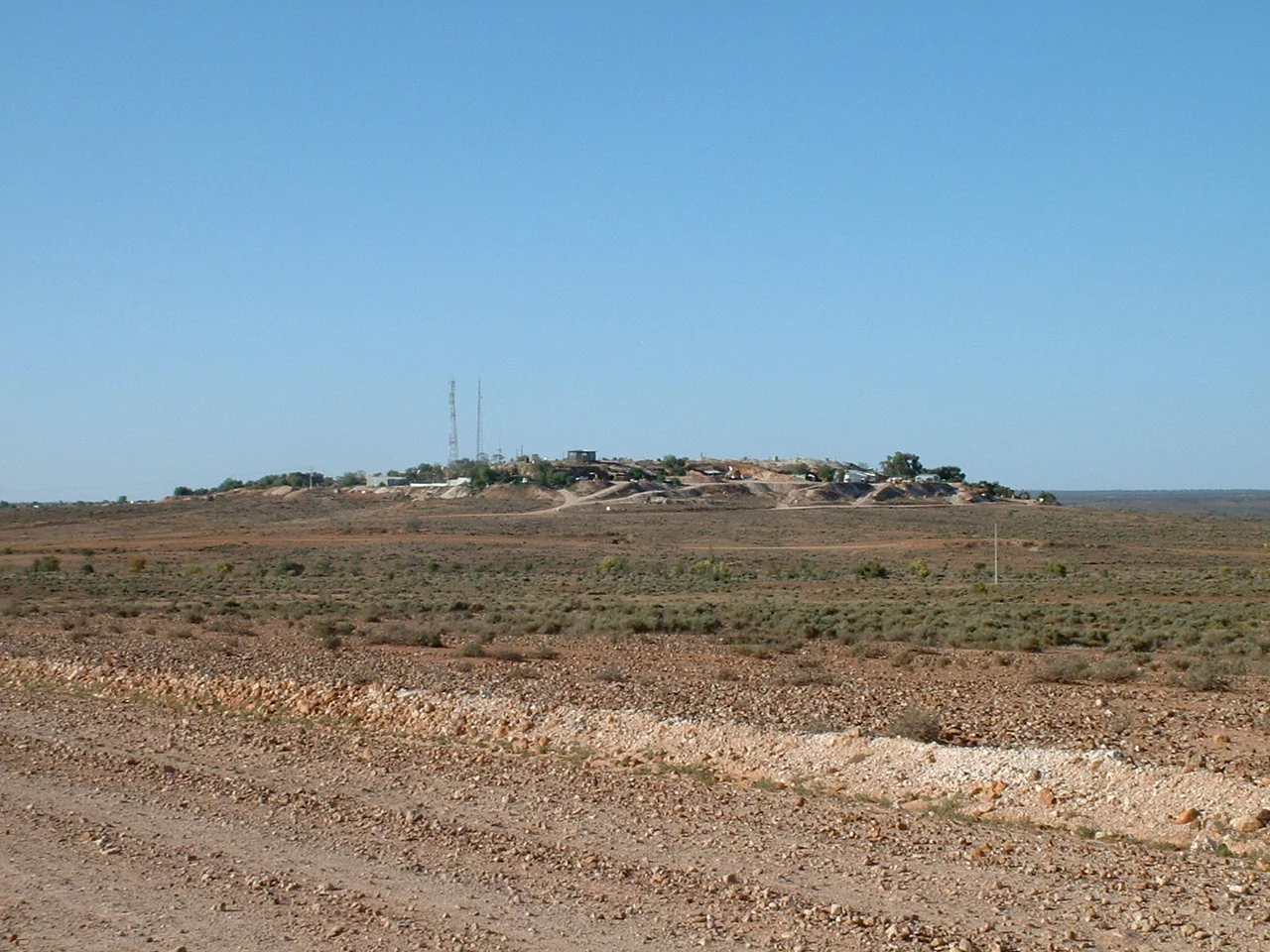

White Cliffs, New South Wales
To find most of the people of White Cliffs, you have to go down. In this scorched corner of outback New South Wales, where summer days routinely climb past 36 degrees and the landscape is a moonscape of pale spoil heaps, the residents long ago made a logical bargain with the heat: they dug their homes into the hills. Around 140 underground dwellings - 'dugouts' - honeycomb the ridges here, holding a steady, blessed 20 to 22 degrees while the surface bakes. You can sleep underground too, in one of the town's subterranean motels. It is one of the strangest, most ingenious small communities in Australia, and the opal that started it all still glints in the rock beneath the floor.
The Stone the Kangaroo Hunters Found
White Cliffs owes its existence to a hunting trip gone slightly sideways. The first Australian opal was found in this area in 1872, when a party of kangaroo hunters was working the low stony country. One of them, tracking a wounded kangaroo over the rises, stooped to pick up a pretty stone that had caught his eye. Back at camp the group suspected it might be opal, and the local jeweller confirmed it - advising them, sensibly, that there was more money in the ground than in kangaroo skins. There was a wrinkle, though: when they went to file a claim, opal had not yet been listed as a gemstone under the law. So the first opal claim in the district was lodged, of all things, under the Gold Mining Act.
A Town That Went Underground
The town proper took shape in the late nineteenth century once opal mining began in earnest, and it has been mined ever since. By the early 1900s the field was booming; the population swelled with seasonal diggers, and the surrounding plain filled with the white mullock heaps that give the place its lunar look. The genius of White Cliffs was its response to the climate. Rather than swelter in tin and timber, miners converted worked-out shafts and dug fresh chambers straight into the hillsides, creating cool, quiet homes shielded from a sun that can be merciless. Today, with the easy opal long since worked over, those dugouts have become the town's signature draw, and White Cliffs leans increasingly on visitors curious to spend a night beneath the desert.
The Tiger of White Cliffs
For a town of a few hundred souls, White Cliffs has produced an outsized legend. In December 1905, in this remote opal settlement, Bill O'Reilly was born - the son of the district's first schoolteacher. He would grow into one of the most feared bowlers cricket has ever known, a fierce, unorthodox leg-spinner nicknamed 'Tiger' who tormented batsmen through the 1930s. The verdict on him came from the highest possible authority: Sir Donald Bradman, the greatest batsman of all time, said O'Reilly was the finest bowler he had ever faced or even watched. From a cradle in the outback to the front rank of the game, the Tiger carried his hometown's name onto the world's great cricket grounds.
Mirrors in the Desert
White Cliffs has a quieter claim to fame, and it points the opposite direction from the dugouts - straight up at the relentless sun. In 1981 the town became the site of Australia's first solar power station, a ring of fourteen parabolic mirrored dishes built to turn that abundant outback sunlight into electricity. Originally rated at 25 kilowatts and later upgraded in 1996 to 45 kilowatts using the same collector dishes and improved technology, the array was, by many accounts, among the first commercial solar power stations in the world - a distinction recognised by engineering heritage bodies in 2006. It was a fitting experiment for a place that had already spent a century learning to live with, and outwit, its punishing climate.
Where the Desert Does Strange Things
What holds White Cliffs together, beyond opal and ingenuity, is a kind of stubborn outback continuity. The primary school opened in 1895 and has run without a break ever since - no small feat 255 kilometres from Broken Hill and 93 from Wilcannia, with barely 250 millimetres of rain in an average year. The town made enough of an impression on the writer Bill Bryson that he stopped here while researching his Australian travelogue, drawn, like everyone, by the spectacle of a community that lives below the ground it mines. Sweltering summers, gentle winters, opal in the rock, and homes carved into the hills: White Cliffs is the outback distilled, a place where, as one visitor put it, the desert does all sorts of strange things.
From the Air
White Cliffs sits at 30.85°S, 143.08°E in far-western New South Wales, about 255 km north-east of Broken Hill and 93 km north of Wilcannia. From the air the town is unmistakable: a vast field of pale opal mullock heaps stippling the red plain like a scattering of white dots, far more visible than the low buildings themselves. There is a small local airstrip at White Cliffs (ICAO YWLC) suitable for light aircraft. Broken Hill Airport (YBHI) to the south-west is the nearest major aerodrome for fuel and services, with Cobar (YCBA) well to the east as an alternate. This is hot, dry, sparsely populated country with typically excellent long-range visibility, but extreme summer heat, isolated terrain, and limited services demand generous fuel and water reserves. The mullock fields read clearly from a circuit at 1,500-2,500 ft AGL, especially in low morning or evening sun.
Nearby Stories
- Mutawintji National Park 3.7 km away
- Paakantyi 33 km away
- Wilyakali 51 km away
- Paroo-Darling National Park 63 km away
- Albert Goldfield Ruins 122 km away
- Tibooburra 156 km away
- Louth, New South Wales 161 km away
- Mount Grenfell 185 km away