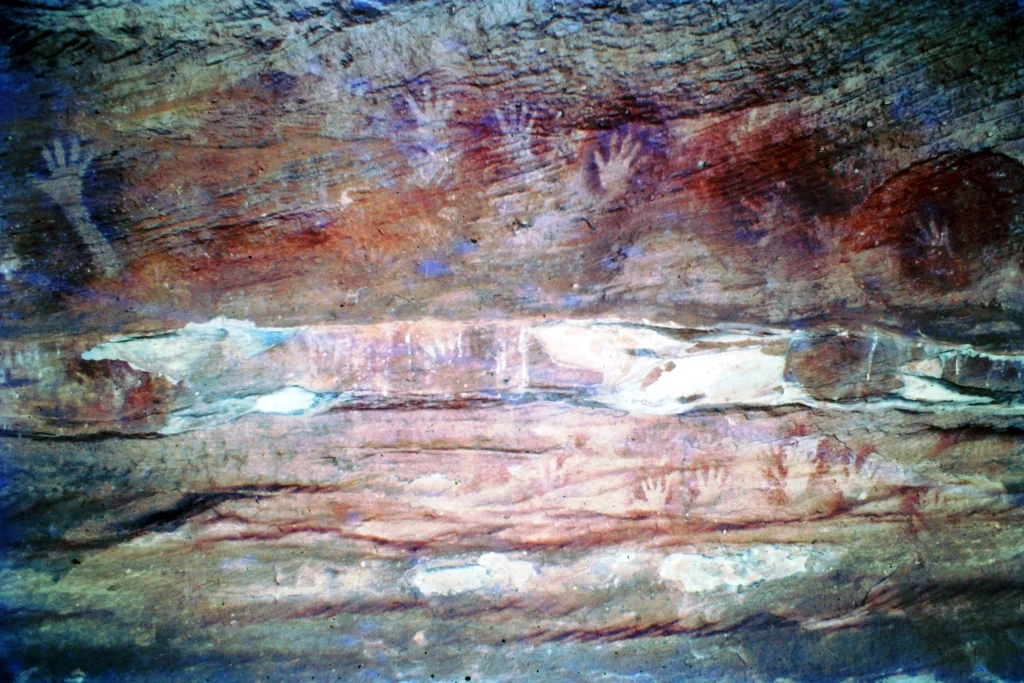

Mutawintji National Park
In September 1983, in searing heat beneath the red cliffs of the Byngnano Range, Aboriginal people put up signs at the gate and turned the tourist buses away. The signs read: Closed by the Owners. For years they had watched outsiders chip at the rock art and tramp through ceremonial ground, and they had decided it would stop. That blockade lit the long fuse that, fifteen years later, made Mutawintji the first place in New South Wales handed back to its Aboriginal owners. To understand why people would stand in the desert sun to defend it, you have to understand what is written on these rocks.
Where the Water Lives
Mutawintji is an oasis in an ocean of dry country, roughly 880 km west of Sydney in the Far West of New South Wales. The mulga-clad Byngnano Range is cut by colourful gorges, and in the shaded creek beds, lined with towering red gums, lie rockpools that hold water when everything around them is parched. In a land where rain is rare and unreliable, reliable water is everything. For thousands of years this made Mutawintji a gathering place, somewhere people could come together across great distances to meet, to trade and to hold ceremony. The park protects roughly 69,000 hectares of this rugged, beautiful country.
The Rocks Remember
Among the caves, overhangs and gorges lie one of the richest concentrations of Aboriginal rock art in New South Wales, including one of the largest collections of rock engravings in the region. Figures of emus, kangaroos and people are pecked into the stone, and across the overhangs spread hand stencils, sprayed in ochre by mouth so that the outline of a real hand, pressed to the rock, remains after the person is long gone. Each stencil is someone saying, across centuries, I was here. These are not decorations. They are records of the social gatherings and ceremonies that took place here over thousands of years, sacred to the Paakantyi and Malyangapa peoples for whom this remains living country.
Closed by the Owners
By the early 1980s, with rock art being damaged and removed and the traditional owners shut out of decisions about their own heritage, the Aboriginal communities of Broken Hill, Wilcannia and White Cliffs acted. The 1983 blockade was peaceful but firm: elders met the tour buses at the boundary, explained why this place mattered, and asked visitors to turn around. It was an act of protection, not protest for its own sake, and it became a landmark in the land rights movement. In 1998 the New South Wales Government agreed. Mutawintji National Park, Historic Site and Nature Reserve were transferred to the Mutawintji Local Aboriginal Land Council, held on behalf of the Malyangapa, Wilyakali, Wanyuparlku and Pantjikali people. It was the first handback of its kind in the state.
A Place of Gathering
What makes Mutawintji extraordinary is not any single carving but the sheer density of human presence layered over time. Because its waterholes held out when the surrounding country dried, people travelled here from far away to meet, and the rock art records those gatherings: ceremonies, stories and the simple, repeated mark of the hand stencil, generation after generation. This is why the damage of the 1970s and 1980s cut so deep. To chip a figure from the stone or to walk uninvited through a ceremonial site was not vandalism of an exhibit; it was an injury to living law and to the ancestors whose hands are still on the rock. The traditional owners were not protecting scenery. They were protecting family, and the continuity of everything those marks represent.
Cared For Together
The land was then leased back to the national parks service and is now managed jointly with the Mutawintji Board of Management, the traditional owners helping to decide how their own country is looked after. Conservation runs deep here in another sense too. Inside the park, in the Coturaundee Range, land was fenced and foxes controlled to protect the last population of yellow-footed rock-wallabies in New South Wales, a delicately marked, cliff-dwelling marsupial that had been vanishing. Today wedge-tailed eagles and peregrine falcons ride the thermals above the gorges, and flocks of budgerigars and corellas wheel over the waterholes. Mutawintji is a place where survival, both human and wild, has been hard-won and is fiercely guarded.
From the Air
Mutawintji National Park is centred near 31.147 degrees south, 142.381 degrees east, in the Far West of New South Wales, about 130 km north-east of Broken Hill. The Byngnano Range stands out as a band of rugged, mulga-covered ridges and gorges rising from flat, reddish plains, with green ribbons of red gum marking the creek lines and waterholes. The nearest sizeable airport is Broken Hill Airport (ICAO YBHI) to the south-west; Wilcannia airfield lies to the south-east. Recommended viewing altitude is 3,000 to 6,000 feet AGL to appreciate the gorge systems while respecting the park's quiet. Please note this is a place of deep cultural significance: keep noise and disturbance to a minimum. Visibility is typically excellent, though summer heat haze and dust can build over the surrounding plains.
Nearby Stories
- Mount Gipps Station 21 km away
- White Cliffs, New South Wales 35 km away
- Wilcannia 61 km away
- Wilcannia Athenaeum 73 km away
- Day Dream Smelter 75 km away
- Broken Hill Mosque 87 km away
- Albert Goldfield Ruins 153 km away
- Lake Pinaroo 209 km away