.jpg)
Wilcannia Athenaeum
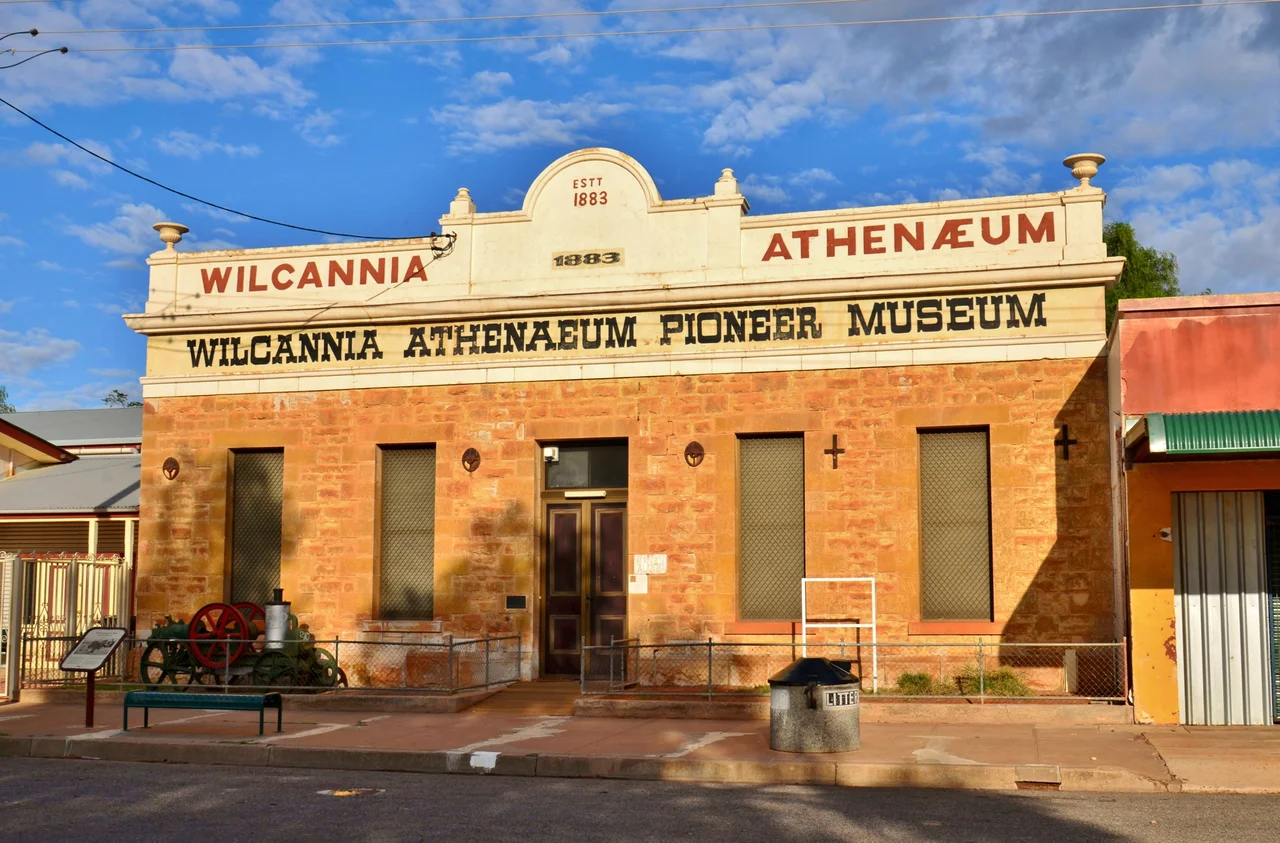
Picture the kind of town that builds a library like this. Not a shed, not a single dusty room behind the post office, but a proper sandstone hall in the Victorian Free Classical style, its parapet crowned with carved urns, its facade announcing to the saltbush plains that here was a place of consequence. The Wilcannia Athenaeum opened with pomp and ceremony in January 1884, on Reid Street, in a town then handling more river trade than almost anywhere inland in the country. The stone was quarried nearby. The ambition was entirely local.
An Idea Built in Stone
The Athenaeum was never meant to be only a library. It was a "school of arts," part of a movement that swept the British world in the nineteenth century: the mechanics' institutes, where working people could read, debate, and better themselves. The land had been granted in 1879 for a Wilcannia Mechanics Institute, and by 1882 plans for the new building were being advertised in cities across the colony. When it rose in 1883 in rusticated sandstone, with a semicircular entablature over the entrance, it was a statement of faith, faith that a remote port on the Darling deserved the same institutions as Sydney or Melbourne, and would keep needing them.
A Champion and His Newspaper
Every civic dream needs someone shouting for it, and Wilcannia had Walterus Brown. As editor of the Wilcannia Times, the short-lived paper he ran from 1874 to 1888, Brown was among the Athenaeum's great supporters, using his columns to rally the town behind its library. He belonged to a peculiar frontier breed: men who arrived in a dusty river port and immediately began publishing newspapers, founding institutes, and arguing about culture, as if sheer will could conjure a city out of the plain. For a while, it nearly worked. The Athenaeum filled with books, subscribers, and the hum of a community that read.
The Long Struggle to Keep the Lights On
The trouble with building grand things in boom times is paying for them afterward. The municipal council moved in, holding its meetings in the building and running the free public library from the same rooms, but money was always tight. In 1896 a dispute flared between the trustees and the council over rent and running costs, with the council threatening to leave. By 1898 the librarian's salary was being cut to stem falling subscription revenue, and in 1899 the Athenaeum was still struggling. The story of the building, decade by decade, became the story of the town itself: holding on, doing more with less, refusing to let the doors close.
Still Standing on Reid Street
The river trade faded, the steamers stopped coming, and the population that once filled the reading room thinned out. Yet the Athenaeum endured every reinvention the years demanded. Council chambers until 1972. A newspaper office. A social hall. In the modern era it housed the Wilcannia Telecentre, bringing the internet to one of the most remote towns in New South Wales, and today it lives on as the Wilcannia Athenaeum Pioneer Museum. The urns still sit on the parapet. The sandstone still holds the marks of the local quarry. More than a century on, the building keeps doing what it was raised to do: gather a community around its own memory.
From the Air
The Wilcannia Athenaeum stands at 31.56 degrees S, 143.38 degrees E, on Reid Street in the small town of Wilcannia, far western New South Wales. From the air the town reads as a tight cluster of pale-roofed buildings hugging a sharp bend of the Darling River, where the Barrier Highway crosses on the historic centre-lift bridge. The river's tree-lined corridor of green is the standout feature against otherwise red-brown semi-arid plains. Nearest airport is Wilcannia Airport (ICAO YWCA), about 9 km from town; Broken Hill (YBHI) lies roughly 195 km to the west. Best viewed from 2,000 to 4,000 feet AGL; the dry climate usually gives excellent visibility, though summer heat haze and dust can intrude.
Nearby Stories
- Paroo-Darling National Park 11 km away
- Mutawintji National Park 37 km away
- White Cliffs, New South Wales 52 km away
- Paakantyi 56 km away
- Menindee, New South Wales 71 km away
- Kinchega Woolshed 113 km away
- Ivanhoe 130 km away
- Louth, New South Wales 154 km away