.jpg)
Kinchega Woolshed
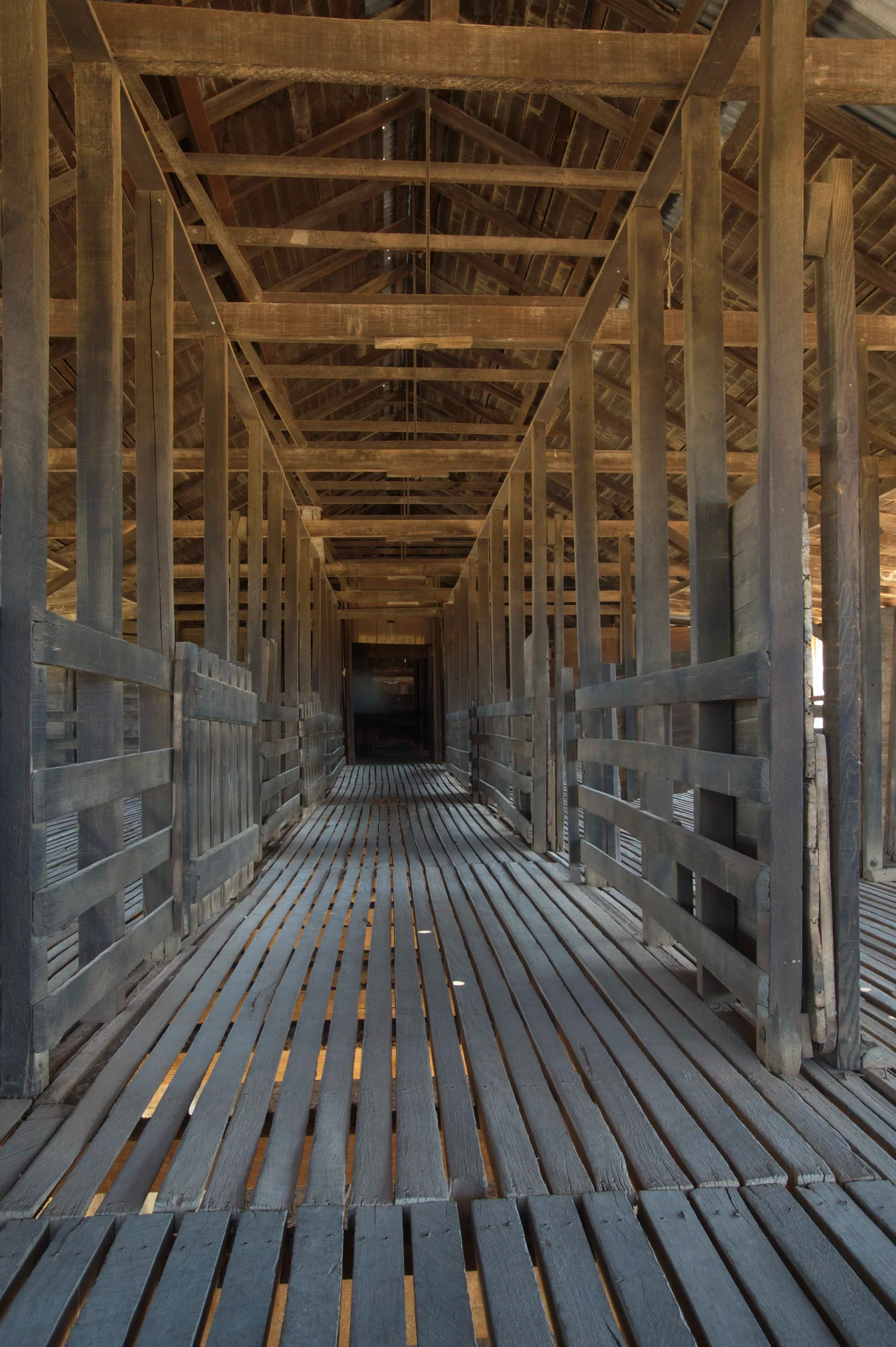
Twenty-six stands run down the length of the Kinchega Woolshed, and at each one, for nearly a century, a shearer bent over a struggling sheep and stripped its fleece in a few hard minutes. Multiply that by the seasons, by the thousands of animals driven through every spring, and you reach a number that defines this building: roughly six million sheep were shorn here between 1875 and 1967. Standing on a low sandy rise above the Darling River near Menindee, the long iron shed is a cathedral of the wool age - and a record, written in timber and corrugated iron, of the human work that built outback Australia.
Built from the River
The woolshed was raised in 1875 from the materials at hand. Its frame is made of trimmed river red gum trunks - the same hardy trees that line the Darling - sawn into roof timbers and set on a floor lifted well clear of the ground. Sheets of corrugated iron clad the long, low-pitched roof and walls, a building method perfectly suited to the heat and dust of the far west. Its most distinctive feature is the pavilion of sweating pens at the southern end, where sheep were held before shearing; their light stud-frame construction contrasts visibly with the heavier timber of the original shed. Around it cluster smaller iron buildings - the shearers' quarters, the cookhouse, the stores - the small village that came to life each shearing season.
The Hands That Did the Work
A woolshed is nothing without the people who fill it. Shearing was brutal, skilled, competitive labour - long days bent double in lanolin-slick heat, paid by the sheep, with a shearer's reputation riding on speed and a clean fleece. Around them moved the rouseabouts who swept the boards, the wool classers who graded the clip, the pressers who baled it, and the cook who kept everyone fed in the heat. Shearing teams travelled the outback circuit shed to shed, and Kinchega's quarters housed them through each season's frantic weeks. These were the men and women who powered Australia's wool economy with their backs and their hands, and the worn boards of the shed still carry the memory of that labour.
A Century of Machinery
The shed witnessed an entire technological revolution pass through its stands. The earliest shearers used hand blades. Then came mechanical handpieces, driven at first by a steam traction engine that still stands outside the building beside its boiler. Steam gave way to kerosene, kerosene to diesel, and finally to electric power - each shift speeding the work and changing the rhythm of the board. Inside, the apparatus of the industry survives: the great wool press, the wool cranes that hoisted the bales, a cart and a buggy, and the shearing gear itself. Few buildings let you read the mechanisation of an entire industry so plainly, all of it preserved in one place where the changes actually happened.
A Landmark in the Plains
There is a darker thread in Kinchega's story, too. By 1860 the station was run by a manager named William Wright, who joined the Burke and Wills expedition as third in command - and was later blamed for failing to bring supplies north to the expedition in time, a lapse that contributed to the explorers' deaths at Cooper Creek. The woolshed outlived that tragedy by more than a century. When Kinchega became a national park in 1967, the shed was preserved rather than demolished, and it was restored in 1993. Believed to be the largest woolshed of its type still standing in the Western District, it remains a prominent landmark in the flat arid country - a visual symbol of the grazing history of the outback, and of the immense scale on which it was once conducted.
From the Air
Kinchega Woolshed stands within Kinchega National Park about 15 km southwest of Menindee, on a low sandy rise close to the Darling River, at roughly 32.48°S, 142.34°E and an elevation near 60 m. From the air the long, pale corrugated-iron roof of the shed is a distinct rectangular landmark against the surrounding red plains, with the dark vegetation line of the Darling River nearby and the broad Menindee Lakes basins to the west. The nearest airport with scheduled flights is Broken Hill (YBHI), about 110 km northwest; Mildura (YMIA) lies to the south. Visibility is generally excellent over this open country.
Nearby Stories
- Central Mine Manager's Residence 30 km away
- First BHP Offices Chimney Ruin 56 km away
- PS Rodney 60 km away
- Broken Hill Mosque 73 km away
- Wilcannia 90 km away
- Willandra Lakes Region 108 km away
- Wilcannia Athenaeum 115 km away
- Redruth Gaol 277 km away