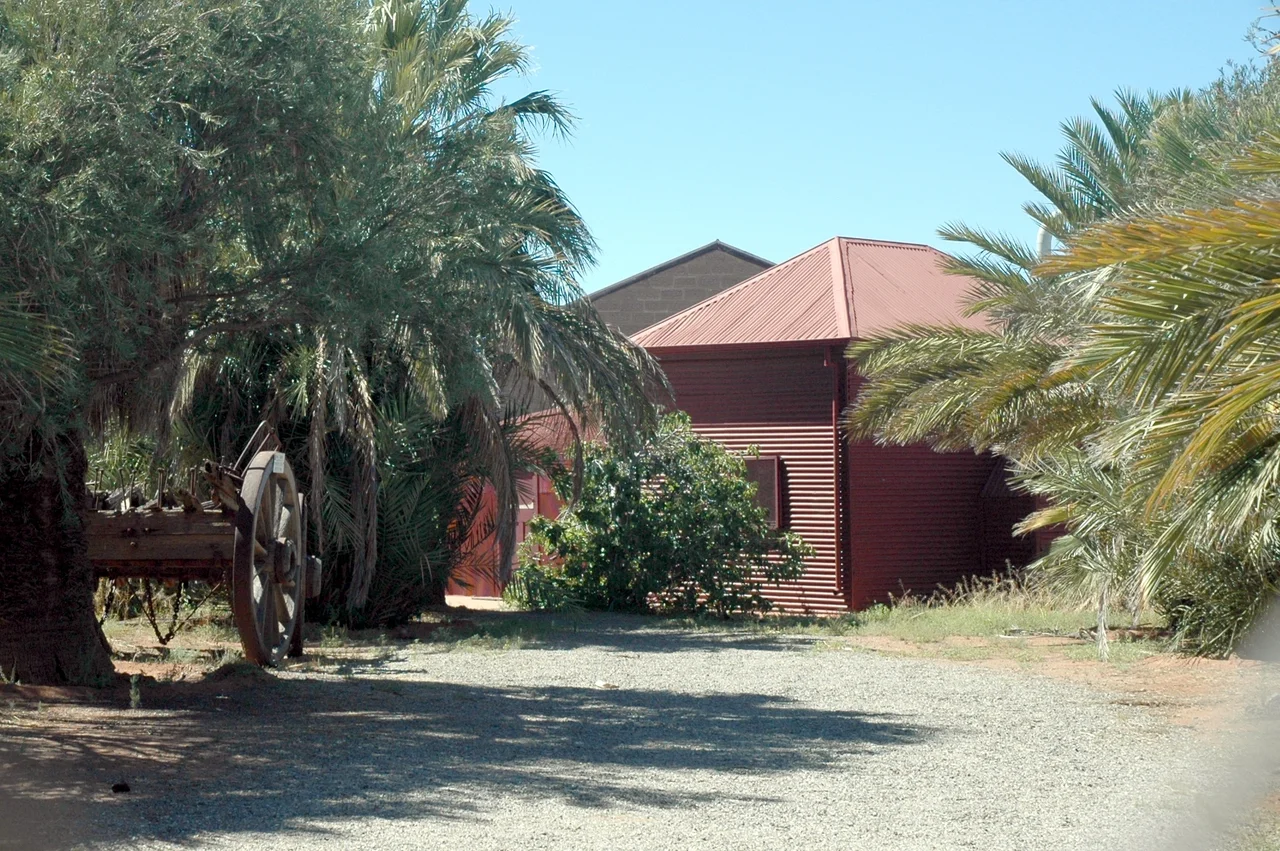

Broken Hill Mosque
The call to prayer once carried across the camel camps on the northern edge of Broken Hill, sung out by an attendant standing on the concrete with his palms cupped to his face, his voice travelling over the humpies toward Ghantown. The men who answered it had come thousands of kilometres to a desert that must have felt both familiar and impossibly far from home. They built their mosque from what the outback offered: sheets of corrugated iron and local timber, painted the rust red that is the colour of Broken Hill itself. The building they raised, modest as a shed and sacred as any cathedral, still stands. It is the oldest surviving mosque in New South Wales, and the only mosque the cameleers built that has lasted to the present day.
Pilots of the Desert
From the 1860s onward, men from Kashmir, Rajasthan, Punjab, Baluchistan, Afghanistan, and what is now Pakistan came to Australia to drive camels through country that broke horses and bullocks. Lumped together as Afghans, though most were not, they became the freight system of the inland. They supplied nearly every remote mine and station, erected fences, guided expeditions, and hauled the poles and wire for the Overland Telegraph that connected the colony to London. The heritage record calls them pilots of the desert, and the phrase fits. Without them the outback economy of the late nineteenth century would have ground to a halt. At Broken Hill their numbers were large enough to support two separate camps of camel drivers, and it was here, in the North Camel Camp, that they built the mosque that survives.
Iron, Timber, and Faith
Worship at the site dates to 1887, and the larger mosque that stands today was built in 1891. Architecturally it is something rare: a building that blends traditional Islamic design with the rough vernacular materials of the Australian frontier. There is an arched alcove marking the direction of prayer, and outside, a channel with water for the ritual ablutions, the wudu, that precede worship. Men removed their footwear, stepped to the concrete channel to wash, and entered across specially made stepping stones now kept in the anteroom. Among the mosque's treasures is a handwritten Sufi manuscript from 1901, linking the community to the Qadiriyya Sufi order and offering scholars a rare window into Islamic spiritual life in colonial Australia. For its blending of two worlds, the building was listed on the New South Wales State Heritage Register in 2010.
The Rhythm of a Week
Faith here was not an abstraction but a rhythm woven through working lives. Friday was the gathering day, the Muslim equivalent of a Christian Sunday, and some of the men would not work between noon and two o'clock so they could pray. The older and more devout went regularly, keeping their observances in a town built on mining shifts and the relentless logic of ore. One resident remembered a man named Mohamed Raffeeg standing outside the mosque, calling the faithful to prayer in a voice that reached across the whole camp. It is a small, human detail, and it matters, because it restores ordinary dignity to people too often remembered only as a category. These were men with names, with devotions, with a week shaped by something larger than work.
Kept by the Town That Remains
The camel trains faded as motor trucks and railways took their trade, and the camps that surrounded the mosque dissolved. But the building endured, cared for across decades by the Broken Hill Historical Society, who became its custodians and kept it standing when it might easily have been lost. By 2010 it was in fair condition; by 2017 it needed help, and the state government and city council together pledged funds to repair its walls and termite-damaged floor. Today it serves two roles at once. It remains a working mosque for Muslim travellers, a holy site held in esteem by Islamic councils across the country, and it is also a museum of cameleer and Muslim history, telling a story that is easy to forget but central to how the Australian interior was opened. In a corner of the outback, a small iron building keeps the memory of the men who carried a continent on the backs of their camels.
From the Air
The Broken Hill Mosque stands at roughly 31.94 degrees south, 141.48 degrees east, in North Broken Hill, New South Wales, on the corner of Buck and William Streets at the northern edge of the city where the old camel camps once lay. The terrain is flat arid plain near 300 metres elevation; from the air the regular grid of North Broken Hill streets and the Line of Lode ridge to the south are the main reference points, though the mosque itself is a small single-storey structure best seen at low level. Broken Hill Airport (ICAO YBHI, elevation 959 ft) lies about 9 kilometres south-southeast and is the nearest aerodrome. Desert visibility is usually very good but vulnerable to sudden dust storms. Recommended viewing altitude 1,500 to 3,000 ft AGL over the northern suburbs.
Nearby Stories
- Mount Gipps Station 5.4 km away
- Radium Hill 33 km away
- Honeymoon Uranium Mine 35 km away
- Menindee, New South Wales 44 km away
- Mutawintji National Park 64 km away
- Kinchega Woolshed 70 km away
- Kinchega National Park 86 km away
- Mount Chambers Gorge 178 km away