.jpg)
Noccundra Hotel
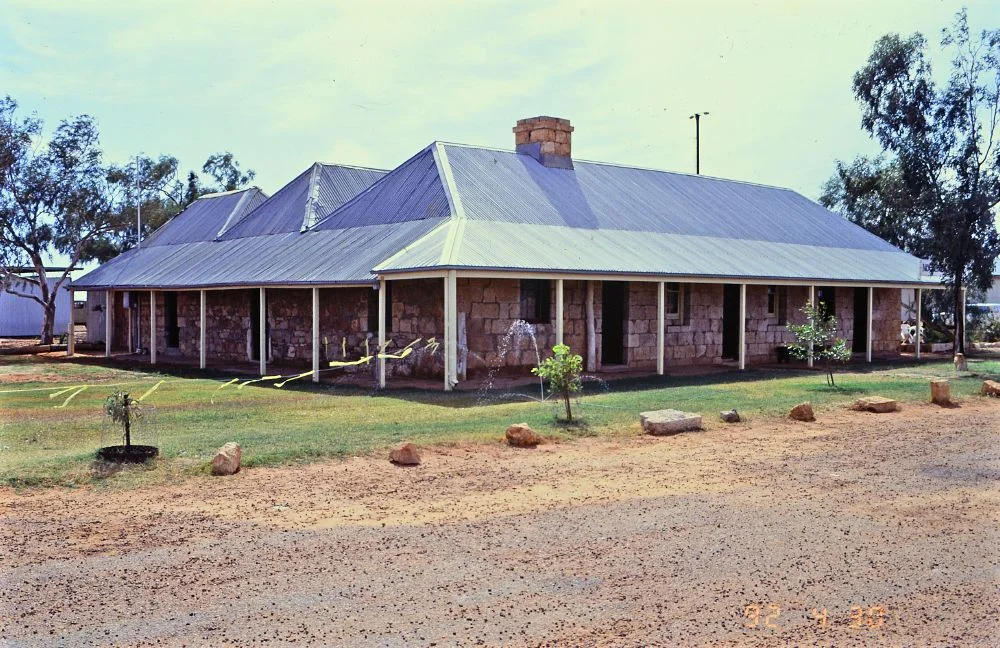
Drive west from Thargomindah across the gibber plains and you will see it long before you reach it: a low building of pale sandstone standing utterly alone against the flat red earth, visible for kilometres in every direction. This is the Noccundra Hotel, built in 1882, and it is the only occupied building in the town that bears its name. The stone that forms its walls did not come from anywhere near here - there was no suitable rock to quarry. It was cut at Mount Poole, some 200 kilometres south across the New South Wales border, and hauled to this spot by camel train. More than a century later the camels are gone, the town that grew around the pub has vanished, and the hotel still stands, still serves, still shelters travellers as it always has.
A Pub at the Crossroads of Nowhere
The hotel rose beside the Noccundra Waterhole on the Wilson River, at the meeting point of the old stock and trading routes - the tracks that ran to Innamincka in South Australia and Tibooburra in New South Wales. In an era before motor transport, when the nearest real town was impossibly far, those routes were lifelines, and a waterhole with a hotel beside it was a natural gathering place. Trade came from teamsters, drovers, travellers and the large workforce of nearby Nockatunga Station. The first license was granted to James Gardiner in 1886, and a township was surveyed in 1889 - though even then the only structures were the hotel, its bathhouse, stable and yards, and a stone store to the west run by a man named James McColl. It was never large. It was simply, for a while, necessary.
Stone for the Furnace of the Interior
The Noccundra Hotel belongs to a vanished architectural world. Its style echoes the surviving stone buildings of Birdsville and Boulia - a vernacular masonry tradition that spread across the arid heart of the continent, through South Australia, the Northern Territory and western Queensland, in the late nineteenth century. The thick coursed sandstone was not chosen for beauty but for survival: it tames the savage temperature swings of the desert, staying cool through blistering days, and it solved the problem of a country with almost no timber to build from. That the stone had to be carried hundreds of kilometres by camel only underlines how completely this region looked west and south, to Adelaide and the colonies, rather than east to distant Brisbane. The interior keeps its ripple-iron ceilings and a stone double fireplace set between the rooms - the bones of a building made to last.
The Town That Faded, the Pub That Stayed
A succession of publicans came and went - the Hogans, the Costellos, the Hugheses - and for a few decades the township held on, with a constable, a saddler and a store. But Noccundra never grew. As motor transport improved and nearby Thargomindah established itself as the local centre, the reasons for the town to exist quietly dissolved. The store closed by 1933, and Noccundra dropped out of the post office directories. The police station shut in 1959. The town simply ceased to be a town. And yet the hotel endured, because in country this empty a place to stop matters more than a place to settle. In the 2021 census the entire locality of Noccundra counted just sixteen people, and the hotel - housing a permanent population of three - remains its only occupied building.
Lifeline and Landmark
For the scattered community of the surrounding stations, the Noccundra Hotel has long been more than a pub. It served as a venue for the monthly medical and dental clinics flown in by the Royal Flying Doctor Service, and as the meeting place of a social and racing club that raised money for the RFDS - the flying doctors who are the only realistic medical care for thousands of square kilometres. It was listed by the National Trust in 1977 and entered the Queensland Heritage Register on 21 October 1992, recognised both for its rarity as a surviving nineteenth-century outback hotel and for its stark aesthetic power - a single human-made object in a vast open plain. Today it draws travellers who come precisely for that isolation, to stand where the camel trains once stopped and feel the size of the country pressing in from every side.
From the Air
The Noccundra Hotel sits at 27.82°S, 142.59°E on the eastern edge of the Sturt Stony Desert, about 140 km west of Thargomindah in the Shire of Bulloo, far southwest Queensland. From the air it is a tiny, bright cluster of stone and corrugated-iron roofs beside the dark line of the Wilson River and the Noccundra Waterhole - an almost startling speck of habitation in an immense, flat gibber plain otherwise empty of structures. The Wilson River and its waterhole are the key navigation reference; the Thargomindah road runs east. Thargomindah Airport (YTGM) is the nearest strip with services, roughly 80 km to the east. Uncontrolled airspace over remote desert; expect intense heat haze and afternoon turbulence in summer, and outstanding clear-air visibility in winter. The hotel's pale stone catches low sun beautifully - best viewing in the early or late hours of the cooler months, May through September.
Nearby Stories
- Dr Ludwig Becker's Grave 22 km away
- Ballera gas plant 32 km away
- Quandamooka People 42 km away
- Tookoonooka impact structure 60 km away
- Thargomindah 73 km away
- Durham Downs Station 88 km away
- Sturt National Park 121 km away
- Tibooburra 154 km away