Dr Ludwig Becker's Grave
He kept painting almost to the end. While the scurvy loosened his teeth and the dysentery hollowed him out, Ludwig Becker propped himself up inside a canvas tent and worked his watercolours across the page, recording the desert that was killing him. Some seventy paintings, drawings and maps survive from his fifteen months in the field, made by a man who was often denied food and sleep for the privilege. His grave sits today on a low rise above the Bulloo River in far southwest Queensland, marked by a plinth, a plaque and three weathered timber posts inside a low metal fence. It is the last grave of the most famous and most disastrous journey in Australian exploration.
A Universal Genius
Becker did not come to Australia to die in a desert. Born in Darmstadt in 1808, he earned a doctorate in philosophy and fled Germany after the failed revolution of 1848, drifting through Rio de Janeiro before stepping ashore at Launceston in 1851. Lady Denison, wife of Tasmania's governor, called him "one of those universal geniuses who can do anything" - a naturalist and geologist who drew, sang, played music, conjured, and could imitate birdsong so precisely that listeners turned to look for the bird. He corresponded with the great ornithologist John Gould about the lyrebird, and was among the first Europeans to try raising a lyrebird chick, mailing sketches of its egg to scientists in Germany and France. Curiosity, not ambition, was the engine of his life.
The Glorious Race
In 1860 that curiosity earned him a place on the Victorian Exploring Expedition, the lavish, doomed venture now remembered by the names of its leaders, Robert O'Hara Burke and William John Wills. The colony of Victoria wanted to beat South Australia's John McDouall Stuart across the continent, and Governor Barkly called it a "glorious race." It was the most expensive expedition in Australian history, equipped with two dozen imported camels, horses, wagons and two years of food. Becker signed on as artist, naturalist and geologist, with instructions to keep a diary and produce daily illustrated maps. He was sixty-one tasks and good intentions ahead of a leader who had little patience for any of it.
Walked Until He Gave In
Burke saw science as dead weight. Impatient at the time it cost, he ordered Becker and the botanist Hermann Beckler to abandon their work, walk instead of ride, and labour like the other men. One report records Burke's reasoning bluntly: if a man of Becker's age and standing could cross to the Gulf, people would think the journey easy, so Becker "was to be walked until he gave in." He went three days without eating and grew faint. He did his writing and sketching in secret, after the others had fallen asleep. When the expedition fractured at Menindee, Becker was left with the rear party under the unreliable William Wright, stranded for months while the supplies that might have saved everyone sat undelivered.
Desolation Camp
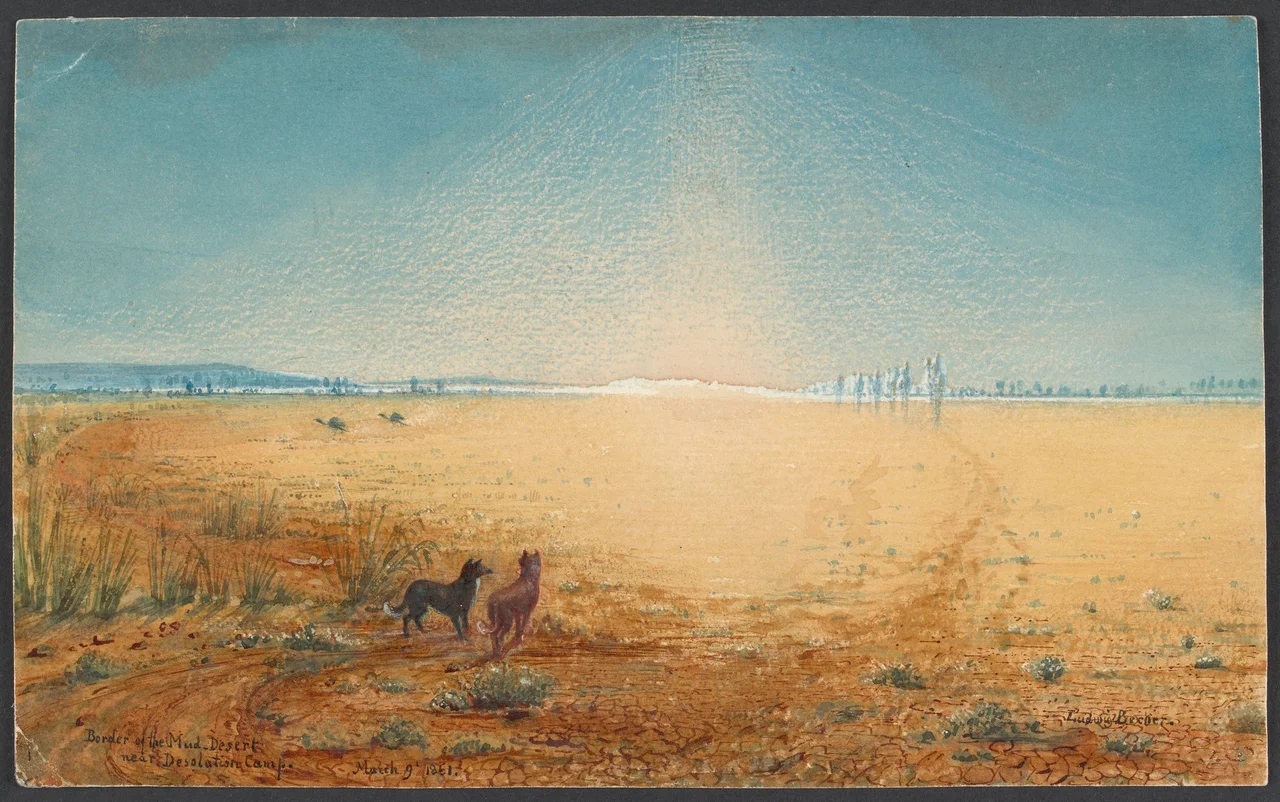
Wright's party crept north into worse and worse country. By the time they reached the depot at Bulloo, scurvy and foul water had ruined them. The cook, Charles Stone, died on 22 April 1861; William Purcell the next day. Beckler, the doctor, had written to his brother that he would have to bury Becker in this place, and dreaded the outcry it would cause in Melbourne. On 27 April the camp was attacked; by then Becker was mostly beyond knowing it. He died on 29 April, largely unconscious, and was laid beside Stone and Purcell. His tent, bedding and clothes were burned. His paintings, including the haunting "Border of the Mud-Desert near Desolation Camp," were packed for the long journey south, and they outlived him.
A Martyr to His Profession
Becker was mourned in newspapers and journals on two continents. Governor Barkly placed his name among the explorers who "sacrificed their lives in the cause of science," and a Queensland parish was named Becker in his memory. The royal commission that followed censured Burke for dividing his party and trusting Wright, but no inquiry could undo the choices that left a gifted, gentle man to be marched to exhaustion in a place he never wished to conquer. Burke won his race to the north; only the expedition's lone survivor, John King, came home, kept alive by Aboriginal people who shared their food. Becker stayed by the Bulloo. The desert he painted holds him still.
From the Air
Dr Ludwig Becker's Grave lies at 28.32 degrees S, 143.12 degrees E, on the western bank of the Bulloo River near Molesworth Station, southwest of Thargomindah in far southwest Queensland. This is deep, sparsely settled outback: the Bulloo is a green thread winding through red and ochre channel country, and the grave site is best located by the river line and stock routes rather than by any town. The nearest aerodrome is Thargomindah (ICAO YTGM), with Quilpie (YQLP) and Cunnamulla (YCMU) the next options further east. Charleville (YBCV) is the regional hub. Visibility is typically excellent in the dry interior, though heat haze and dust can soften the horizon in summer; recommended viewing altitude is 2,000-4,000 feet AGL to trace the river and waterholes that defined the expedition's last days.
Nearby Stories
- Thargomindah 14 km away
- Noccundra Hotel 37 km away
- Lake Bindegolly National Park 58 km away
- Currawinya National Park 69 km away
- Nockatunga Station 70 km away
- Adventure Way 84 km away
- Sturt National Park 97 km away
- Royal Mail Hotel, Hungerford 118 km away