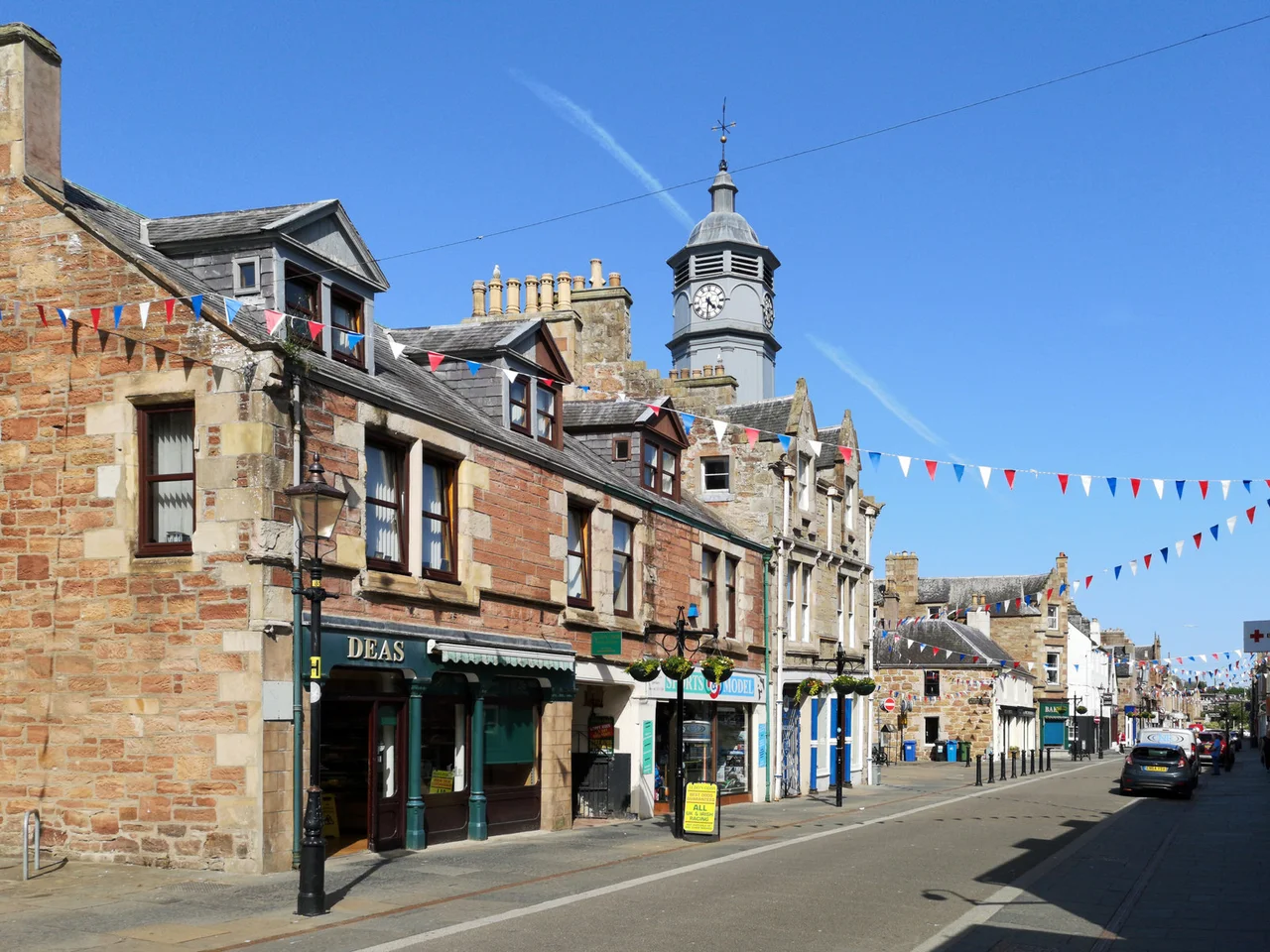

Dingwall
The name is the giveaway. Dingwall comes from the Old Norse Þingvöllr - field of the assembly - the same word that gives Iceland its Thingvellir, the Isle of Man its Tynwald, and tells you that the Vikings ran this end of the Highlands long before Scottish kings got around to it. In the eighth century the Norse came up the Cromarty Firth and decided this flat ground at the mouth of the Peffery was where they would hold their thing, their open-air parliament. Twelve hundred years later the town that grew up around the assembly is still called by the assembly's name. The Moothill where the meetings took place lies under the Cromartie memorial now, paved over and forgotten by most people who walk past it. That is Dingwall in miniature: a place where the deepest history is almost always under something else.
The Port That Lost the Sea
Walk through Dingwall today and you would never guess that the town was once a major medieval port. The topography has changed. The Cromarty Firth used to reach right up to the High Street, and Dingwall was a hub of foreign trade and customs collection, exporting hides and salt fish, importing wine and timber. Alexander II made it a royal burgh in 1226, the seat of the Earls of Ross. James IV renewed its royal charter in 1497. Then, slowly, the land silted up and the harbour pulled back. Today the firth's western shore lies a mile or so east of the town. The Dingwall Canal - the shortest in Britain, also locally called the River Peffery - is what remains of the port. The town's population is now about 5,491. Across that long retreat from the sea, Dingwall has stayed the administrative centre of Easter Ross.
Macbeth's Thane and the Vitrified Fort
Three miles west of the town rises Knockfarrel, a hill topped by an Iron Age vitrified fort whose stone walls were melted by some ancient fire - whether deliberately fortified by glassy heat or destroyed by attackers nobody is sure. In the early Middle Ages Dingwall Castle, established in the eleventh century, was reputed to be the largest castle north of Stirling. The tradition that Macbeth was born in Dingwall - he was Thane of Ross, and possibly Mormaer here before he became King of Alba in 1040 - is one of those tantalising claims that historians cannot quite confirm and locals will not quite let go of. The Eagle Stone, a Pictish-era carved monolith on Mitchell Hill, is older than any of the certainties: a hooded figure and a beast carved into stone that already had centuries on it when the Vikings arrived.
The Leaning Tower and a Poem from the Clearances
After George Mackenzie, 1st Earl of Cromartie, died in 1717, his family built a 51-foot obelisk over his grave near the parish church of St Clement. It subsided. By the nineteenth century it was leaning so badly it had earned a nickname - the Leaning Tower of Dingwall - and was eventually demolished and replaced with a smaller copy. The Dingwall Town Hall, built in 1745, still stands. In 1845 a much darker piece of history came out of the area. James Gillanders of Highfield Cottage, factor for the Robertson estate while his employer served with the British Army in Australia, oversaw the mass eviction of the crofting tenants of Glencalvie in Ross-shire - one of the most brutal episodes of the Highland Clearances. A Gaelic-language poem denouncing Gillanders for his cruelty was eventually published anonymously in a Canadian Gaelic newspaper in Nova Scotia. It is believed to be the only Gaelic-language source documenting the Glencalvie evictions, an act of literary witness preserved by exile. On 6 August 1904 the town unveiled a pale pink granite memorial to the Seaforth Highlanders killed in the Boer War.
Ross County, Kate Forbes, and the Argentine Connection
Modern Dingwall is the home of Ross County Football Club, which won promotion to the Scottish Premier League in 2012 and won the Scottish League Cup in 2016 by beating Hibernian 2-1 - a remarkable record for a town of five thousand people. Kate Forbes, the Deputy First Minister of Scotland, was born here and went to school here. So was Sir Hector MacDonald, the soldier-general nicknamed Fighting Mac, son of a Rootfield crofter who rose from the ranks to command a brigade. Willie Logan, who founded the airline Loganair, was a Dingwall civil engineer. Strangest of all is Colin Calder, who left Dingwall for South America in the 1880s and on 24 December 1889 founded the football club Club Atletico Rosario Central in Argentina - the team that would later produce Lionel Messi's home crowd. A Highland town that lost its sea has scattered its sons across the world, and given a small Argentine city the football club its greatest player would inherit by birth.
From the Air
Dingwall sits at 57.5972°N, 4.4278°W at the head of the Cromarty Firth, where the Peffery flows in from the west. Inverness Airport (EGPE) lies about 18 miles south-southeast at Dalcross. From the air the town reads as a small dense grid at the western tip of the firth, with the Black Isle to the east, Ben Wyvis (1,046 m) dominating the western horizon, and the wooded hill of Tulloch immediately south of the town. Recommended viewing altitude 3,000-4,500 ft AGL. The A9 trunk road crosses the firth on the Cromarty Bridge a few miles east, and the Far North railway line threads through the town. Low cloud often hangs over Ben Wyvis in winter and spills down into the Peffery valley.
Nearby Stories
- Nairn 1.7 km away
- Portmahomack Sculpture Fragments 2.4 km away
- Loch Ness Monster 3.4 km away
- Ardgay 5.8 km away
- Glen Affric 5.9 km away
- Strathspey Railway (preserved) 9.2 km away
- Battle of Leckmelm 11 km away
- Corrieshalloch Gorge 22 km away