
Dinorwic Quarry
From the air it looks like someone cut a city out of a mountain. Twenty terraced galleries climb each of the two main pits, stepping up in flights so regular they could be staircases for giants. Some are flooded. Some are roofed by collapsed slate. The walls are not grey but bruise-purple, banded with the slick blue-black where rain has run for fifty-seven years since the last shift went home. Dinorwic Quarry covered 700 acres at its peak in the early twentieth century, the second-largest slate quarry in the world, and the second-largest only because Penrhyn down the road was bigger. Three thousand men worked here. Then in July 1969 the company locked the gates. Then it got stranger.
The Vein and the Smiths
The slate vein at Dinorwic runs nearly vertically, lying at or just below the mountain's surface - which is why the quarry could be worked as a series of open stepped galleries rather than as a deep mine. The first commercial extraction began in 1787 when a private partnership took a lease from the landowner, Assheton Smith. War with France, taxes, and the cost of moving rock to the sea held progress back. The Smith family took direct control in 1809, and the business boomed after 1824 when a horse-drawn tramway was built down to Port Dinorwic on the Menai Strait - the slate's gateway to the world. By the late nineteenth century Dinorwic was producing 100,000 tonnes of finished slate a year and employing more than 3,000 men. The original sixteen separate small quarries - Adelaide, Allt Ddu, Braich, Bryn Glas, Harriet, Matilda, Victoria, Wellington and the rest - slowly merged through the 1840s into the great combined workings whose shape you can still trace from the air today.
Padarn and the Hunslets
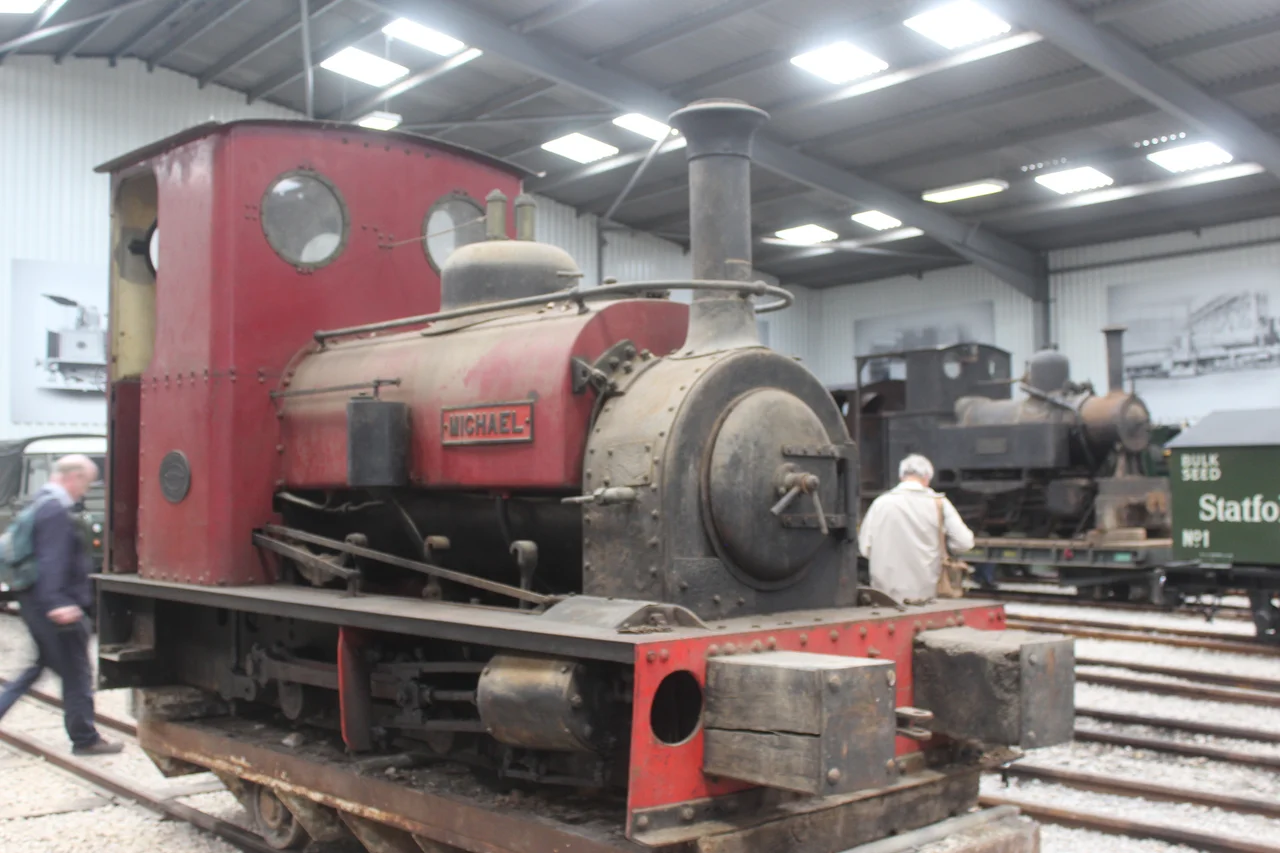
Slate is heavy. Moving it required engineering. The Padarn Railway ran four-foot gauge from the quarry's main yard at Gilfach-ddu to Port Dinorwic, carrying transporter wagons loaded with narrower two-foot trucks of slate. Inside the quarry itself, a web of internal tramways climbed the galleries on self-acting inclines - loaded wagons going down hauled empty ones up by gravity. Most of the locomotives came from the Hunslet Engine Company of Leeds, which from 1886 built three purpose-designed classes for Dinorwic: Alice for the quarry galleries, Port for harbour work, and Tram (or Mills) for marshalling at the mills. Their black smoke once hung over the galleries in still weather. Many of those Hunslets survived the closure; you can find them today on heritage railways across Britain, polished and steaming for tourists who do not always know what they were built to move.
Locking Up in 1969
The quarry closed in July 1969. Slate had been losing ground for half a century - to ceramic roofing tiles, to corrugated metal, to imports from Spain and China. The Penrhyn quarry next door closed for similar reasons. But Dinorwic did not vanish; it changed jobs. The mountain that had been hollowed out by men with hammers was about to be hollowed out further by men with tunnelling machines. In 1974 work began inside Elidir Fawr on the Dinorwig Power Station - a pumped-storage hydroelectric scheme using the two lakes the quarry had already shaped. At full output Dinorwig generates 1,728 MW from a standing start in about 16 seconds; from the surface you see almost nothing of it. The galleries above are the visible roof of one of the most powerful electric machines in Europe.
Cantilevers, Climbers, and Dragons
The old workshops at Gilfach Ddu became the National Slate Museum, leased from the county council to the National Museum of Wales. Equipment from the internal railway was relaid as the Llanberis Lake Railway, carrying tourists along the trackbed of the old Padarn line. The quarry itself became a major British rock climbing venue, particularly in Twll Mawr ("the big hole"), Vivian, Rainbow Slab, and the section called Australia. Johnny Dawes put up The Quarryman, an E8 7a in Twll Mawr; James McHaffie made the first ascent of The Meltdown, a 9a sport route on the same wall, after Dawes and Jerry Moffatt had attempted it for years. Filmmakers found the place irresistible. Willow in 1987, Street Fighter in 1994, Clash of the Titans in 2009, House of the Dragon more recently - the alien stepped landscape can pretend to be almost any planet or any age. In 2023, the band Everything Everything shot the video for "Cold Reactor" inside the quarry walls.
The Rockfall Problem
Slate weathers. After fifty years of frost and rain, the Vivian quarry suffered major rockfalls in 2020 and again in 2022; foot access has been permanently closed there. In spring 2025 a wave of TikTok videos brought a surge of visitors who did not always know the difference between an open path and a closed pit. The site was "overwhelmed," CCTV went up, mountain rescue teams pulled out trespassers. In June 2025 there was another rockfall in a prohibited area. The galleries that took two centuries of skilled labour to dig are slowly demolishing themselves on a timescale of weather. From the air, all of it - the museum buildings clustered at the foot, the climbers' chalk smudges on Rainbow Slab, the pumped storage scheme buried inside Elidir Fawr - still looks like one of the strangest things humans have ever done to a mountain in North Wales.
From the Air
Located at 53.12°N, 4.10°W on the eastern flank of Elidir Fawr, between Llanberis and Dinorwig villages. The quarry's stepped galleries are visible from 2,500 ft AGL and unmistakable from 5,000 ft - look for the bruise-purple terraces stepping up the mountain east of Llyn Padarn. The Dinorwig Power Station's high reservoir, Marchlyn Mawr, sits 600 m above. Nearest airports: EGCK (Caernarfon Airport) 8 nm WSW, EGOV (RAF Valley) 18 nm WNW. Watch for severe rotor turbulence off the surrounding Glyderau in westerly winds.
Nearby Stories
- Tudweiliog 3.6 km away
- Denbigh Castle and Town Walls 6.4 km away
- Rhoscolyn Lifeboat Station 7.6 km away
- Butlin's Pwllheli 20 km away
- East–West Interconnector 20 km away
- New Brighton Lifeboat Station 31 km away
- Battle of Oswestry 31 km away
- Celtic Array 44 km away