
Diocese of the Isles
Draw a line on a modern map from the Isle of Man up through Islay, Jura, Mull, Skye, the Outer Hebrides, and out to remote Barra. To anyone today, this is a string of separate places in two different countries. For the bishops who once governed them, it was one diocese. Suðreyar, the Norse called it, the Southern Isles, and the title their bishops carried said the rest: Sodor and Man. From the 11th century onward, a single church held this scattered maritime kingdom together with little more than wooden ships, Latin liturgy, and patience.
A Bishopric on Salt Water
Most medieval dioceses look reasonable on a map. The Diocese of the Isles does not. Its parishes were islands, and its bishop's seat was a fortified rock off the coast of another island. The original cathedral stood on St Patrick's Isle, a tidal islet at Peel that was barely connected to the Isle of Man itself. Travel meant boats and weather. A visit to Iona, or Skye, or distant Barra could take weeks. The bishop's authority was real, but it crossed open sea to reach every parish that owed him. In a region where Norse longships still hauled in to shelter and where the saga of Mann was being written down by monks, the church became one of the few institutions binding the scattered Isles into a single jurisdiction.
Under Trondheim, Then York, Then No One
The diocese's allegiances shifted with the tides of northern politics. From around the 11th century the bishops answered to the Archbishop of York. Then, with the rise of the Archdiocese of Niðarós, jurisdiction moved north to Trondheim in Norway. After the Treaty of Perth ended Norwegian rule over the Isles in 1266, the Diocese of the Isles became one of the thirteen dioceses of Scotland. Things did not stay tidy. When England took Mann in the 14th century, the diocese tore in half. The Isle of Man kept its own bishop and old cathedral on St Patrick's Isle. The northern half regrouped, first at Snizort on Skye, then on Iona. Two churches, one ancient name, governed by rival crowns.
Parishes Across an Inland Sea
Read the parish list and the geography becomes prayer. Barra in the far south of the Outer Hebrides. Howmore on South Uist. Trumpan on Skye, where in 1578 a massacre would later mark its name. Kildonan on Eigg. Kilbride on Arran. Rothesay on Bute. Kildalton on Islay, where one of the great Celtic crosses still stands. Each name describes a small chapel, a graveyard above a beach, a parish priest serving fishermen and farmers who would never see their bishop. The diocese held these communities for centuries. When the Scottish Reformation reached the Isles in the 16th century, the structure shattered into pieces, but the parish names survived, and many of the chapel ruins still survive too.
Afterlife of an Idea
The Catholic diocese formally ended at the Reformation. Episcopacy persisted under the Church of Scotland on and off, abolished in 1689 with the death of Bishop Archibald Graham of the Non-juring Scottish Episcopal Church coming in 1702. For nearly a century and a half, the old Diocese of the Isles existed only as memory and contested jurisdiction. In 1847 the Scottish Episcopal Diocese of Argyll and The Isles was established, with Bishop Alexander Ewing as its first bishop, living at Lochgilphead. In 1878, after the Restoration of the Scottish Catholic hierarchy, a Roman Catholic Diocese of Argyll and the Isles was reestablished and still exists. The Isle of Man went its own way. Manx Catholics today fall under the Roman Catholic Archdiocese of Liverpool, and the Anglican Diocese of Sodor and Man, consisting solely of the island, still keeps the medieval title alive.
What Remains at Peel
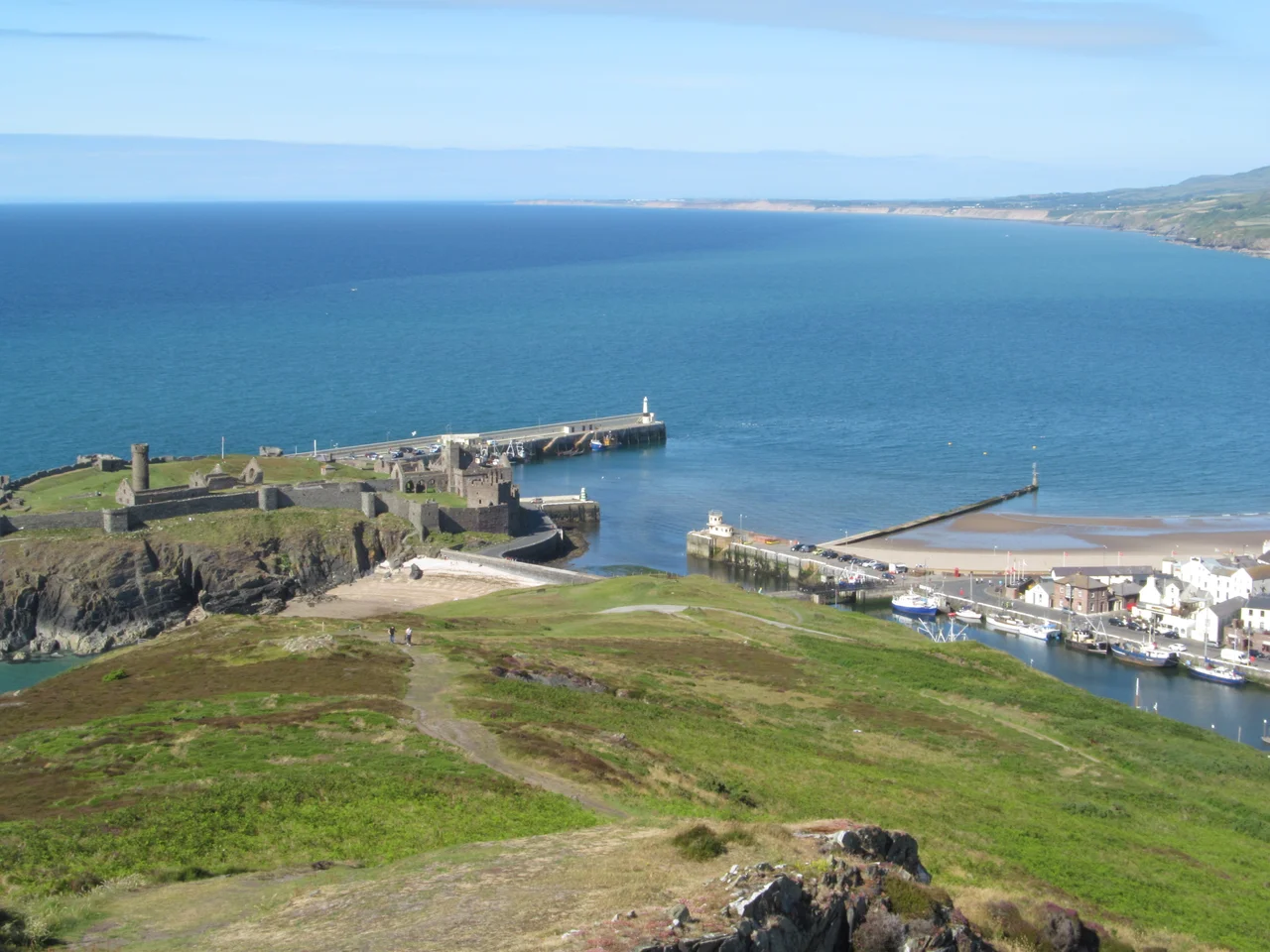
Stand today on the causeway to St Patrick's Isle and the original cathedral is right there: red sandstone and green slate, roofless, walls open to the wind. John Betjeman called the bishop of Sodor and Man the luckless one whose cathedral is a beautiful ruin on an islet overlooking Peel. He meant it as poetry, not insult. The ruin sits where Norse kings, then Scottish lords, then English overlords took turns deciding which crown the Isles belonged to. Through every change, the church held on, replaced one cathedral with another, and kept saying Mass. Across the harbour, the modern Cathedral Isle of Man in Peel carries the line forward into the present day.
From the Air
The historic seat sits at 54.226°N, 4.698°W on St Patrick's Isle off Peel, west coast of the Isle of Man. View from 2,500 to 5,000 ft AGL on a clear day shows the ruined cathedral inside the curtain walls of Peel Castle, the causeway to the mainland town, and Peel harbour to the east. Nearest airport is Isle of Man (EGNS) Ronaldsway, about 17 nm to the south-southeast. To the west, the Mourne Mountains of Northern Ireland may be visible on clear days; to the north, the Scottish Galloway coast.
Nearby Stories
- Ballywalter 14 km away
- Pasages (steam trawler) 15 km away
- SS Georgetown Victory 19 km away
- Celtic Array 31 km away
- Raeberry Castle 34 km away
- German submarine U-1051 36 km away
- St Bees Lifeboat Station 49 km away
- PS Rothsay Castle 73 km away