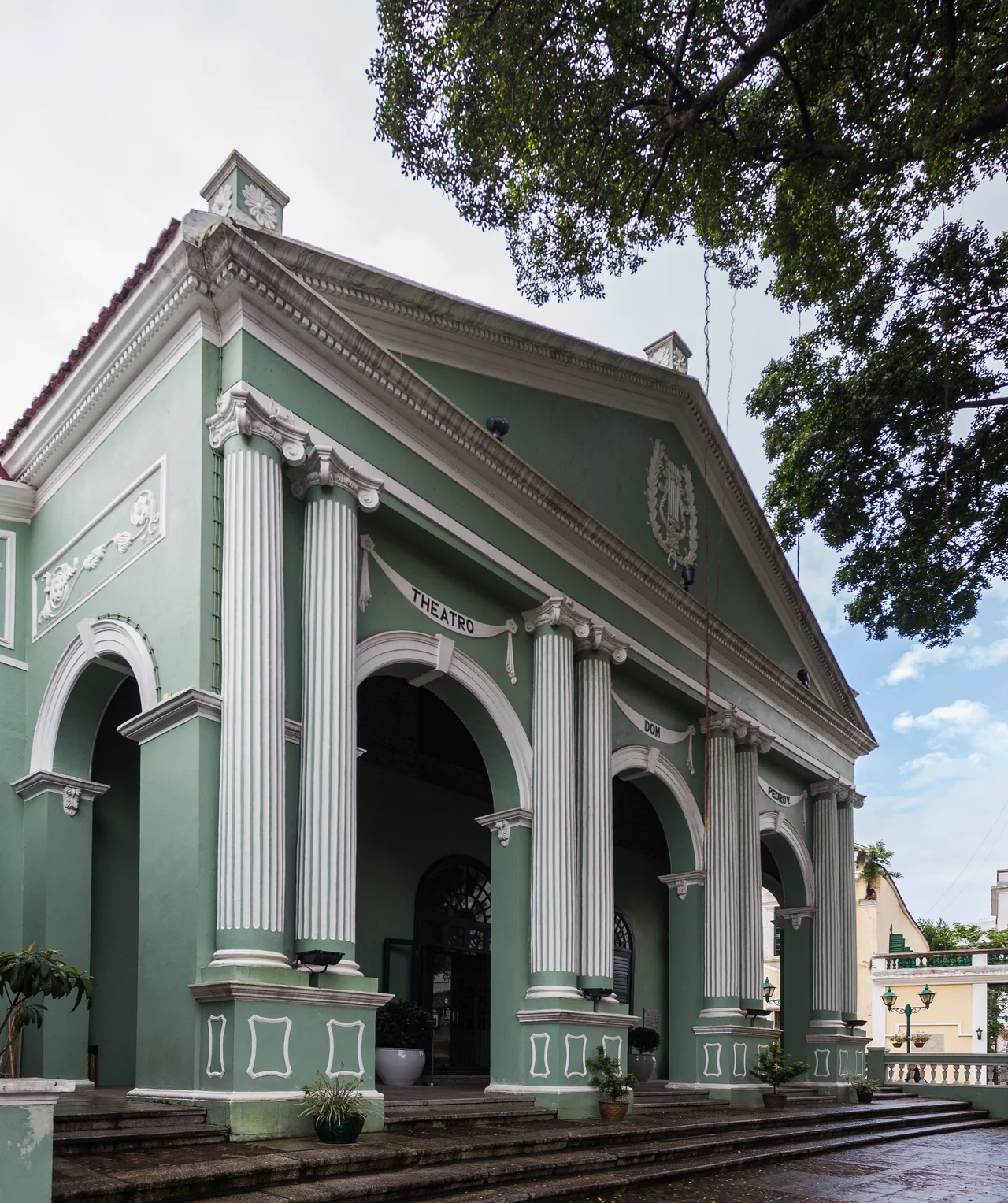

Dom Pedro V Theatre
The termites nearly finished what time and neglect had started. For almost twenty years, the Dom Pedro V Theatre stood dark and unused on the Largo de Santo Agostinho, its neoclassical facade intact but its interior quietly being consumed. When restorers finally arrived and the theatre reopened in 1993, it had been silent since the 1970s. The green-and-white portico, which looks as though it was lifted from Lisbon and set down on a Macau hillside, had waited.
Built for a King, Used by a Community
The theatre was built in 1860 by Macau's Portuguese community to honor their reigning king, Peter V — a monarch known for his scientific curiosity and his reign cut tragically short by cholera in 1861, the year after the theatre's completion. The local Portuguese and Macanese residents used the building as a social and cultural center: a regular meeting place in a colonial city where such institutions anchored community life. Its current facade, including the green-shuttered portico that has become the building's most recognizable feature, was added in 1873. The building measures 41.5 meters long and 22 meters wide, incorporating not only the main theatre but a ballroom, a study room, and a billiard room — the full suite of amenities a colonial social club required.
The Night Butterfly Premiered in Asia
At some point in its long history — the theatre's records do not specify the date — the Dom Pedro V hosted the Asian premiere of Puccini's Madama Butterfly. The opera, which tells the story of a Japanese woman abandoned by an American naval officer, had its world premiere in Milan in 1904. That it reached Asia through this small neoclassical theatre in Macau says something about the territory's cultural position: isolated from Europe, but connected to it by Portuguese colonialism, and part of a circuit of ports and settlements that exchanged cultural productions as readily as commercial ones. Butterfly's story of cross-cultural encounter and betrayal resonated differently in a colonial port city than it did in Europe, though the opera's relationship to its own subject matter has been the subject of sustained reexamination since.
Wartime Walls
During the Second World War, Japan occupied Hong Kong and much of China's coast, but Macau — a Portuguese territory under a nominally neutral government — remained unoccupied. The peninsula became a refuge for people fleeing Japanese-controlled territories, and the Dom Pedro V Theatre, like many large buildings in Macau during the war years, was pressed into service as a shelter. The formal performances stopped. The theatre held people instead of audiences. After the war ended, normal use eventually resumed, but the building's long dormancy in the following decades — the combined result of structural deterioration and shifts in social life — meant that the wartime interruption was only the first of several long pauses in the theatre's history.
Reopened, Recognized, Survived
The 1993 restoration returned the Dom Pedro V Theatre to working condition after the years of termite damage had eaten through structural elements. In 2005, it was designated one of the twenty-five sites of the Historic Centre of Macau, the UNESCO World Heritage property that recognized the peninsula's unique cultural layering. Typhoon Hato struck in August 2017 with enough force to damage the portico ceiling — a reminder that subtropical weather remains a persistent threat to buildings that are already carrying more than a century and a half of wear. The theatre continues to operate as a venue for public events and performances, its green shutters and white columns still catching the afternoon light on the Largo de Santo Agostinho, still standing watch over one of Macau's quieter squares.
From the Air
The Dom Pedro V Theatre is located in the São Lourenço district of Macau Peninsula at 22.192°N, 113.538°E, on the Largo de Santo Agostinho. The surrounding historic district, with its low colonial-era buildings and open squares, is distinguishable from the denser commercial districts to the north and east. Approach from the south at 1,500–2,500 feet for the clearest view of the peninsula's historic core. Macau International Airport (VMMC) is on Taipa Island, about 3.5 km to the southeast. The A-Ma Temple at the peninsula's southwest tip and the Lisboa casino towers to the northeast bracket the historic district and provide useful visual orientation. Haze is common in summer; October through February offers the best visibility.
Nearby Stories
- 2024 Shenzhen Stabbing 0.8 km away
- Lantau Peak 1.5 km away
- Kweilin Incident 2.4 km away
- Taishan City 7 km away
- Wanshan Archipelago Campaign 38 km away
- Hong Kong 12 68 km away
- Battle of Nanpeng Island 82 km away
- Erhai Lake 1335 km away