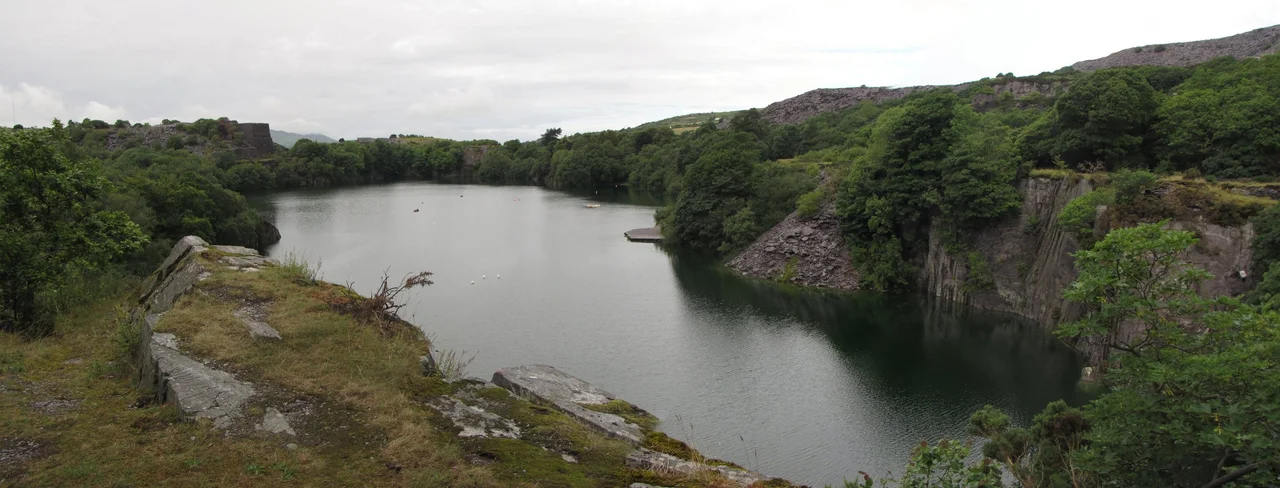

Dorothea Quarry
The deepest of Dorothea's six pits goes down 106 metres - taller than the Statue of Liberty, deeper than the average North Sea oil platform stands above the water. For most of the twentieth century the only thing keeping that pit from being a lake was a Cornish beam engine, installed in 1904, that pounded away day and night pulling groundwater out so the quarrymen below could cut slate from vertical veins. When the engine stopped in 1951 the electric pumps took over. When the electric pumps stopped in 1970 the lake was inevitable. In the decade between 1994 and 2004, twenty-one divers drowned in it.
Cloddfa Turner
Quarrying at the Dorothea site began in the early 1820s, but the venture became serious around 1829 when an industrialist named William Turner leased the workings and gave them his own name - Cloddfa Turner, Turner's Quarry. By the 1830s it was generating two thousand pounds in annual profit, the equivalent of nearly two hundred thousand pounds today. Turner's son took over as manager and renamed the place Dorothea, apparently after Dorothea Garnons, the wife of the local landowner Richard Garnons. The change reads now like an act of corporate flattery. The name stuck. The quarry stayed Dorothea for the next 140 years.
The Quarrymen Buy In
Profits faded in the 1840s and the lease was put up for sale in 1848. What happened next was unusual for the slate industry: a group of the quarrymen themselves - John Robinson, William Owen and John Jones - bought Dorothea from the Turner family for three thousand pounds in 1851. For more than a decade it was a worker-owned operation, employing two hundred men and producing five to six thousand tons of finished slate a year. The arrangement gradually unravelled. From 1864 onward John Williams of Denbighshire bought out the shares one by one, and by 1879 he controlled more than seventy per cent of the quarry. The era of the quarrymen-owners was over.
The Cornish Beam Engine
The geology at Nantlle is strange and lucrative: the slate veins run vertically rather than at an angle, which meant the easiest way to follow the seam was to dig straight down. The deeper the pit went the more groundwater filled it. Steam pumping had been part of the operation almost from the start, but in 1904 the company installed a full Cornish beam engine - the great industrial pumping technology developed for Cornish tin mines - and it stayed in service until 1951. For nearly fifty years a single engine, beam rocking above its house at the pit edge, kept Dorothea workable. Electric pumps took over after the Second World War. The pit walls kept going down. By the end the deepest face stood at 106 metres below the surface, well below sea level.
Twenty-One Divers
When quarrying ceased in 1970 the pumps were turned off, the groundwater rose, and Dorothea slowly filled. Within a decade it had become one of the deepest inland diving sites in Britain - more than a hundred metres of cold dark water, with hidden ledges and dropped equipment, drowned trees and the rusting remains of machinery. There were no facilities, no licensing, no instruction; the landowner did not officially permit diving, but he did not actively prevent it either. The combination was lethal. Between 1994 and 2004, twenty-one divers died. Most were experienced. Many overestimated their depth tolerance and ran out of breathing gas at the bottom. The British Sub Aqua Club eventually advised all members to stay away.
Diving Returns, Carefully
In 2021 controlled diving resumed at Dorothea, this time under proper license from the landowner and managed by the North Wales Technical Divers. The new rules are strict: technical qualifications only, trimix-trained divers, no recreational access. The site is too deep and too cold to be safe for anyone untrained for the conditions. The Bagnall locomotive Wendy, which once hauled wagons here, sits preserved at the Statfold Barn Railway in Staffordshire. The beam engine is gone. What remains at Dorothea is the lake - 106 metres of stillness on the floor of the Nantlle valley, holding the slate cuttings and the memory of the men who worked here for a century and a half, and the divers who did not come back up.
From the Air
53.05°N, 4.24°W on the floor of the Nantlle Valley, near Talysarn in Gwynedd. Best viewed at 2,000-3,500 ft to make out the six flooded pits with their dark green water below stepped grey spoil tips. Cilgwyn Quarry sits just to the north on the valley's other slope. EGCK (Caernarfon) is the nearest active airport, 8 nm north.
Nearby Stories
- GeoMôn 1.9 km away
- Battle of the Conwy 3.2 km away
- Irish Sea Bridge 5.2 km away
- Ysbyty Ifan 10 km away
- Machynlleth 16 km away
- Barmouth Lifeboat Station 23 km away
- Irish Sea 27 km away
- HMS Tyler 32 km away