
Dumfries and Galloway Aviation Museum
It started with a buried bomber. On the night of 3-4 June 1943, a Vickers Wellington Mk. X took off from RAF Wing near Leighton Buzzard at 2340 hours, heading for a training flight that would end on the approach to RAF Dumfries. One of its Bristol Hercules engines failed. The aircraft crashed short of the runway, killing three of its crew and seriously injuring two more. Thirty years later, in 1973, a group of local enthusiasts started digging. They pulled both engines out of the Galloway soil. One of them, with its wooden propeller still attached, is now the first thing visitors see at the museum it inspired.
From a Flight Hut to the Tower
The Dumfries and Galloway Aviation Group formed in 1976 to look after the artefacts that kept emerging from the old airfield. The obvious site for a museum was RAF Dumfries itself - in service from June 1940 until 1957, then closed and sold to a private company in 1960. The museum opened in 1977, initially housed in the airfield's old pilot's flight hut, the last building to have been used by the Dumfries Gliding Club. The first complete airframes acquired were a de Havilland Vampire T11 and a Gloster Meteor T7, both passed down from the Royal Aircraft Establishment at West Freugh, eighty miles to the west. The opening ceremony was performed by Michal Cwynar DFC, a Polish fighter ace who had flown for the RAF and stayed on after the war. He became the museum's patron. By 1979, with the acquisition of a North American F-100 Super Sabre, a Lockheed T-33 Shooting Star, and a Dassault Mystere, the small space around the flight hut was full, and the museum moved into the three-storey wartime watch tower where it sits today.
What the Hills Gave Back
Some of the museum's most affecting objects came from aircraft that crashed in the Galloway hills and stayed there for decades. On 9 August 1940, a Heinkel He 111H-4 of 1 Gruppe Kampfgeschwader 4, flying from Soesterberg in the Netherlands on a mine-laying mission off Belfast, became lost and flew into the summit of Cairnsmore of Fleet. The bombs aboard exploded; all four crewmen were killed. They are buried at the Cannock Chase German war cemetery in Staffordshire. One of the aircraft's Junkers Jumo 211 engines is on display. In 1942 Pilot Officer David Hunter-Blair was killed when his Spitfire AD540 crash-landed on the slopes of Cairnsmore of Carsphairn. The Spitfire had been nicknamed 'Blue Peter' after the 1939 Derby winner. The museum recovered the wreck in 1992, filmed in conjunction with the BBC children's programme of the same name. Hunter-Blair's aircraft is on display in unrestored condition - a deliberate choice, the way you might display the wreck without smoothing over what it was.
The Cold War on a Scottish Airfield
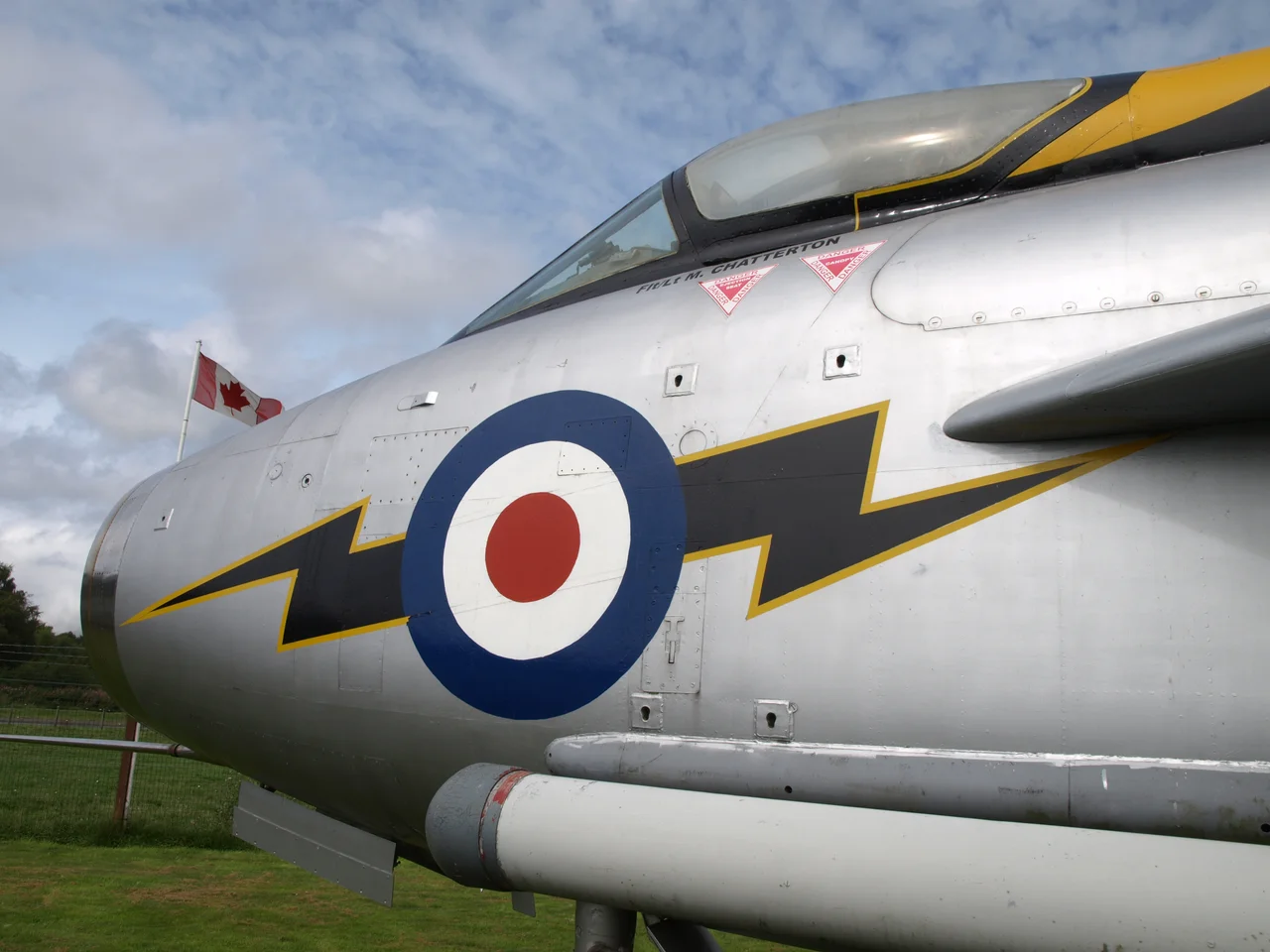
The museum's collection has filled out across four decades into one of the more varied aviation displays in southwest Scotland. The fighters represent both sides of the postwar order. There is an English Electric Lightning F.53 - the export variant the RAF never flew - and a SEPECAT Jaguar GR.1 alongside the F-100 and the Dassault Mystere IVA. A Saab J 35A Draken from the Swedish Air Force sits beside an English Electric Canberra T.4 and a Hawker Hunter F.4. Heavier hardware includes a Hawker Siddeley Buccaneer S.2B, a Fairey Gannet AEW.3 with its strange triple-fin tail, and a complete Hawker Siddeley Trident 3B airliner, G-AWZJ. The General Dynamics F-111E escape capsule on display - a self-contained pod the entire crew of two ejected in, parachute and all - is one of the few examples in the UK. In 2003 the museum became a registered charity. In 2017 a fully restored Spitfire Mk.IIa, P7540, joined the collection.
What the Tower Is For
The watch tower itself is the artefact that holds the rest of the museum together. Built in 1940 to a standard wartime pattern, it is the building from which RAF Dumfries controlled its flights for seventeen years - including the night the Wellington came down short of the runway. It is also the building from which controllers tracked the gliders that flew here in the postwar civilian years. The three storeys are now stacked with cabinets of cockpit instruments, flight logs, uniforms, ration cards, and what the museum describes as an 'ever-expanding collection of memorabilia honouring airborne forces.' Outside, the aircraft sit on what is left of the dispersal pans and taxiways. The runways themselves are gone, ploughed back into farmland. The museum is open seasonally, staffed entirely by volunteers.
From the Air
The Dumfries and Galloway Aviation Museum sits at 55.09 N, 3.57 W on the former RAF Dumfries site, two miles northeast of Dumfries town centre. The active nearest airport is Carlisle (EGNC) 25 nm southeast across the Solway, with Prestwick (EGPK) 50 nm northwest. The former RAF site itself - now Dumfries and Galloway Light Aviation - retains a grass strip used by light GA. From 1,500 to 3,000 feet AGL the museum reads as the cluster of buildings and parked aircraft on the south side of the old airfield outline; the wartime watch tower is the tallest object. The Galloway Hills rise west, with Cairnsmore of Fleet and Cairnsmore of Carsphairn - both the resting places of aircraft now in the museum - visible on clear days.
Nearby Stories
- Cumnock 9.5 km away
- Solway Firth 11 km away
- Garlieston 11 km away
- Battle of Arkinholm 12 km away
- Crawford Castle 12 km away
- Caldbeck 15 km away
- Battle of Glen Trool 17 km away
- Hawick 25 km away