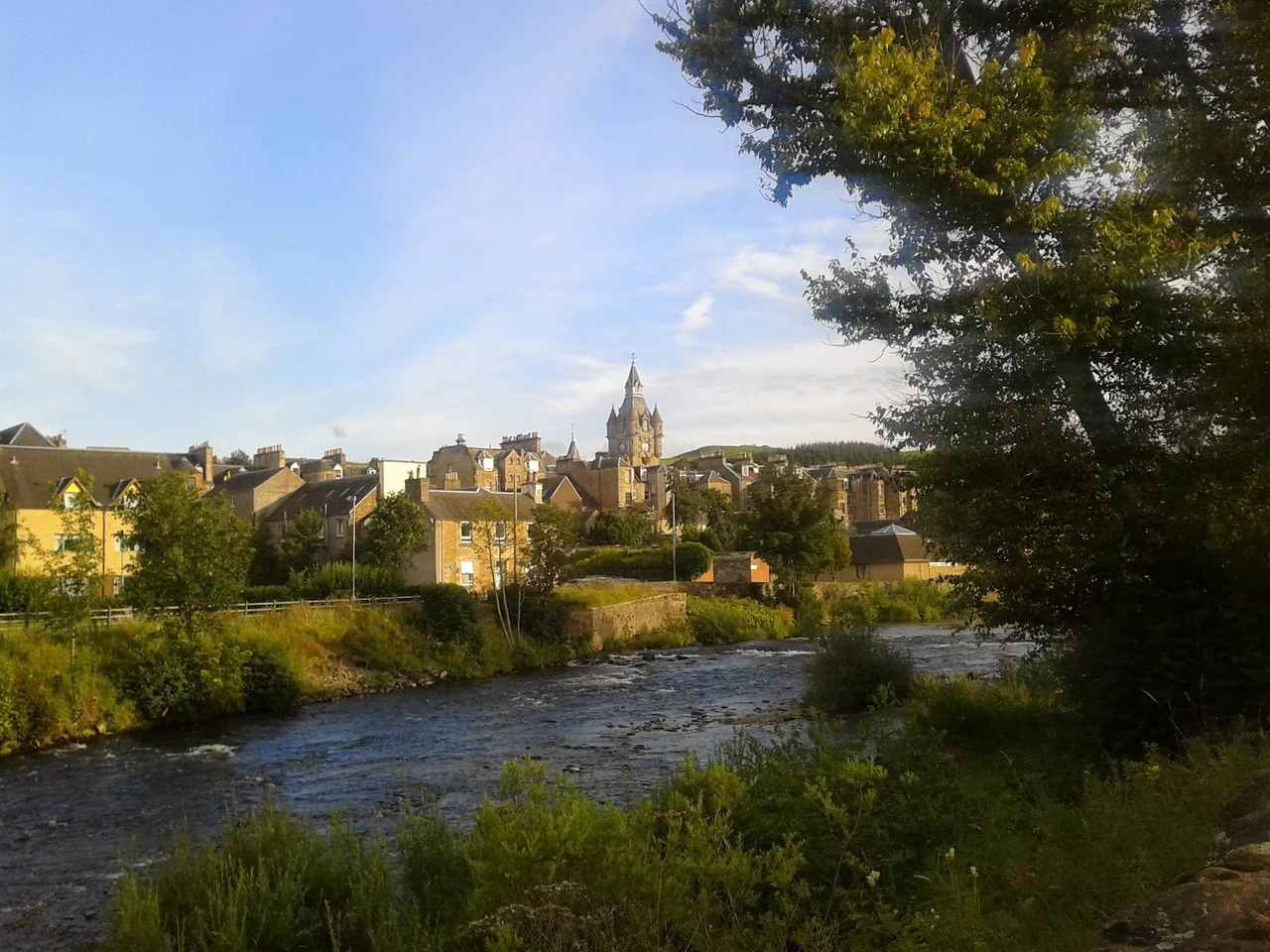

Hawick
James Murray, the man who would eventually edit the Oxford English Dictionary, grew up here. In the 1860s, while still working as a local schoolteacher in Hawick, he was already chasing down the origin of his town's name, a question that would set the methodological pattern for his life's work on the OED. He concluded that Hawick came from Old English, first recorded in 1167, meaning 'enclosed farm' or 'enclosed hamlet.' That a town in the Scottish Borders should bear an English name speaks to the layered, contested history of this country, where the line between Scotland and England has shifted over centuries and where the people on either side have always shared more with each other than either kingdom liked to admit.
Furthest from the Sea
Hawick sits in the east Southern Uplands, ten miles south-west of Jedburgh and just under nine miles south-south-east of Selkirk, at the confluence of the Slitrig Water with the River Teviot. It is one of the furthest towns from the sea in all of Scotland, marooned in the heart of Teviotdale and surrounded by the rolling hills that gave the Scottish Borders their characteristic landscape: half pasture, half moor, with stone dykes climbing the contours and sheep dotted everywhere they can find a footing. The town is the biggest in historic Roxburghshire and the regional centre for the southern Borders. The architecture is distinctive: many sandstone buildings with slate roofs, the warm honey colour of the stone catching the low northern light in winter and giving the town's main streets a particular quality that photographs only partly capture.
Knit Town
By the late seventeenth century Hawick was already growing. The Industrial Revolution and the Victorian era turned it into a textile town. The Scottish Borders specialised in knitting and weaving, working with tweed and cashmere, and Hawick became internationally known for fine knitwear. Mills lined the Teviot. Pringle of Scotland, founded here in 1815, made the town synonymous with quality cashmere; Peter Scott, Lyle and Scott, and other historic firms followed. By the mid-twentieth century, knitwear and tweed from Hawick were sold in luxury shops from Tokyo to New York. The industry declined sharply from the 1980s onward as production moved overseas. Peter Scott closed in 2016; Pringle shut its Scottish knitwear plant the same decade. The town still produces high-end cashmere, and brands like Hawick Cashmere and Johnstons of Elgin's Hawick mill carry the tradition forward, but the streets remember a denser industrial past.
Knights and Sheriffs
The history is older than the wool. The west end of town contains the Motte, the remains of a likely twelfth-century Scoto-Norman motte-and-bailey castle, the earthwork foundation on which a wooden keep would once have stood. On 20 June 1342, Alexander Ramsay of Dalhousie was holding court in the church of Hawick in his role as Sheriff of Teviotdale when William Douglas, Lord of Liddesdale, arrived with an armed retinue. He was courteously welcomed. Douglas and his men then attacked Ramsay, dragged him bleeding and in chains across the moors to Hermitage Castle, and threw him into a dungeon where he was left to starve. The motive, as far as historians can reconstruct, was that Douglas believed he should be Sheriff of Teviotdale. The story is grim even by Border standards, where the cycle of feud, raid, and reprisal among the great families made the fourteenth century a long, slow horror. Ramsay's dungeon is still shown to visitors at Hermitage.
Common Riding
The defining civic event of Hawick is the Common Riding, held every June, the oldest of the Border Common Ridings. The tradition commemorates a single morning in 1514. The Battle of Flodden the previous year had killed most of the able-bodied men of Hawick along with King James IV. With the older generation dead, an English raiding party probably expected easy pickings the next spring. Instead, they were met at Hornshole by the young men of the town, mostly teenagers, who routed them and captured their flag. The capture of that flag, and the ride to the boundary stones of the town's common lands, became the focus of the annual celebration. In 2014, on the 500th anniversary, around 1,800 children dressed in period costume re-enacted the battle. The Common Riding still gallops through Hawick every June, hundreds of horses and riders led by the Cornet, the town's elected young horseman, carrying a replica of the captured flag. It is part civic ritual, part Border defiance, part fierce affection.
A Bowl of Hawick Balls
Hawick has its own confectionery, its own dialect, its own rugby tradition. Hawick Balls are hard-boiled mint sweets with a peppermint and brown sugar flavour, sold in the town's shops in twists of paper. The local accent and dialect, sometimes called Teri or Hawick Scots, is distinctive even by Borders standards; conversations recorded by the BBC's Voices project in the 2000s captured a speech rhythm that locals defend fiercely against the smoothing-out forces of broadcast English. The rugby club, Hawick RFC, founded in 1873, has produced more Scotland internationals than any other club in the country, including the broadcaster Bill McLaren, who taught PE at Hawick High School for decades and called rugby matches with such warmth and precision that his commentary became as much loved as the sport itself. He died in 2010. The town misses him still.
From the Air
Coordinates: 55.425°N, 2.784°W. Recommended viewing altitude 3,000-5,000 ft AGL. Hawick sits at the confluence of the Slitrig Water and the River Teviot, surrounded by the rolling Southern Uplands. The town's sandstone architecture and the river valleys are the obvious landmarks. Scottish Borders airspace, generally uncongested. Nearest airports: Carlisle Lake District (EGNC) approximately 25 nm south-west, Edinburgh (EGPH) approximately 41 nm north, Newcastle (EGNT) approximately 47 nm south-east.
Nearby Stories
- Berwick-upon-Tweed Lifeboat Station 8 km away
- Kielder Water 8.8 km away
- Wallington Hall 11 km away
- Battle of Homildon Hill 12 km away
- Penicuik 12 km away
- Lockerbie 15 km away
- Oliver Castle 18 km away
- Yester Castle 19 km away