
Dumfries Museum
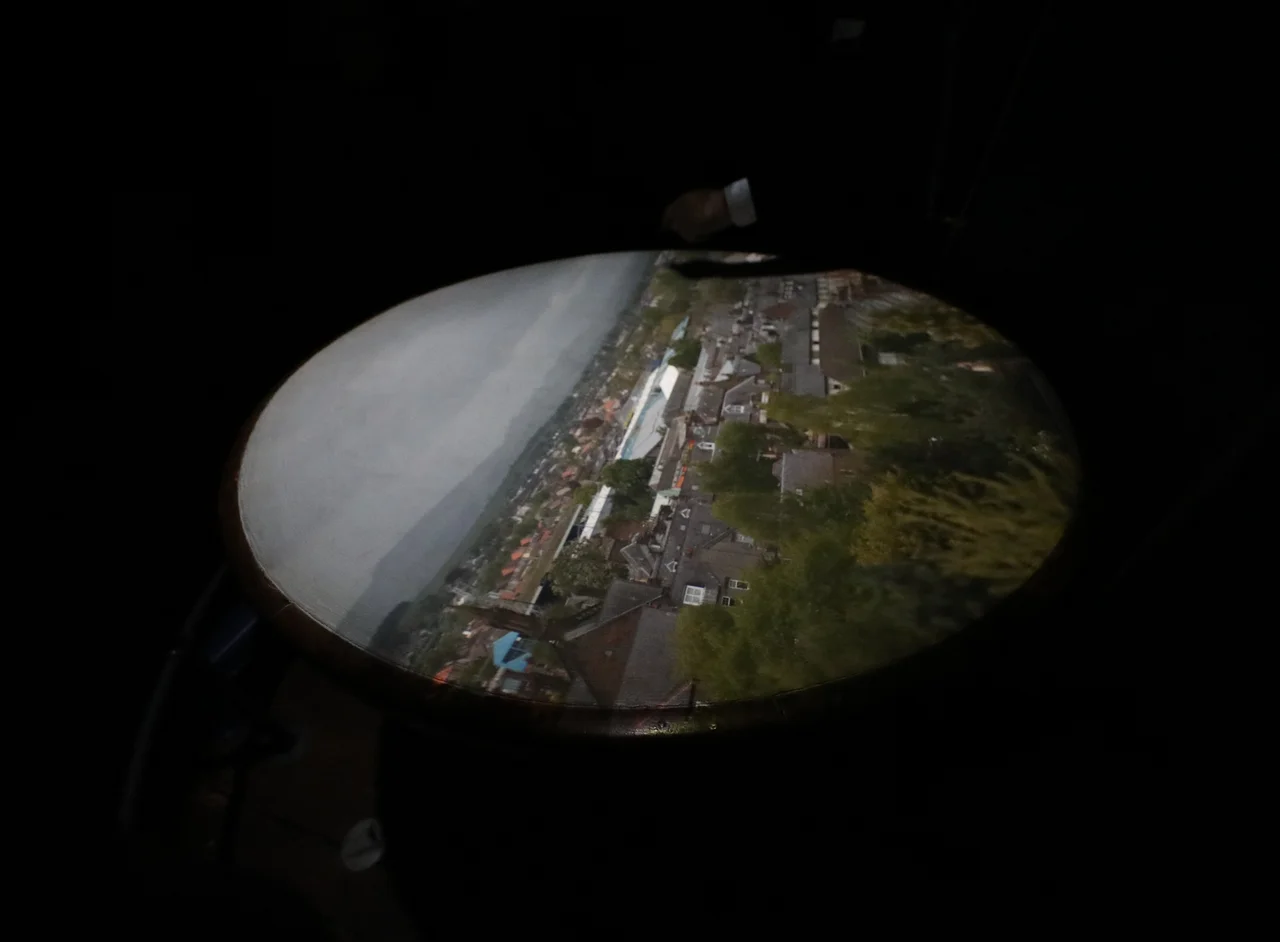
Climb the spiral stairs of the old windmill on Corbelly Hill, and at the top you'll find a small dark room with a pulley and a wooden viewing table. Pull the rope and a hidden mirror above the roof turns, projecting a live image of the surrounding landscape - Dumfries spread below, the Nith winding south, the green ridge of Criffel rising in the distance - onto the white surface in front of you. The instrument has been doing this since 1836. It is the oldest working camera obscura in the world.
A Windmill That Missed Halley's Comet
The building started life in 1798 as a four-storey windmill, raised on Corbelly Hill - the highest point in Maxwelltown, on the west bank of the Nith opposite Dumfries proper. In 1834 the Dumfries and Maxwellton Astronomical Society bought the site to convert it into an observatory. They took advice from Sir John Ross, the polar explorer who had spent two winters in the Arctic searching for the Northwest Passage, and commissioned a telescope from a Mr Morton of Kilmarnock. The conversion took two years. The telescope was installed and the observatory opened for business in 1836. Halley's Comet had passed overhead the year before - the observatory just missed it. They used the instrument as an astronomical observatory until 1872, when Dumfries's growing street lights made serious viewing impossible. The camera obscura at the top, installed during the same 1836 conversion, has been operating continuously ever since.
The Main Hall
The main museum hall went up in 1862 to house the collections of the newly founded Dumfries and Galloway Natural History and Antiquarian Society. A major new wing - galleries, shop, search room, offices for the curatorial staff - was added in 1981. The exterior of the old windmill tower was refurbished in 2011. Together they make up the largest museum in the Dumfries and Galloway region, and admission is free. (A small charge applies for the camera obscura, partly to fund its maintenance, partly to limit traffic through what is a delicate 19th-century optical instrument.) The collections cover the natural history and human pre-history of the entire region, from geology and fossil tracks to folk dress and early photography.
The Cast of a King
The notable artefacts are notable in different registers. There is a cast of the skull of Robert the Bruce, along with femur and foot bones - the cast was made in 1818 when his tomb at Dunfermline Abbey was opened during reconstruction work. There is a Bronze Age cist burial with the remains of a 35-year-old man from the Beaker culture, the people who began arriving in Britain around 2500 BC with their distinctive pottery and metalwork. There is a large collection of Roman and Celtic stone crosses and funerary monuments, gathered from across Galloway. A replica of the first pedal bicycle, as designed by Kirkpatrick Macmillan of Keir Mill in 1839, sits in one of the upper galleries - Macmillan was a Dumfriesshire blacksmith and his treadle-driven 'velocipede' is generally credited as the first true bicycle, though the original itself does not survive. Personal items belonging to Thomas Carlyle - a Dumfriesshire man who became one of the most influential British historians of the 19th century - are kept in a small gallery dedicated to him.
Fossil Footprints and a Refugee's Lens
From the local Permian sandstone, particularly the Corncockle Quarry near Lochmaben, come fossil reptile tracks 250 million years old. The trackways are some of the earliest reptile prints found anywhere in Britain. A different, much more recent set of images came from Dr Werner Kissling, the museum's photographic expert for thirty years. Kissling was a German aristocrat and ethnologist who fled Nazi Germany in the 1930s, settled in Scotland, and spent the rest of his life documenting the disappearing folk culture of the Highlands and Islands - thatched cottages, peat-cutting, herring-curing, work that nobody else was photographing systematically as it vanished. When he died, he left his entire photographic archive to Dumfries Museum, where it remains one of the most important records of pre-modern Scottish rural life.
How the Light Gets In
The camera obscura is what most visitors come for. The instrument runs only during the summer months and only on days when the weather is clear enough to project a sharp image - the system uses a lens and an angled mirror, and direct sunlight is what makes the projection work. Twist the rope and the mirror rotates, sweeping the live view around the room: river, town, hills, returning to river. There is no electricity involved, no screen, no digital trickery. It is the oldest optical principle in the world - a small hole, light bent through a lens, an image cast on a flat surface - executed by Scottish Victorian engineers in 1836 and still functioning the way they designed it. Watch it work in summer when you can. The hill it sits on still has the highest view of the town.
From the Air
Dumfries Museum sits at 55.07 N, 3.61 W on Corbelly Hill in Maxwelltown, on the west bank of the River Nith opposite central Dumfries. The nearest airport is the former RAF Dumfries (now light GA only) about 3 nm northeast; Carlisle (EGNC) is 25 nm southeast and Prestwick (EGPK) 50 nm northwest. From 1,500 to 3,000 feet AGL the windmill tower of the museum stands out on the high ground west of the Nith, with central Dumfries - tightly packed red sandstone buildings - on the opposite bank. Criffel (1,866 ft) lies to the south-southwest, the Solway Firth opens south, and the Galloway Hills rise west.
Nearby Stories
- Cumnock 9.5 km away
- Solway Firth 11 km away
- Garlieston 11 km away
- Battle of Arkinholm 12 km away
- Crawford Castle 12 km away
- Caldbeck 15 km away
- Battle of Glen Trool 17 km away
- Hawick 25 km away