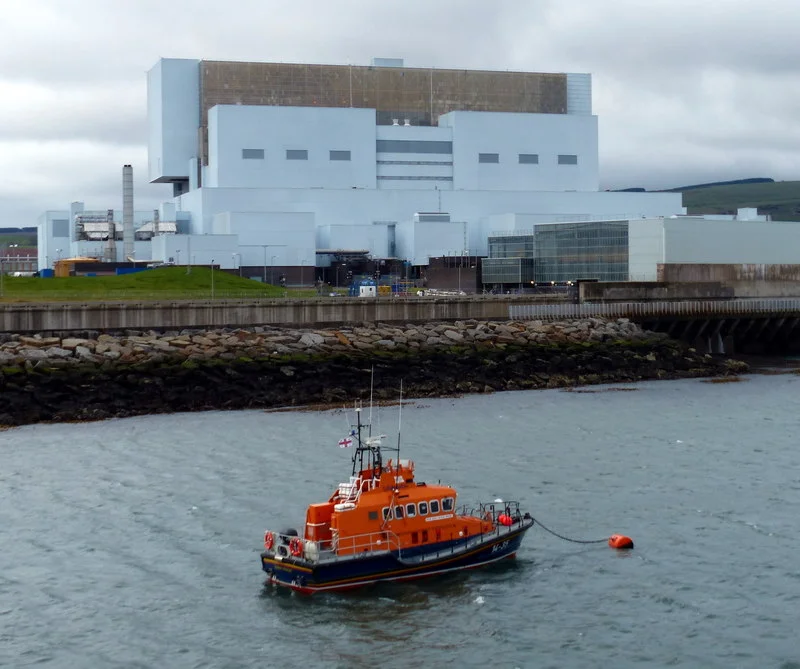

Dunbar Lifeboat Station
A bookseller in Dunbar named George Miller had, as a child, dreamed of mortar-launched lines that could reach shoreline wrecks. He kept thinking about the idea for years before George William Manby's similar apparatus made it a national technology. In April 1789, on a trip to South Shields for work experience with a bookseller there, Miller arrived in the town just weeks after the wreck of the Adventure on the Herd Sands had made South Shields the epicentre of lifeboat innovation in Britain. He came home to Dunbar fascinated and began campaigning. It took the death of a sailor in a wreck at Thorntonlock in September 1807, and a public subscription that raised more than 366 pounds, before Miller finally got a lifeboat built. By 1808, the Dunbar Lifeboat Station was open. It is one of the oldest in Britain.
The First Lifeboat
The 1808 boat was built to Henry Greathead's design, the same model the South Shields committee had chosen in their famous 1789 competition. It came to Dunbar with a boat-carriage to drag it down to the shoreline, a boathouse to keep it dry, and a Manby apparatus to shoot a line out to a stricken vessel. Five rescues by the original Dunbar lifeboat have been documented, though the records are incomplete. The largest came on 18 December 1810. HMS Pallas, a Royal Navy frigate, wrecked in the Firth of Forth in heavy weather. The Dunbar lifeboat made the run to her twice, bringing 45 men ashore. On the third trip the boat was overloaded. She capsized. Eleven men, including the volunteer crewman B. Wilson, drowned. The disaster did not destroy the station, but it did expose the limits of early lifeboat technology in storm conditions, and the station eventually closed in 1821.
Wallace and the Railways
The station was re-established in 1864 by the Royal National Lifeboat Institution, which had been founded forty years earlier under a different name and had only recently rebranded to the form by which it is still known today. The new boat was a 33-foot self-righting Pulling and Sailing design, ten oars and a set of sails. Three railway companies, the Great Northern, the North Eastern, and the North British, carried her north to Dunbar free of charge. A new boathouse cost 165 pounds to build at Victoria Harbour. The boat itself was funded by a 300-pound gift from Lady Cuninghame-Fairlie, and at her request was named Wallace. The Wallace served until 1893, with one near-disaster on 13 October 1877 when she capsized during an exercise and the volunteer crewmen R. Clements and Robert Harkes drowned. Two crew lost in training, just sixty-seven years after eleven crew lost coming back from rescuing the Pallas, made vivid what every lifeboat town already knew: the sea takes its servants as well as its strangers.
Skateraw and the Sand
Dragging a lifeboat to the water was harder at Dunbar than at most stations. The harbour at low tide could not be reached. In a storm in March 1877, when the steamship James was seen drifting toward Belhaven Bay, horses and men together had to drag the Dunbar lifeboat out across soft sand before she could be launched. By the time she reached the wreck, the vessel had grounded, but the crew of four were taken off alive. To solve the access problem, the RNLI established a satellite station at Skateraw in 1907, five miles south-east along the coast. The Dunbar crew operated both stations when called. Skateraw stayed open until 1943. Today the all-weather lifeboat is kept on a mooring 4.2 nautical miles east of Dunbar, in the bay next to Torness nuclear power station, to bypass the harbour access problem entirely.
Sir Ronald Pechell and a Storm
The 14-09 Sir Ronald Pechell Bt served at Dunbar from 1995 to 2008. Across thirteen years she launched 206 times and rescued 171 people. On the Easter weekend of 2008, severe storms snapped her moorings off the coast and drove her ashore. She was damaged beyond economic repair, a 1.05 million pound boat written off at a salvage value of 208,000. Her replacement, the 14-35 John Neville Taylor, came from the RNLI relief fleet and has been on station ever since. The current inshore lifeboat, David Lauder D-844, joined her in 2019. Both boats sit at the heart of a network of medals and citations that go back to 1827, when the Coastguard officer Randal Stap received the RNIPLS Silver Medal for rescuing the master of the sloop Brothers in March of that year. The most recent major honour is the British Empire Medal awarded in 2015 to fundraiser Kenneth John Headley for services to maritime safety.
Two Centuries of Volunteering
What survives at Dunbar Lifeboat Station today is a structure of voluntary commitment that runs in an almost unbroken line back to George Miller and his book-keeping shop in 1808. The boathouse at Victoria Harbour was rebuilt in 1901, refurbished in 1996, and still houses the inshore boat. The honours board lists names from across the past two centuries: Walter Fairbairn for the SS King Ja Ja rescue of 1905; Robert Wight for searching for divers in 1990; Gary Fairbairn for the rescue of two from the yacht Ouhm in 2009. The names on the roll of honour, the men lost serving the Dunbar lifeboat, include the eleven from Pallas in 1810 and the two from the 1877 capsize. Two centuries on, the boats and the technology have changed beyond recognition. The commitment has not.
From the Air
Dunbar Lifeboat Station sits at the Victoria Harbour in Dunbar at 56.01 N, 2.51 W, with the all-weather lifeboat moored offshore near Torness nuclear power station about 4 nm east-south-east. Edinburgh (EGPH) lies roughly 25 nm west; the North Sea is immediately north. The harbour itself is dwarfed by the red sandstone ruins of Dunbar Castle directly above it. The Bass Rock and North Berwick Law to the west, and the Torness cooling stacks to the south-east, provide reliable visual landmarks. The Firth of Forth opens to the north.
Nearby Stories
- Leith 0.8 km away
- Crail 1.4 km away
- Falkland Palace 2.8 km away
- Peebles 8 km away
- Mellerstain House 9.9 km away
- Eyemouth Disaster 11 km away
- Battle of Homildon Hill 19 km away
- River Dee Ferryboat Disaster 99 km away