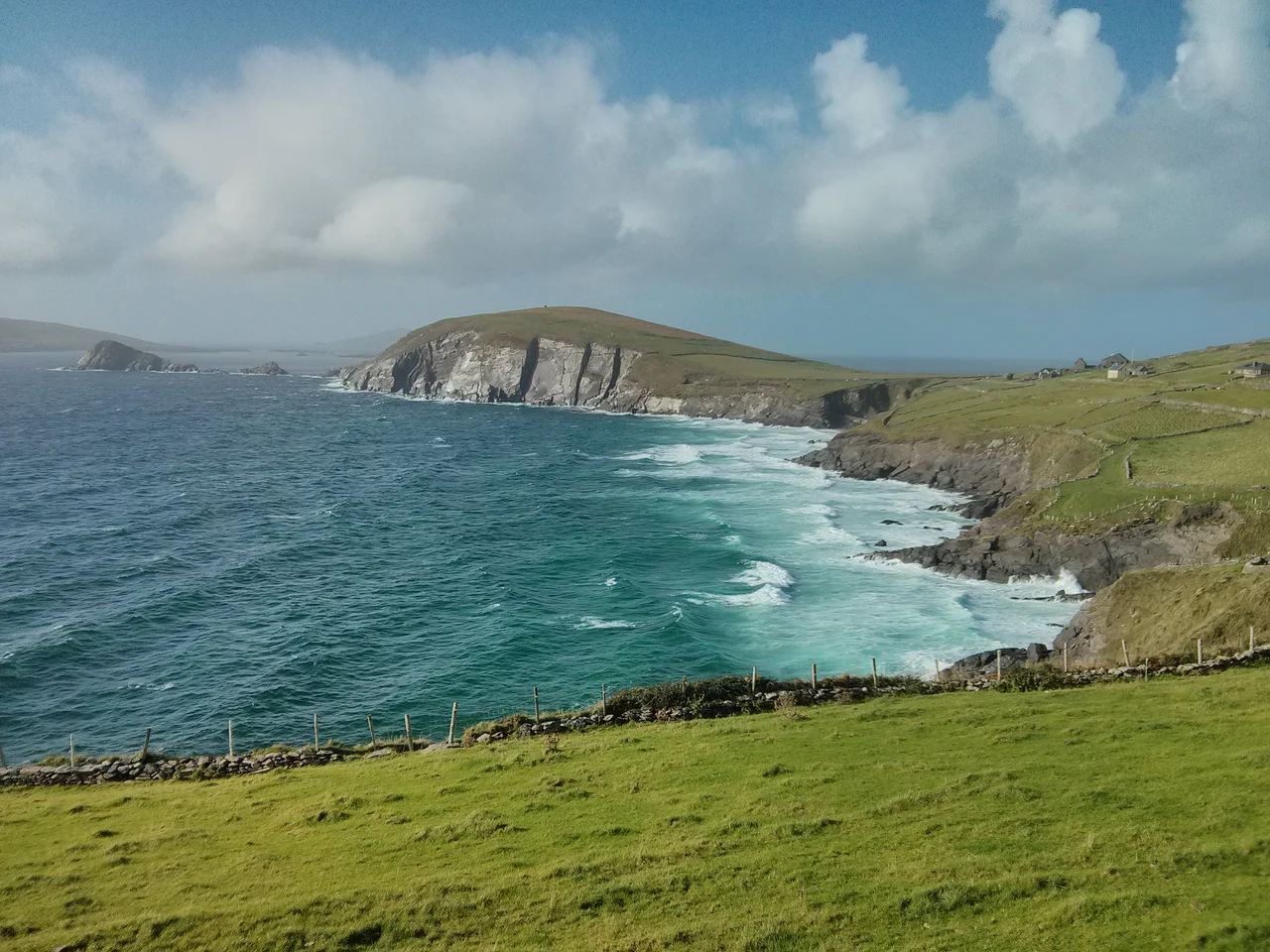

Dunmore Head
When the Star Wars sequel The Last Jedi needed a planet at the edge of the galaxy in 2017, the production crew came here. Dunmore Head is the westernmost point of mainland Ireland — and one of the westernmost points of Europe — a long, steep headland of sandstone that drops three hundred feet into the Atlantic. The sky is enormous, the wind unrelenting, the Blasket Islands a procession of dark shapes offshore. Cinematically, it stood in for the planet Ahch-To, where Luke Skywalker had retreated from the galaxy in self-imposed exile. The film crew left. The headland remained exactly the same: an immense slab of rock at the end of Europe, doing what it has done since the Devonian period.
Old Red Sandstone
The headland and the northern slopes of nearby Mount Eagle are made of cross-bedded sandstones that geologists assign to the Eask Sandstone Formation, part of what is traditionally called the Old Red Sandstone. The rock formed during the Devonian period, roughly four hundred million years ago, when this part of the world lay just south of the equator and the surface was a vast river system depositing layer upon layer of pinkish sand. Today those beds dip steeply toward the sea, exposed in the cliffs as bands of warm-toned rock that catch the late afternoon sun. The cross-bedding — the angled internal patterns where ancient river currents preserved the slope of underwater sand bars — is visible in the cliff faces.
The Westernmost Point
Mainland Ireland tapers to its absolute western limit here. There is no further to go without putting a boat in the water. The Blasket Islands lie offshore, with Great Blasket and Inishtooskert and Inishvickillane spread across the horizon like vertebrae. Beyond them: nothing, for two and a half thousand miles, until Newfoundland. The wind reflects that distance. Stand on Dunmore Head on a winter day with the gale full from the southwest and you can feel the entire Atlantic pushing against your chest. The water below works the cliff at the foot, and overhead the gulls and gannets cut into the wind on stiff wings, hardly bothering to flap.
The Wreck of the Ranga
On 11 March 1982, a Spanish container ship called MV Ranga lost power in a storm off Slea Head. The wind drove her onto the rocks at Dunmore Head, and she broke up in the surf. There was no loss of life — the crew were taken off by helicopter and the local lifeboat — but the ship itself was a total loss, and pieces of her cargo washed ashore along the beaches of the peninsula for weeks afterward. Cliffside walks here pass the spot where she went aground. The Atlantic delivers its wrecks to this coast with a regularity that the local memory has stopped finding remarkable. The Ranga is one in a long ledger that stretches back to the Spanish Armada and beyond.
Ahch-To
For the Star Wars production, what made Dunmore Head right was less the geology than the atmosphere. The headland feels remote in a way few accessible places do. Even on a clear summer day, with cars parked in the lay-by below and walkers strung out along the trail, the wind and the empty Atlantic horizon do most of the work. The film crew used the headland and the nearby Coumineole Beach for several scenes; Luke Skywalker stares west across this water in the moment before Rey arrives. After the cameras left, the area saw a modest spike in visitors. Most of them, locals report, walk to the tip, look out, and stay quiet — which is, on a headland like this, exactly the right response.
From the Air
Located at 52.11°N, 10.48°W at the westernmost extremity of mainland Ireland. The headland tapers westward toward Dunmore Head Point at a coordinate close to 10°28'W. Cliffs roughly 300 feet high on the south and west faces. Nearest airport is Kerry (EIKY), about 60 km east. Recommended viewing altitude 1,500–4,000 feet, with the Blasket Islands clearly visible offshore. Strong Atlantic winds at headland level — expect significant turbulence at lower altitudes in fresh westerly conditions.
Nearby Stories
- Ballyheigue Castle 1 km away
- Killemlagh Church 2.8 km away
- Pouldergaderry Sinkhole 6.8 km away
- Derreen Garden 11 km away
- Kilkee 59 km away
- The Laki Eruption: The Volcano That Changed World History 1366 km away
- The Northern Lights: The Sky Show That Vikings Thought Was Bridge to the Gods 1469 km away
- Sao Miguel 1935 km away