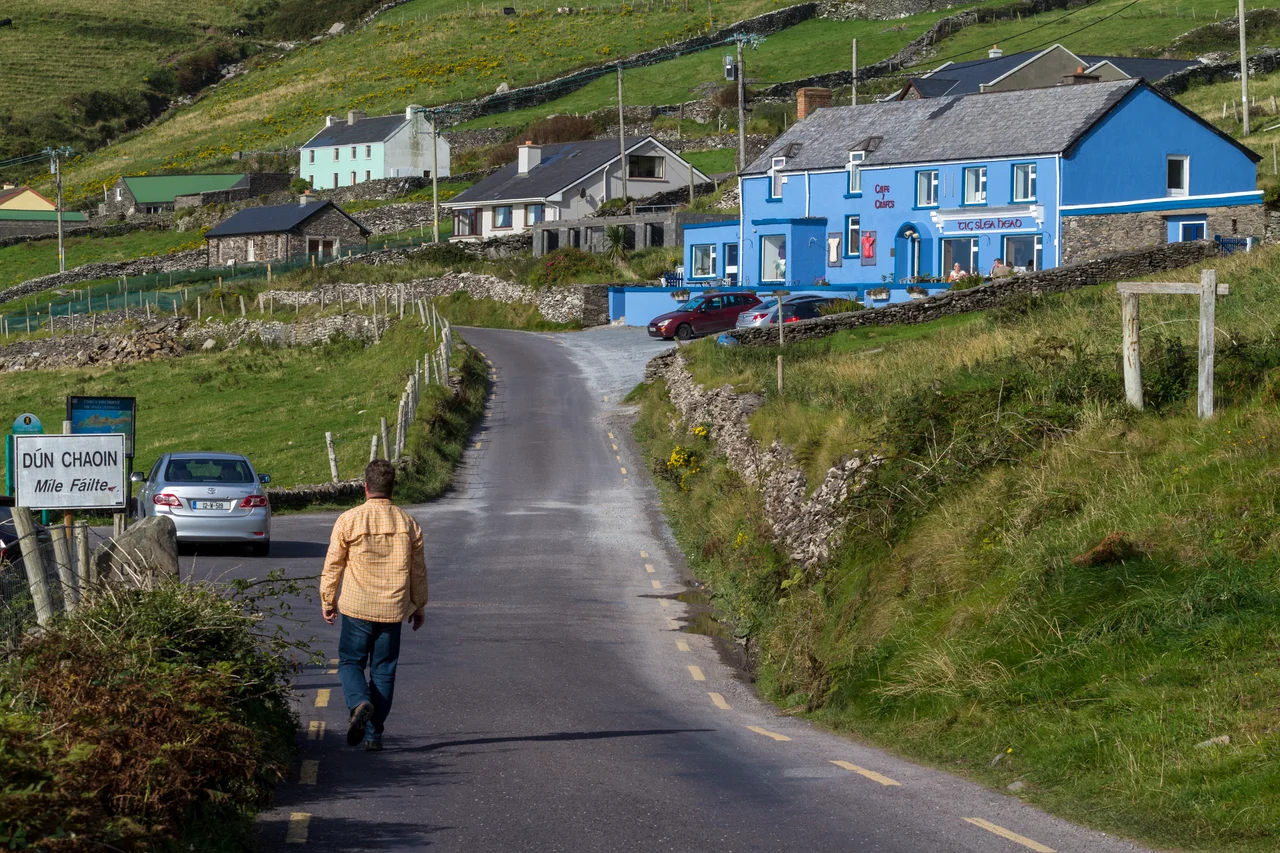

Dunquin
At ten degrees and twenty-seven minutes west, Dunquin is the westernmost settlement of Ireland and, excluding Iceland, of all Eurasia. The village clings to a slope above the Blasket Sound, looking out at islands where, in 1953, the last permanent residents were finally evacuated because the population had fallen too low to sustain life through an Atlantic winter. Below the cliffs, a vertiginous concrete path zigzags down to a pier where, in summer, a small ferry still crosses to the Great Blasket. The village above has been the setting for ethnographic films, Hollywood productions, and the founding of the British Campaign for Real Ale. Everything about this place is unlikely.
The Blasket Writers
From a population that never exceeded a couple of hundred, the Blasket Islands produced three of the great Irish-language memoirs of the twentieth century. Peig Sayers, who lived on Great Blasket and was buried in Dunquin in 1958, dictated Peig to her son in 1936 — a book that generations of Irish schoolchildren would later read, complain about, and quietly remember. Tomás Ó Criomhthain wrote An tOileánach (The Islandman) in 1929, describing the rhythms of island life through a year. Muiris Ó Súilleabháin's Fiche Blian ag Fás (Twenty Years A-Growing) came in 1933. The Blasket Centre in Dunquin tells their story, and the story of the community that produced them — and that vanished from the islands the same decade Hemingway was reading their books in Cuba.
Ryan's Daughter
In 1969 and 1970, David Lean came to Dunquin to film Ryan's Daughter, a Robert Bolt screenplay set during the First World War. A schoolhouse was built specifically for the production at Coumineole Beach, and most of the village population worked as extras, set crew, or in support roles. Lean was famously meticulous: weeks of waiting for the right light, the right storm, the right sky. The film, when it finally premiered, divided critics but transformed Dunquin. Tourism arrived in earnest. The 1968 ethnographic documentary The Village, made by Paul Hockings and Mark McCarty, had earlier captured the community in its struggling pre-film state — small farms, hand-cut turf, a marginal economy. Ryan's Daughter changed that economy, and the village it left behind.
Kruger's Bar and CAMRA
Kruger's Bar in Dunquin claims to be the westernmost pub in Europe, and in 1971 it earned a slightly unexpected place in British social history. Four young Englishmen on a holiday in Kerry — fed up with what they considered the bland industrial keg beer that was taking over the British pub trade — drank in Kruger's and decided to start a campaign. They called it the Campaign for the Revitalisation of Ale, soon renamed the Campaign for Real Ale, or CAMRA. The organisation now has around 150,000 members and is credited with saving traditional cask-conditioned ale from extinction. Its founding moment, by its own account, happened in a small Irish pub looking out at the Atlantic, several hundred miles from the nearest industrial brewery.
Star Wars and the Dingle Way
Scenes from Star Wars: The Last Jedi (2017) were filmed on the cliffs at Dunquin, with the landscape standing in for the planet Ahch-To where Luke Skywalker had retreated into exile. The village is also the western pivot of the Dingle Way, a 179-kilometre circular walking trail that loops around the peninsula. Walkers reach Dunquin near the midpoint of their journey, descend to the pier for the view, and continue north along the coast. In summer, a passenger ferry departs the steep concrete slipway for the Great Blasket — twenty minutes across one of the most dangerous stretches of water in Ireland, where Spanish Armada galleons sought shelter in 1588 and several were wrecked. A memorial on the cliffs marks the spot.
The School That Refused to Close
In the 1970s, the small national school in Dunquin — Scoil Náisiúnta Naomh Gobnait, opened in 1914 — became the centre of a national controversy. The government decided to close it as part of a programme to consolidate small rural schools. The community refused. Protest marches, sit-ins, and arrests followed. After almost three years of closure, the school reopened in 1973. It is still there. For a village of barely a hundred people, holding the line against the state for the sake of a single classroom was an extraordinary act, and the survival of the school became, for many Irish-speakers, a symbol of what could be saved when communities refused to be reasonable.
From the Air
Located at 52.13°N, 10.45°W, near the westernmost tip of the Dingle Peninsula at longitude 10°27'16"W. The village sits above Dunquin Pier, with the Blasket Islands strung along the horizon to the west and southwest. Nearest airport is Kerry (EIKY), about 60 km east. Recommended viewing altitude 2,000–4,000 feet for the village, cliffs, and the offshore islands. The famous switchback path down to the pier is most visible in low oblique light.
Nearby Stories
- Ballyheigue Castle 1 km away
- Killemlagh Church 2.8 km away
- Pouldergaderry Sinkhole 6.8 km away
- Derreen Garden 11 km away
- Kilkee 59 km away
- The Laki Eruption: The Volcano That Changed World History 1366 km away
- The Northern Lights: The Sky Show That Vikings Thought Was Bridge to the Gods 1469 km away
- Sao Miguel 1935 km away