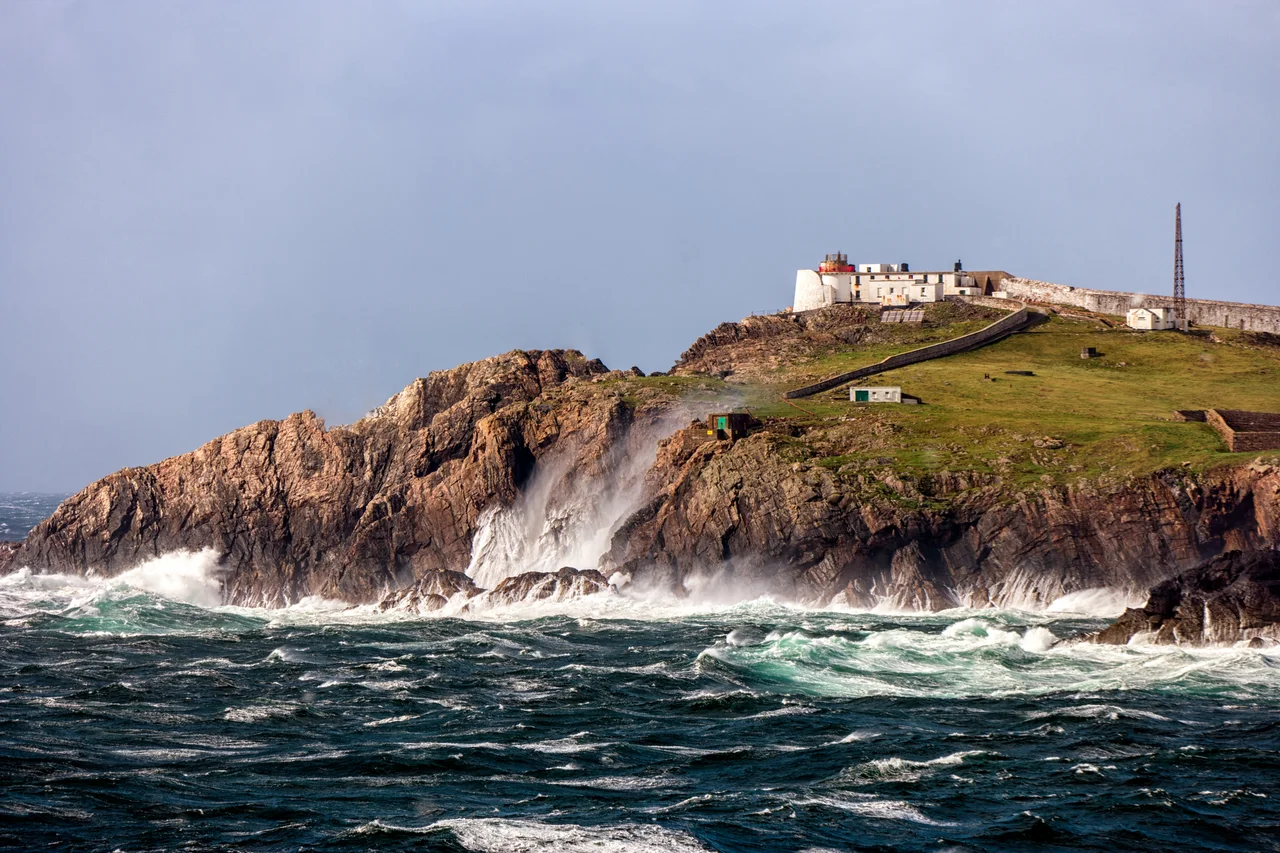

Eagle Island lighthouses
The original 1841 census of Eagle Island recorded two lighthouses and seven dwelling houses standing on a rock at the edge of the Continental Shelf. By the 1911 census, only one dwelling house was listed. The Atlantic had not stopped attacking the island in the intervening seventy years. Despite the construction of a massive storm wall to protect the lighthouses, waves came over the top and struck the lights themselves, repeatedly. It became clear, slowly and against the wishes of the families who had made a life here, that Eagle Island was not suitable for human habitation.
A Compromise on a Rock
The Eagle Island lighthouses owe their existence to a disagreement. The Coastguards had complained in the late 1820s about the conditions at Blackrock, the much higher exposed pillar of rock further south in Blacksod Bay. They wanted lights to help shipping. The Board of Irish Lights commissioned new lighthouses in 1830, but the inspector overruled the Coastguards on the location. He chose Eagle Island, off the western shore of the Mullet Peninsula, with one lighthouse to the east and another to the west of the island, 132 yards apart. The combined cost approached £40,000 in 1830 money. Their lights, both 220 feet above the sea, were aligned so that ships approaching from the east could see them as far as Broadhaven Bay, while ships from the south could pick them up in Blacksod Bay. They went into service in September 1835.
The Edge of the Shelf
Eagle Island sits just inshore of the Continental Shelf, which means the Atlantic loses its footing here. Waves that have travelled three thousand miles unimpeded suddenly find the sea floor rising under them, and they rear up before breaking. The exposure was unusual even by Irish standards. Storm waves did not merely splash; they crashed clean over the storm walls and onto the lighthouse balconies. There are accounts of glass in the lantern rooms being shattered by water and stones flung up from the rocks below. The remoteness compounded the difficulty. Supplies had to be brought by boat from the mainland, and in winter the boat often could not come. The families who lived here did not have the option of going for a walk inland.
Moving the Families Off
By the end of the nineteenth century, the impossibility of family life on the island had been accepted by the authorities. The wives and children of the lighthouse keepers were rehoused near Corclough on the mainland, leaving only the keepers themselves to maintain the lights on rotation. The two lighthouses had become one by then, the western light decommissioned. The keepers continued to live on the island for most of the twentieth century, hauling stores up the rock and tending the lamp through Atlantic gales. Their lives were a long sustained version of the work that lighthouse keepers everywhere did: methodical, repetitive, and absolutely necessary to anyone trying to come ashore alive in fog or storm.
The Last Keeper Leaves
On 31 March 1988 the Eagle Island lighthouse was made automatic. The remaining keepers were withdrawn. The light still flashes; the Commissioners of Irish Lights maintain it remotely, and ships still rely on it to fix their position when approaching the Mullet from the northwest. But no human being lives on the island anymore. The seven houses of 1841 have long since been reduced to weathered stones. The eastern lighthouse stands, painted white against the dark cliff, with the storm wall still visible at its base. From the cliffs of the Mullet, on a clear evening, you can see the light begin its rotation as the sun goes down: a single flash of constancy on a rock that the Atlantic has spent two centuries trying to drown.
From the Air
Eagle Island lies at 54.28°N, 10.09°W just off the western coast of the Mullet Peninsula. From the air, the rocky island and its white lighthouse are striking against the open Atlantic; on calm days the contrast between the island and the deep ocean shelf to the west is dramatic. Belmullet Aerodrome (EIBT) is about 12 km east; Ireland West Airport (EIKN) is roughly 85 km east-southeast. Weather here is notoriously volatile; even moderate Atlantic systems can produce wave heights that wash over the lighthouse balconies. Best photographed from offshore in steady westerly visibility.
Nearby Stories
- Achill Island 1.4 km away
- Ballycastle, County Mayo 10 km away
- Battle of Castlebar 17 km away
- Action of 7 May 1794 27 km away
- Glencolmcille 55 km away
- RMS Carinthia (1925) 84 km away
- RMS Empress of Britain (1930) 87 km away
- The Laki Eruption: The Volcano That Changed World History 1149 km away