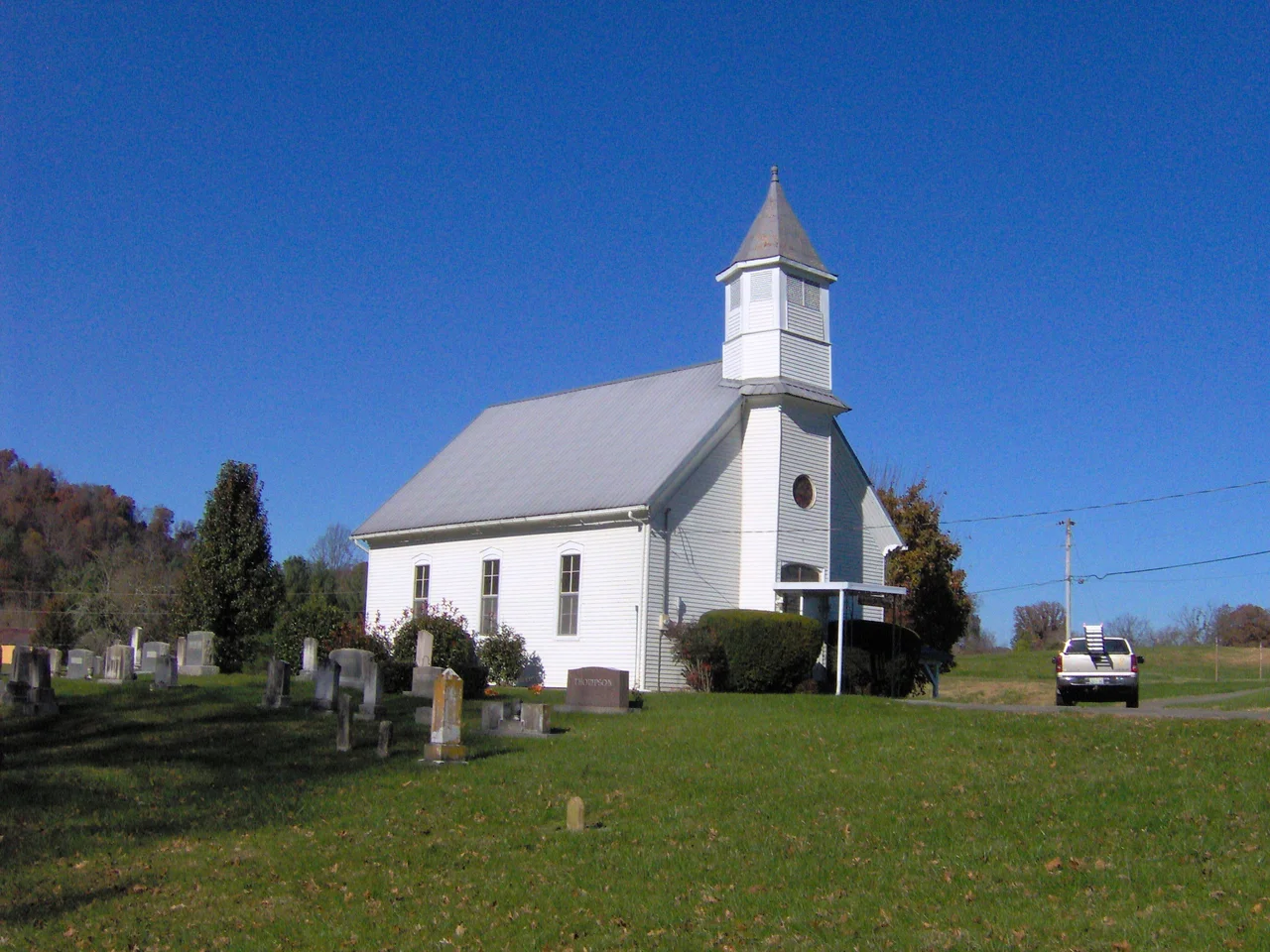

Earnest Farms Historic District
Henry Earnest arrived at this bend of the Nolichucky River sometime before 1774, when the land was still nominally Cherokee and the United States did not yet exist. His descendants are still here. The Earnest Farms Historic District covers four working farms — Elmwood, Broyles, Crum, and Jim Earnest — and the Ebenezer Methodist Church, home to the oldest Methodist congregation in Tennessee. Elmwood Farm is the state's second-oldest continuously cultivated property. The Earnest Fort House, finished in 1782 or 1783, has stone walls on the ground floor and V-notched log construction above, built thick enough to withstand frontier raids that the Watauga and Nolichucky settlers genuinely feared. Two and a half centuries later, tobacco still grows on three of the four farms, and the bridge abutment in the Nolichucky that the Earnests built in 1903 stood until Hurricane Helene tore it down in September 2024.
A Family That Did Not Leave
Henry Earnest, born in 1732, was already farming the Nolichucky bottomlands when the American Revolution broke out. The family supported the Patriot cause: Earnest's son Felix fought at the Battle of Kings Mountain in 1780, a decisive Patriot victory in the Carolina backcountry. When Greene County was created out of Washington County, North Carolina in 1783, Henry Earnest served as its first tax assessor. His son Henry Earnest Jr. represented the county in the Tennessee state senate from 1811 to 1813 and became a founding board member of Tusculum College when it was chartered in 1818. Tusculum is the oldest college in Tennessee. The Earnests' civic involvement in the founding of nearly every local institution — county government, college, church — meant their farms were never just farms. They were the physical center of how a community organized itself out of frontier into something more settled.
The Fort House, the Bridge, and the I-House
The Earnest Fort House was finished in 1782 or 1783. Its first-story walls are limestone block, thick enough to repel small-arms fire; the upper two stories are logs joined with V-notches. It was added to the National Register in 1978 in its own listing, before being incorporated into the district. The Henry and Peter Earnest House began as a rear wing built by Henry around 1800. In 1820, Peter Earnest added a Federal-style brick front facade, creating the I-house silhouette that Southern farmsteads kept building for the next century. A separate two-story brick smokehouse went up the same year, later repurposed for milk storage when the family experimented with dairying. A Colonial Revival portico was added in the 1920s. The Earnest Bridge Substructure — a stone pier rising from the river just west of the modern TN-351 crossing — was built in 1903 using stones recycled from the 1869 toll bridge that Peter Earnest had originally established in the 1850s to connect the farms to the East Tennessee and Georgia Railroad. Helene's flood destroyed the abutment in September 2024.
The Slave Quarters in the Rear
When Peter Earnest expanded the family house in 1820, he added a smokehouse and slave quarters to the rear. The National Register documentation names this directly. Enslaved people farmed this land, built these outbuildings, and kept this household running for the decades before the Civil War. East Tennessee was Unionist territory — Greene Countians voted 2,691 to 744 against secession in June 1861 — but Unionism and slaveholding were not mutually exclusive in this part of the South. Some of the most prosperous Unionist families owned enslaved workers, including the Earnests. Acknowledging this is part of reading the property honestly. The brick that Peter Earnest had laid was almost certainly fired and stacked by enslaved hands. The smokehouse where bacon was cured to feed everyone on the farm was operated by people who were not free.
Tobacco, Dairy, and the Long Decline
After Emancipation and the war, the Earnest farms survived mostly intact, though the local economy was wrecked. The toll bridge was rebuilt in 1869 and again in 1903. The Broyles family bought the Henry Earnest Jr. properties in 1903 and, in the 1940s, tried to convert the operation to dairy farming to take advantage of a Pet Milk condensing plant in Greeneville. The dairy venture failed — small mountain farms could not match the consolidation pressures of mid-century agriculture — and the Broyles, Elmwood, and Crum farms turned back to tobacco, which is still their chief crop. The Crum Farm, developed in the 1920s, includes a board-and-batten chicken coop whose design may have been based on extension publications from the University of Tennessee. The Jim Earnest Farmstead, a separate property inherited through Felix Earnest's line, centers on a three-story 1880 Folk Victorian house with an Italianate-influenced front bay. These are not preserved museums. They are still farms, still working, still doing what families have done at this river bend for 250 years — though Helene's flooding in 2024 left scars that the community is still measuring.
From the Air
The Earnest Farms Historic District lies at roughly 36.198 N, 82.681 W along the Nolichucky River near Chuckey, in western Greene County, Tennessee, at about 1,260 feet elevation. The four farms span both banks near the TN-351 crossing. David Crockett Birthplace State Park lies directly across the river to the east. Best viewed at low altitude on clear days — the brick farmhouses, tobacco barns, silos, and the cleared bottomland fields are visible against the wooded ridges. Greeneville Municipal (0A9) is about 10 nm west; Tri-Cities Airport (KTRI) lies roughly 22 nm north-northeast. This is the Ridge-and-Valley province, with parallel northeast-southwest ridges channeling valley winds. Note: extensive flood damage from Hurricane Helene in September 2024 changed the Nolichucky channel through this reach and destroyed the historic 1903 Earnest bridge abutment.
Nearby Stories
- Black Mountains (North Carolina) 11 km away
- Holston Mountain 13 km away
- Amis House (Rogersville, Tennessee) 15 km away
- Mitchell County, North Carolina 16 km away
- The Titanic Museum: The Ship That Docked in Tennessee 24 km away
- Richmond Hill Inn 34 km away
- Cumberland Gap 39 km away
- 2016 Great Smoky Mountains Wildfires 57 km away