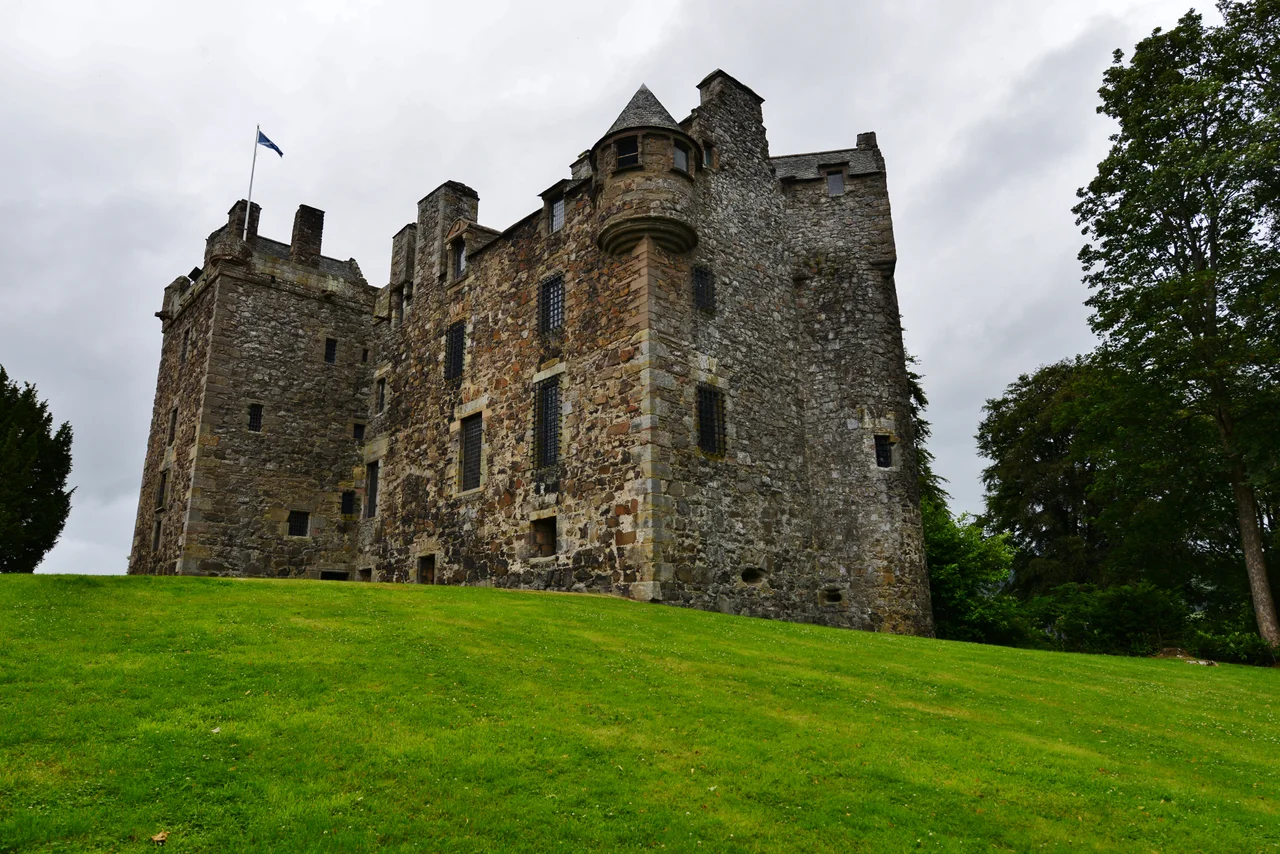

Elcho Castle
Seventeen gun loops watch the approaches, ready to repel any attacker who came up from the Tay. Step inside, and you find en suite latrines off the bedchambers - the kind of plumbing comfort a sixteenth-century laird would normally only encounter in a French mansion. Elcho Castle, four miles south-east of Perth, makes no apology for being two things at once. It was built around 1560 for Clan Wemyss as a country retreat that could, if pressed, hold its own in a fight. Most striking of all, it never had to.
A Country House With Teeth
The Wemyss family had their main seat at Wemyss Castle in Fife. Elcho was the place where the laird came to enjoy the river - a Z-plan tower house with a great square tower at one corner and three more rising from the north side. From above, the building looks like a giant letter Z laid in sandstone rubble, with overlapping fields of fire designed to leave no attacker a safe approach. Yet the south-eastern turret is a corbelled jewel-box of large windows, designed for the view, not for defence. The walls would once have been harled - rendered smooth in pale lime - but only patches survive. The parapet walkway was for strolling and admiring the Carse of Gowrie, not for archers.
The Noble Floor
Climb the great turnpike staircase and you arrive at the noble floor, where the public life of the castle played out. The main hall faces south, soaked in light from a row of generous windows. Off it sits the great bedchamber, doubling as a private reception room, with a side closet and the famous en suite latrine - a feature unusual enough that Historic Environment Scotland still flags it as a defining oddity. A long corridor connected the lower rooms; a discreet servants' staircase let cooks and pages reach the upper floors without crossing the lord's path. The castle was meant to project comfort and status to honoured guests, while quietly reminding them that the lord could shoot back if the visit went badly.
The Wedding Planner of 1589
Elcho's most consequential moment had nothing to do with siegecraft. Sir David Wemyss, the son of the castle's builder, helped arrange the 1589 wedding of James VI of Scotland to Anne of Denmark - the union that would, decades later, bring the Scottish king to the English throne. Carved beside the door are the letters E I W, thought to stand for Earl James Wemyss. Sir John Wemyss died in 1649, the same year Charles I was executed; his son David, 2nd Earl of Wemyss, became Lord Elcho but preferred the family seat in Fife. Elcho had already become what it would remain for centuries: cherished, occupied lightly, and remarkably intact.
The Riot the Grain Caused
The only time Elcho came close to burning was in 1773, during a famine. Grain was being stockpiled at the castle for export, on the calculation that hungry foreign markets would pay better than hungry Perth. The townspeople disagreed. Soldiers had to be posted to stop a riot, and the grain was eventually sold in Perth at the open market. Sixty years later, in 1830, Francis Douglas, 8th Earl of Wemyss, paid to re-roof the castle, a single act of stewardship that has kept it standing ever since. Guardianship passed to the state in 1929. In 1999, ninety apple and pear trees were planted in a new orchard against the south wall, and in 2019 the castle was a stop on the River Tay water taxis, briefly reviving the river-borne approach for which it had been designed.
From the Air
Elcho Castle sits at 56.37N, 3.35W on the south bank of the River Tay, four miles south-east of Perth. Best viewed at 1,500-3,000 ft AGL when the low sun rakes across the sandstone walls. Nearest ICAO airport is Perth (EGPT) 6 nm to the north-west; Dundee (EGPN) lies 18 nm east along the Tay. Kinnoull Hill rises just north of the river as a natural waypoint. Expect changeable lowland visibility and frequent autumn ground fog along the river.
Nearby Stories
- Drummond Castle 0.4 km away
- St Andrews 0.8 km away
- Aberfeldy 2.2 km away
- Yellowcraig 2.7 km away
- Fordell Castle 3 km away
- Battle of Sauchieburn 3.2 km away
- Battle of Dun Nechtain 3.3 km away
- Airlie Castle 13 km away