
Ellanor C. Lawrence Park
When Caroline Machen stood barricading the door of her sick husband's house against Union soldiers on August 30, 1862, she was defending a farm whose history was already long. The land had been worked by Algonquian-speaking peoples for thousands of years. It had been leased to her great-grandfather Thomas Brown in 1742 in exchange for 530 pounds of cured tobacco a year and a two-hundred-tree apple orchard. It had been bought by her husband Lewis in 1843 as a refuge from the political volatility of his job as a Senate clerk. The next day, September 1, 1862, the Battle of Ox Hill broke out in their cornfield. Lewis was still ill. Caroline kept the family alive.
The Three-Lives Lease
Willoughby Newton, an absentee Virginia planter, bought 2,500 acres around Centreville in 1739 and leased the land to tenant farmers. Thomas Brown took a so-called three-lives lease for 150 acres in 1742 - the lease ran for the lives of Brown, his wife Elizabeth, and his eldest son Joseph. Rent: 530 pounds of dried, cured tobacco per year, payable annually, plus an obligation to plant and maintain a two-hundred-tree apple orchard. Brown built his small farm into something larger; by 1776 he and his youngest son Coleman had bought outright 630 acres, including the original leased parcel. They probably built the small stone house that became Walney Visitor Center around the same time. As the Piedmont tobacco soils exhausted, the Browns shifted to wheat, corn, and rye. Thomas died in 1793. Coleman ran the farm until his own death in 1830, leaving it to the children of his daughter Mary Lewis with instructions that it be sold and the proceeds divided - but reserving his widow Elizabeth's right to live there for the rest of her life. She did, until 1840.
The Senate Clerk's Experiment
Lewis H. Machen bought 725 acres of the Brown farm in 1843 for $10,879. He was a clerk for the United States Senate - a politically precarious job, and Machen knew it. The farm was meant to be his retreat and his insurance. The Machens never sold their Washington house, so Lewis kept working in the Senate while his wife Caroline and sons Arthur and James ran the farm. Lewis was a participant in the scientific farming movement of the 1840s and 1850s. He experimented with crop rotation. He bought Peruvian guano fertilizer. He wrote long letters to his sons giving detailed instructions and kept workbooks recording every task completed, who completed it, and the weather that day. His son Arthur named the farm Walney for the walnut trees in front of the house. Arthur went to Harvard Law in 1849 and never came back as a farmer. The Machens grew oats, wheat, corn, radishes, and potatoes; raised cattle, sheep, milk cows, hogs, and chickens; and built an ice pond and ice house in 1853 to harvest their own winter ice. They hired white farmhands and rented enslaved African Americans from local slave-owners.
The War in the Cornfield
In the winter of 1861-1862, more than 40,000 Union troops camped in the Centreville area near Walney, cutting down trees for firewood, fortifications, and shelter. The Machens housed sick soldiers in their stone house and the women nursed them. In August 1862, immediately after the Second Battle of Manassas, the Union army's retreat path ran directly across the Machen farm. Soldiers stole oxen, horses, food, supplies. They plundered the stone house and tried to break into the framed house where Lewis lay ill. Caroline Machen stood at the door and refused to let them in until a passing Union officer ordered them off. The next morning, September 1, 1862, the Battle of Ox Hill - sometimes called the Battle of Chantilly - broke out partly in the Machens' own cornfield. Union generals Philip Kearny and Isaac Stevens were both killed in the fighting. The casualties came to about 1,300. Walney itself, somehow, survived the war with less damage than many neighboring farms. Lewis Machen did not survive 1863. After his death Caroline and Emmeline moved to Baltimore. James came back from Confederate service to keep the farm going.
From Dairy to Estate
James Machen rebuilt the farm after the war. In December 1874 a faulty chimney burned down the frame house where his family was living, and he moved into the stone house after restoration in 1875. By 1880 James was producing 3,000 pounds of butter a year. In 1881 he expanded into cheese. After his wife Georgie died in 1895 he began to wind the farm down. None of his children wanted to take over. He died in 1913. His children rented out the property through the 1920s, after which it sat abandoned through the early Depression. In 1935, Ellanor C. Lawrence - wife of David Lawrence, founder of U.S. News & World Report - bought the property from Machen descendants for $16,500. The Lawrences used it as a country estate. They tore down some of the original farm buildings, renovated the stone house and Middlegate (originally the Cabell's Mill miller's house), and Ellanor planted formal gardens with plants imported from Japan. They never lived in the Walney house itself - they used Middlegate as their residence.
The Park That Followed
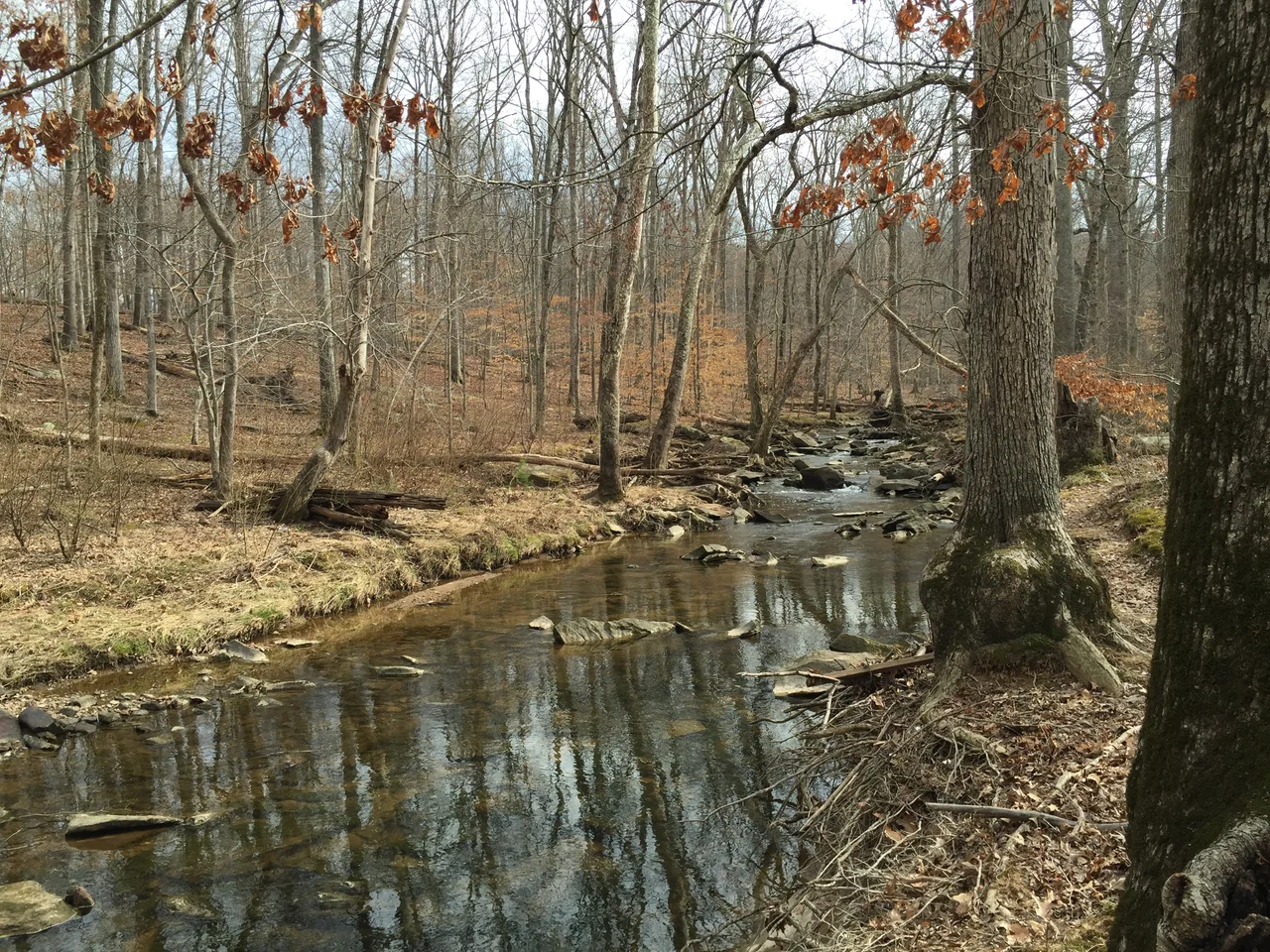
Ellanor C. Lawrence died in 1969. She left the property to her husband David with the explicit wish that he convey it to a public agency for preservation. In 1971 David Lawrence deeded 640 acres to the Fairfax County Park Authority in Ellanor's memory. The Walney Visitor Center was established in 1982 in the same small stone house the Browns probably built around 1776 - the building that had been Lewis Machen's library, James Machen's residence, and a tenant rental. Cabell's Mill, on the southeastern end of the park, was built in the 18th century and is now rented out for weddings. The park has approximately four miles of earthen trails through diverse habitats - hardwood forest, meadows, ponds, the Big Rocky Run stream corridor. The visitor center interprets eight thousand years of human use of the same ground. From the air the park sits as a green island in the dense Fairfax County suburbs, with Virginia Route 28 bisecting it and the Dulles Airport corridor visible to the west. The cornfield where Kearny was killed in 1862 is now part of the trail network.
From the Air
Ellanor C. Lawrence Park sits at about 38.85 N, 77.42 W, in Chantilly, Virginia, just north of Centreville, with Virginia Route 28 bisecting the property. Recommended viewing altitude is 1,500 to 3,000 feet AGL for a clear look at the 640-acre preserve, the small Walney Visitor Center, Cabell's Mill at the southeastern corner, and the surrounding suburban Fairfax County landscape. The nearest airport is Manassas Regional (KHEF), about 8 nautical miles southwest. Dulles International (KIAD) lies 6 nm north - watch Class B airspace carefully. The Ox Hill Battlefield Park sits about 2 nm east. Best light is mid-morning.
Nearby Stories
- Bladensburg Dueling Grounds 4.6 km away
- Monocacy Aqueduct 6.4 km away
- Howard County, Maryland 7.9 km away
- Third Battle of Winchester 8.1 km away
- Long Branch Plantation 12 km away
- Stafford County, Virginia 24 km away
- Battle of Cedar Mountain 30 km away
- St. Mary's City, Maryland 73 km away