
Enaghbeg
When Robert Gill died in January 1930 at the age of 106, his obituary appeared in newspapers across Ireland under headlines like 'Centenarian who never saw a train'. The detail seemed remarkable: he had lived his entire life in the townland of Enaghbeg, less than fifteen kilometres from Ballina railway station, and had never once made the journey to see the trains run. He came from a long line of family bone-setters, the rural specialists who reset broken limbs and dislocated joints in places where doctors were too distant or too expensive. His patients walked to him from across North Mayo. He simply never had a reason to walk anywhere himself. Enaghbeg is that kind of place: a 401-acre townland west of Crossmolina where centuries of human life have been quiet, intricate, and almost entirely off the historical record except where they erupted into court.
401 Acres, Eight Townland Borders
An Irish townland is a small thing. Enaghbeg covers 401 acres, about 1.6 square kilometres, and borders eight other townlands: Ballinlabaun, Freeheen, Gortnahurra Upper, Knockbaun, Polladoohy, Rathmore, Tobermore. The names form a kind of incantation, each one a small unit of farmland with its own ancient name and its own ancient boundaries. The townland sits just north of the N59 main road that runs from Crossmolina to Belmullet. It first appears on the Down Survey maps of 1670, which Oliver Cromwell's surveyor William Petty had drawn up to document who owned what land in Ireland after the Cromwellian confiscations. At that point Enaghbeg was held by a Protestant landlord named Andrew Ram. The 1841 census recorded 161 people living there. By 1901 the population had collapsed to 74 across just fifteen households. The famine had taken most of the rest.
Brother v. Brother
Most of what is recorded about Enaghbeg in the historical record comes from court cases, because the local press reported court cases. In October 1911, Patrick Sweeney, the executor of his father's estate, applied to evict his own brother Daniel from two pieces of land. The application succeeded. In 1926, Robert Gill sued his brother Michael Gill and his sister-in-law Anne over unpaid conacre rents on land that had originally been leased by their mother. The court ruled for Robert. In 1928, the Sweeney brothers were among a group of Crossmolina-area farmers sued for unpaid rent that had been quietly accumulating for years. The judge adjourned the case indefinitely, which probably suited both sides. These were not unusual disputes. They were the everyday legal fabric of rural Irish life: marginal land, narrow margins, complicated inheritances, and feuds that compressed and decompressed across generations of the same families.
The Open Manure Pits
In 1896, the local sub-sanitary officer Mr. Fleming visited Enaghbeg and found a large number of open manure pits scattered through the townland. He served notices on twelve households to clean them up. When he returned in July 1897, most of the pits were still there. He then served legal summonses. The records do not say what happened next. The episode is small but oddly revealing: the late-Victorian state was beginning to assert itself in the most remote parts of Ireland through public health legislation, and rural farmers were beginning to discover that the way their grandfathers had handled cow dung was now subject to fines. The manure piles were eventually moved. The bureaucracy that moved them never went away.
Donkey Trespass and Sick Calves
Among the court cases, the texture of daily disputes appears in fine detail. In January 1919, Peter Gill sued James and Martin Sweeney for ten pounds in damages caused by a trespassing donkey that had got into his fields and eaten his crops. The judge ruled against Gill. In 1930, Peter McGoff sued his neighbour Francis Kilroy over a poorly worded deed that had not specified access rights to small land parcels. McGoff lost. In 1940, the farmer James McHugh sued Jack Moran, a cattle dealer from Ballyhaunis, claiming Moran had sold him five calves that turned out to be diseased. McHugh received compensation for two. Each case is the kind of thing that defines rural life: small money, real stakes, slow grinding through the legal system, and almost always somebody walking away angry.
The Tomb and the River
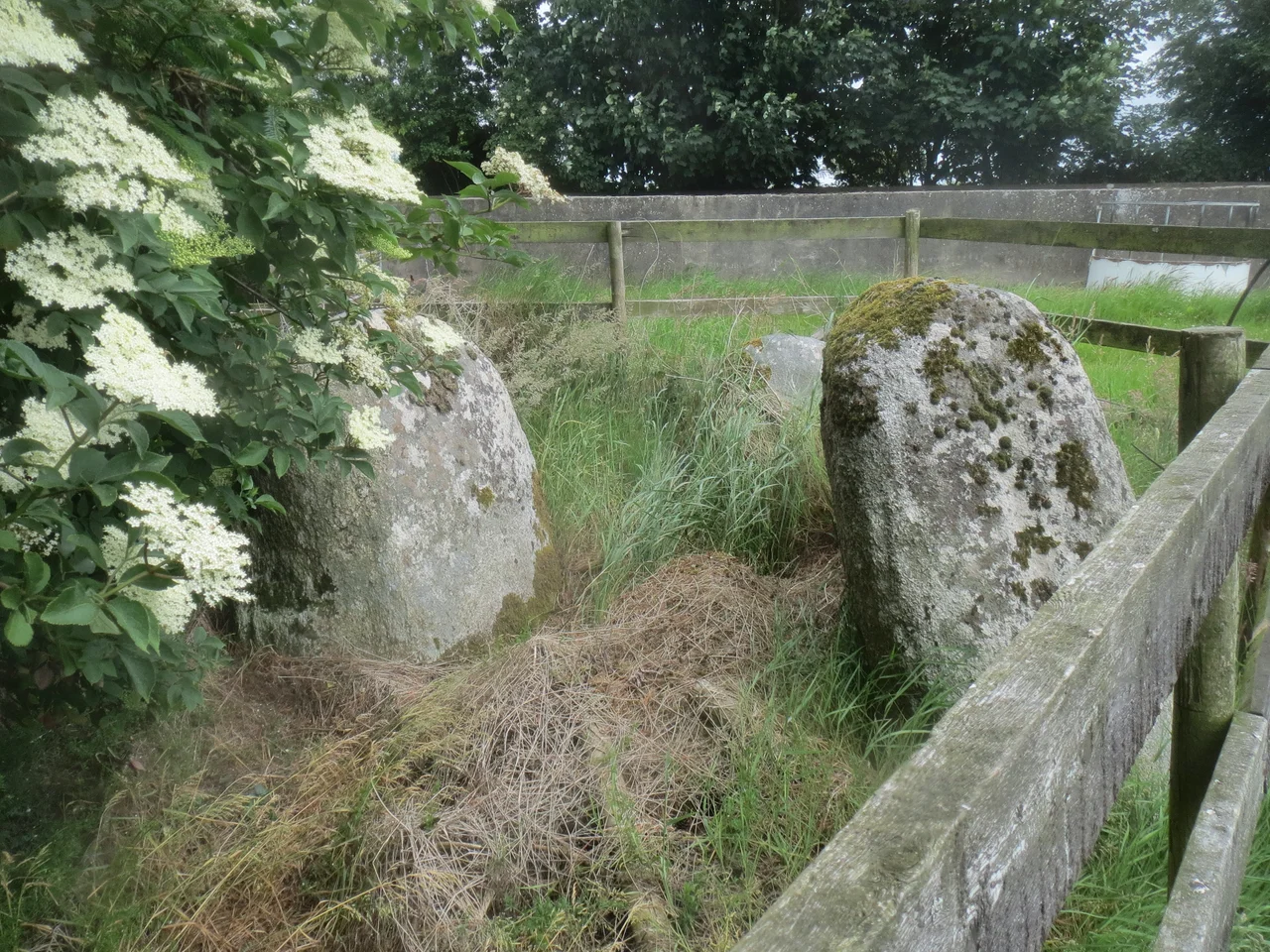
Somewhere in a field by the road that runs through the centre of Enaghbeg lies the remains of a megalithic portal tomb, several thousand years old, mostly forgotten until the National Inventory of Architectural Heritage scheduled it for inclusion in their next survey. Like so many things in this townland, it has been there longer than anyone alive, the dolmen stones gradually leaning into each other as the soil settles around them. The Enaghbeg River, a tributary of the larger Deel, runs through the land. In 1936 the residents of Enaghbeg, Pulladoohy and Rathmore petitioned Mayo County Council about flooding caused when the Irish Land Commission began draining nearby bogs and pumping the excess water into the river. The land's slope is gentle, the river's banks are low, and the same flooding still happens periodically. The bone-setter who never saw a train would have known the floods. So would his great-grandfather. The land remembers its own habits, even when the people pass through.
From the Air
Enaghbeg sits at 54.11°N, 9.37°W in North County Mayo, about 4 km west of Crossmolina and just north of the N59 to Belmullet. The terrain is gently rolling farmland with bogs to the west. Best viewed from 2,000-3,500 ft AGL. Ireland West Airport Knock (EIKN) is approximately 35 nm south-southeast. The townland has no distinct landmarks; it blends into the surrounding North Mayo agricultural landscape with Lough Conn visible to the south-southeast.
Nearby Stories
- Ballyhaunis 2.9 km away
- Ballintubber Abbey 4.2 km away
- Doohoma 6.9 km away
- Lissadell House 14 km away
- Caher Island 15 km away
- Ballymote Castle 18 km away
- Ballygilgan 50 km away
- Action of 7 May 1794 63 km away