
Endeavour Reef
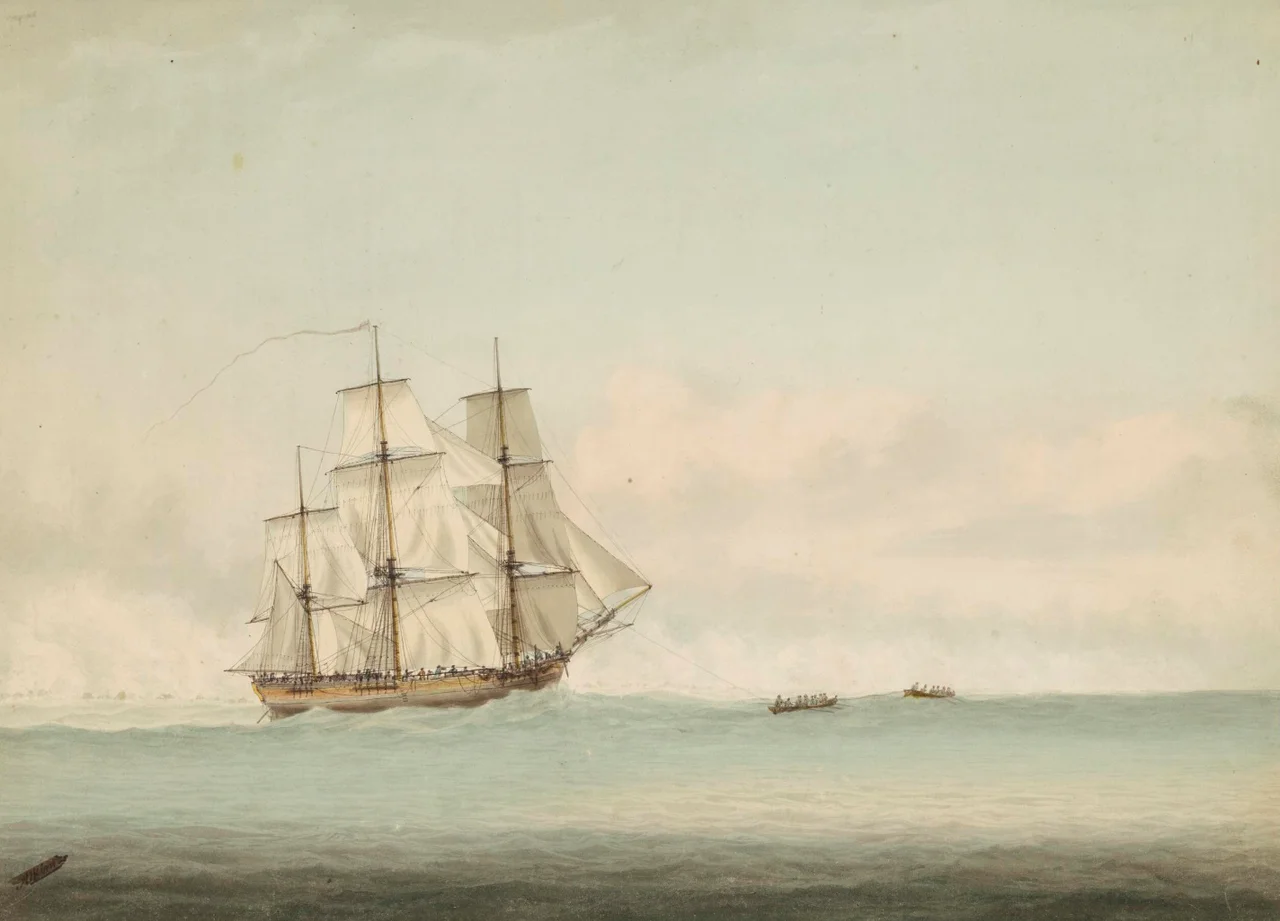
At eleven o'clock at night on 11 June 1770, the HM Bark Endeavour sailed straight onto a coral reef she could not see and stuck fast. Captain James Cook had passed Pickersgill Reef only an hour before; this one gave no warning. The ship hung on the rock with the tide falling and the sea pouring in through her shattered hull. For the next twenty-four hours, one of the most famous voyages in history balanced on the edge of disaster on a seven-kilometre shoal that would, ever after, carry the wounded ship's name. Endeavour Reef is an unremarkable patch of the Great Barrier Reef until you know what happened on it. Then it becomes one of the most consequential pieces of coral in the Pacific.
The Night on the Reef
Cook's crew did everything men can do to save a sinking ship. They worked the pumps without rest and threw overboard nearly fifty tonnes of anything heavy: ballast, casks, decayed stores, oil jars, and six of the ship's iron cannons, buoying some of the guns in the faint hope of recovering them later. The first high tide the next morning failed to lift her. It was not until the following high tide, almost a full day after the strike, that the Endeavour finally floated free. Even then she leaked badly. The fix came from a young midshipman, Jonathan Monkhouse, who had seen the trick before: a spare sail was spread on deck, smeared with chopped wool, rope fibre, and dung into a sticky mat, then drawn under the hull so the inrushing water sucked the matting into the hole. The technique is called fothering, and it worked so well that a single pump could keep the bilges dry. With that improvised plug holding, Cook nursed the ship about fifty kilometres northwest to a river mouth where he could beach and rebuild her, and named it the Endeavour River. The town that grew there centuries later is Cooktown. Monkhouse never saw home; he died of malaria in 1771 on the voyage back.
A Reef in a Field of Reefs
The reef runs roughly seven kilometres east to west, a low coral platform in a labyrinth of thousands more like it. That labyrinth is exactly the danger. The Great Barrier Reef is the largest living structure on Earth, and to an eighteenth-century navigator with no charts it was an invisible maze of stone hidden just beneath a calm tropical surface. Cook had no way of knowing how far the reefs extended or where the safe water lay. He had been threading them by lookout and lead-line for days. Striking Endeavour Reef was not carelessness; it was the near-inevitable price of being the first to sail a wooden ship through one of the most treacherous stretches of water in the world, in the dark, without a map.
The Cannons Come Home
The guns Cook abandoned vanished. Coral grew over them, swallowing iron into living rock until they were invisible from above. They stayed lost for almost two hundred years. The German diver Hans Hass searched without success in 1952, and expeditions in the mid-1960s came up empty. Then in 1969 a team from the American Academy of Natural Sciences scanned the reef with a magnetometer, matching their search to the positions on Cook's own charts, and found all six cannons along with iron ballast and the bower anchor, encased in coral. Underwater explosives freed them from the reef. After conservation, the six guns were dispersed to museums that now read like a map of the voyage's reach: the National Museum of Australia in Canberra, the Australian National Maritime Museum in Sydney, Royal Museums Greenwich in London, and the Cooktown Museum, which holds one of the cannons and the anchor a short distance from where the ship came ashore.
From the Air
Endeavour Reef lies offshore at approximately 15.778 degrees south, 145.581 degrees east, in the Great Barrier Reef about 50 km southeast of Cooktown and the mouth of the Endeavour River. From altitude in clear conditions the reef shows as a pale turquoise-and-cream shoal set in deep blue water, one shape among countless reefs and cays scattered across the shelf; the mainland ranges behind Cooktown form the western horizon. The nearest airport is Cooktown Airport (ICAO YCKN); Cairns Airport (YBCS) lies roughly 175 km to the south. Reef colours read best in the dry season, May to October, under high sun and light wind; the wet season brings cloud, haze, and reduced visibility over the water.
Nearby Stories
- Aboriginal Shire of Hope Vale 21 km away
- Mount Pieter Botte 35 km away
- Nuggety Gully Water Race and Chinese Camp 39 km away
- Grassy Hill Light 50 km away
- Byerstown 51 km away
- HMS Mermaid (1817) 134 km away
- Cyclone Yasi 206 km away
- Kapa Kapa Trail 645 km away