
Ennistymon
On the freezing morning of 25 February 1848, somebody pinned a note to the torn shirt of a barefoot boy and left him at the workhouse gate in Ennistymon. "Gentlemen," the note read. "There is a little boy named Michael Rice of Lahinch aged about 4 years. He is an orphan, his father having died last year and his mother has expired on last Wednesday night, who is now about to be buried without a coffin!! Unless ye make some provision for such. The child in question is now at the Workhouse Gate expecting to be admitted, if not it will starve." The note was signed Rob S, Constable. Michael Rice's name now appears on a memorial in Ennistymon, alongside the carved figures of a child at the workhouse door, his mother's anguished face, and the text of the note that saved or perhaps did not save him.
The Cascades and the Bridge
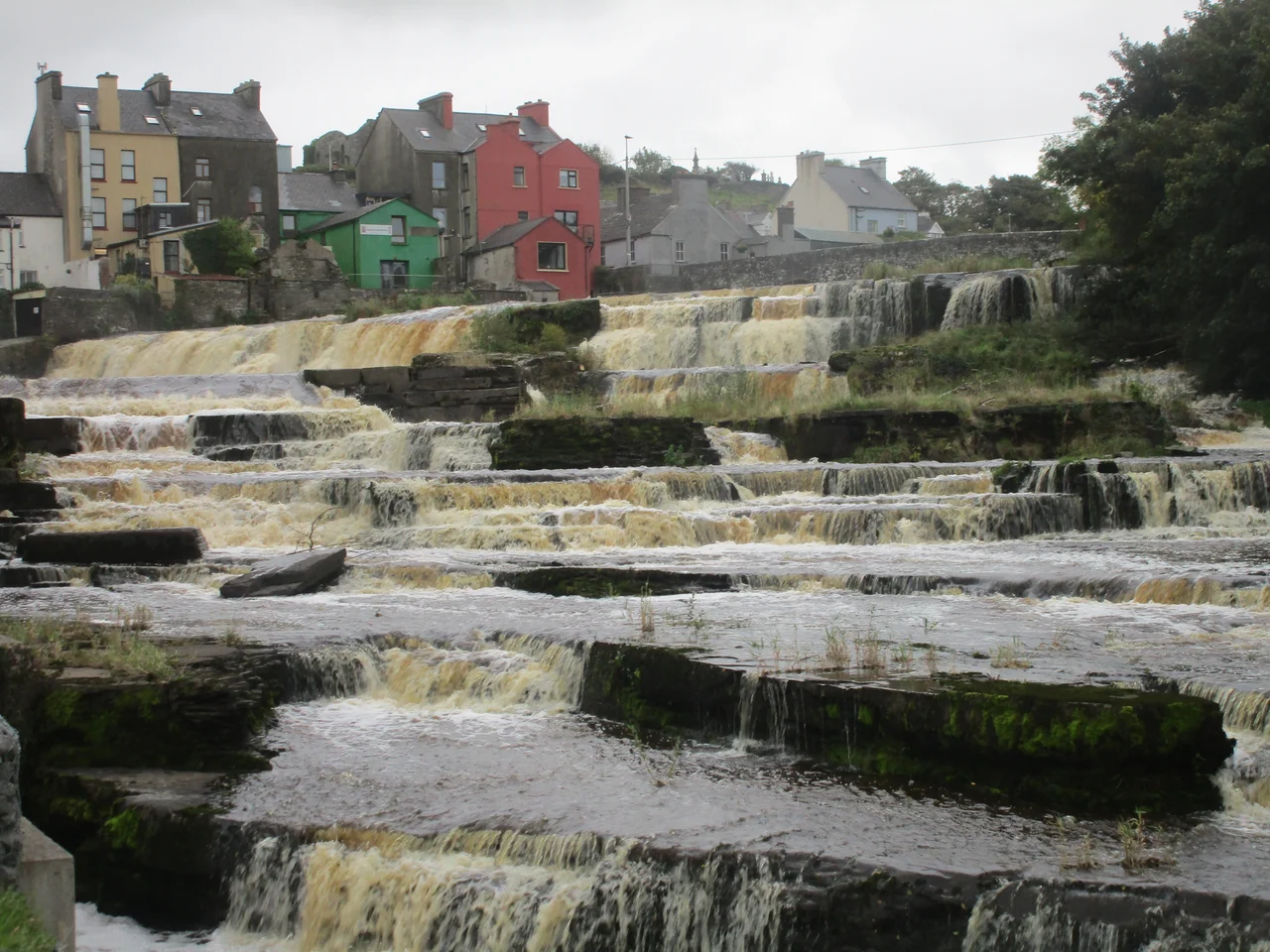
Ennistymon sits where the Cullenagh River drops over a series of small rapids - the Cascades - before becoming tidal as the Inagh River and pushing on to meet the sea at Lahinch. The water has been working at this rock for a long time. The town that grew along the river was for centuries a hamlet of three or four cabins. By 1810, Ennistymon had 120 houses, seventy of them slated. The oldest part of the town still runs along the narrow street near the bridge over the river.
The N67 (Galway-Tarbert) and the N85 (Ennistymon-Ennis) cross here. Ennistymon was once a stop on the West Clare Railway, which from 1887 connected the town to Ennis and the coastal villages running south to Kilkee. The station opened on 2 July 1887. The whole line closed on 1 February 1961. Today the nearest train is at Ennis, twenty-five kilometers away. Bus Eireann route 350 carries on the connection - Ennis, Ennistymon, Cliffs of Moher, Doolin, Lisdoonvarna, Kinvara, Galway.
The Workhouse Memorial
The Ennistymon workhouse was one of dozens built across Ireland in the 1840s to house the destitute, just in time to be overwhelmed by the Great Famine. The story of Michael Rice - the four-year-old orphan dropped at the gate with the note pinned to him - survived because someone in the workhouse copied it into the Union Minute Books, which are now in the Clare County Library archive. There were tens of thousands of children like Michael across Ireland in those years. His name survived because of the note.
The memorial that now stands in Ennistymon is the work of contemporary sculptors and carries the full text of the constable's note. One side depicts a small child standing before the workhouse door. Across from it: the head of an anguished mother, two hands clenched in frustration or grief, and the words of the note carved into stone. The note was passed forward through 175 years from a coatless winter morning to a town that decided to remember.
Reprisal at the Lehane House
Seventy-two years after Michael Rice's note, Ennistymon was burning. On the night of 22 September 1920, in reprisal for the IRA's Rineen ambush along the road four kilometers southwest of the town, British forces conducted a series of raids across the area. In Ennistymon they killed Tom Connole, the secretary of the local Irish Transport and General Workers' Union branch, and burned his home. They killed PJ Linnane, a fifteen-year-old boy. Several other businesses and homes were torched.
The local historian Aideen Carrol later described the RIC and military as having run "amok in Lahinch and Milltown Malbay in an orgy of burning and beating." The same was true here. By morning, Ennistymon's main street had several blackened shells where shops had stood. The Lehane house at Cragg near Lahinch was raided around the same time; Dan Lehane was shot dead in his doorway, and his son Patrick burned to death in the attic of the burning house. The reprisals were defended in the British House of Commons as targeting "notorious Sinn Feiners." Most of the dead had been bystanders.
Brian Merriman and the Submarine
A statue of Brian Merriman stands outside St Andrew's church, the Gothic Revival Church of Ireland built in the 1830s and converted to a cultural centre called Teach Ceoil in 1989. Merriman was an Irish-language poet and teacher whose great work, The Midnight Court, ran to over a thousand lines of comic-erotic verse in Munster Irish, completed around 1780. The poem is one of the masterpieces of eighteenth-century Irish literature. Merriman taught in this town. He is buried in the churchyard at Feakle.
John Philip Holland - the engineer who designed the first practical submarine, the USS Holland commissioned by the US Navy in 1900 - attended Ennistymon Christian Brothers Secondary School. Kootenay Brown, who emigrated and became a Canadian polymath, soldier, fur trader, and pioneering conservation advocate, was also from here. The town that gave the world the submarine and a Canadian park ranger - and a thousand-line poem of female complaint and male incompetence - now centres on a memorial to a barefoot four-year-old. The Falls Hotel, formerly Ennistymon House, is a Georgian house built on the site of an earlier castle, taking its name from the same Cascades that still tumble through the centre of town.
From the Air
Ennistymon sits at 52.94 N, 9.29 W, on the River Inagh (locally called the Cullenagh above the Cascades), about 25 km northwest of Ennis. Shannon Airport (EINN) is 55 km southeast; Galway (EICM) is 65 km northeast; Connemara (EICA) is 40 km north. Recommended viewing altitude is 1,500 to 3,000 feet AGL. The town is small and identifiable by its bridge across the Inagh and the white-water of the Cascades just upstream. To the west, the road runs 4 km down to Lahinch and the Atlantic. The Cliffs of Moher are 10 km north-northwest; the Burren limestone country starts immediately north of the town. The Rineen ambush memorial is 4 km southwest along the road to Milltown Malbay. Weather is unpredictable Atlantic - cloud bases below 2,500 feet are normal.
Nearby Stories
- Saint Macdara's Island 6.8 km away
- Limerick Institute of Technology 12 km away
- County Galway 15 km away
- 2003 Derrybrien Landslide 15 km away
- Kilrush 16 km away
- Knockmoy Abbey 20 km away
- Mace Head Atmospheric Research Station 37 km away
- Illauntannig Monastic Site 47 km away