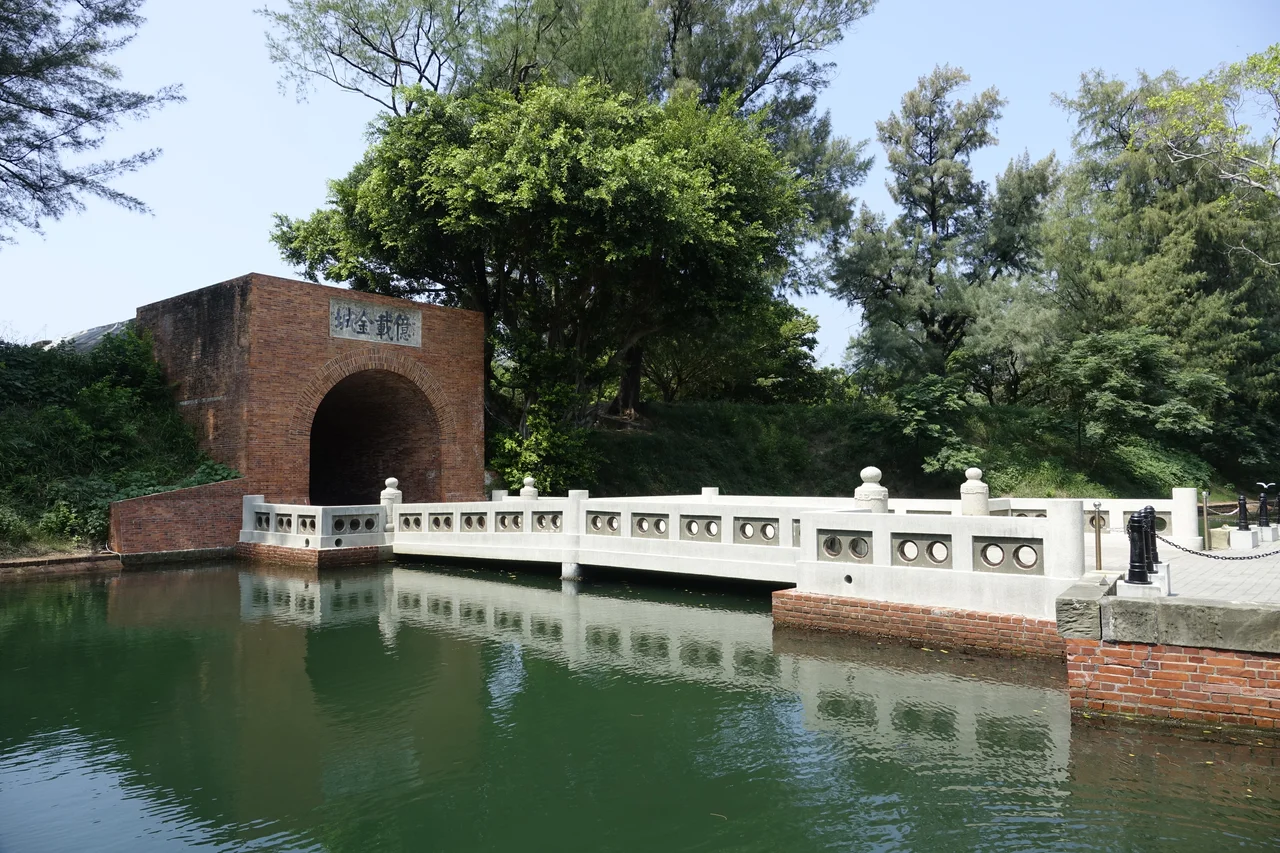

Eternal Golden Castle
The fortress was supposed to be eternal. Its Chinese name -- Yizai Jincheng, the Eternal Golden Castle -- promised permanence, and when Qing official Shen Baozhen ordered its construction in 1874, the threat it was built to counter seemed permanent too. Japan was probing Taiwan's defenses, and the island needed a modern coastal fortification. Two years of construction produced a bastion castle with a moat, cannon emplacements, and clear sight lines across the approaches to Anping harbor. It saw its first combat within a decade. But eternity, it turned out, had an expiration date.
Shen Baozhen's Answer
The Japanese expedition to Taiwan in 1874 -- ostensibly a punitive action against indigenous Paiwan people who had killed shipwrecked Ryukyuan sailors -- exposed the Qing dynasty's vulnerability on its island frontier. Shen Baozhen, dispatched to strengthen Taiwan's defenses, chose a site in Anping District for a Western-style fortification. Construction began in 1874 and finished in 1876, producing the Erkunshen Battery -- a name that never caught on the way Eternal Golden Castle did. The castle was built to European specifications, with a square bastion plan designed to eliminate blind spots and provide overlapping fields of fire. Its moat surrounded the entire structure, and its walls were thick enough to absorb cannon fire from approaching warships.
Two Wars and a Fire Sale
The castle's first test came in 1884 during the Sino-French War, when French naval forces clashed with Chinese defenders along Taiwan's coast. The Eternal Golden Castle held. Its second came in 1895, when the Qing dynasty ceded Taiwan to Japan under the Treaty of Shimonoseki. Rather than accept Japanese rule, local leaders proclaimed the Republic of Formosa and attempted to resist the invasion. Taiwanese fighters used the Eternal Golden Castle as a defensive position against Japanese battleships -- one of the few moments in history when a short-lived republic attempted to hold a fortress against an imperial navy. The resistance failed. Under Japanese control, the castle lost its military value. During the Russo-Japanese War, the imperial government sold some of the fort's cannons -- the very weapons meant to defend the island -- stripping the fortress of the hardware that gave it purpose.
Picnics in the Moat
Today, the Eternal Golden Castle has traded warfare for leisure. A park surrounds the castle grounds where families spread picnic blankets. Rental paddle boats let visitors circle the moat that once kept attackers at bay. Evening brings occasional music performances to the site, and actors sometimes fire the single remaining artillery piece -- the last cannon the Japanese did not sell -- to give visitors a taste of what the fortress was designed to do. The bastion walls still stand, their square geometry with four corner bastions visible from above, a military architecture lesson written in brick and earth. For the price of an NT$70 admission ticket, visitors can walk the ramparts where Formosan republicans once aimed cannons at Japanese warships, stand in gun emplacements that faced the Sino-French conflict, and contemplate the irony of a fortress whose occupiers sold its defenses for scrap.
From the Air
Located at 22.99N, 120.16E in Anping District, Tainan, on Taiwan's southwestern coast. The bastion fort with its surrounding moat is clearly visible from the air, forming a distinctive geometric pattern. Nearest airport is Tainan Airport (ICAO: RCNN), approximately 8 kilometers to the east. The castle sits near the coast in a park setting, distinguishable by its square bastion design with four corner bastions and water-filled moat.
Nearby Stories
- Chung Li-ho Museum 0.7 km away
- Jingzaijiao Tile-paved Salt Fields 8 km away
- Wanchin Basilica of the Immaculate Conception 9.3 km away
- Namasia District 16 km away
- Battle of Penghu 21 km away
- Shoushan (Kaohsiung) 21 km away
- Penghu Air Raids 62 km away
- Daya Bay 512 km away