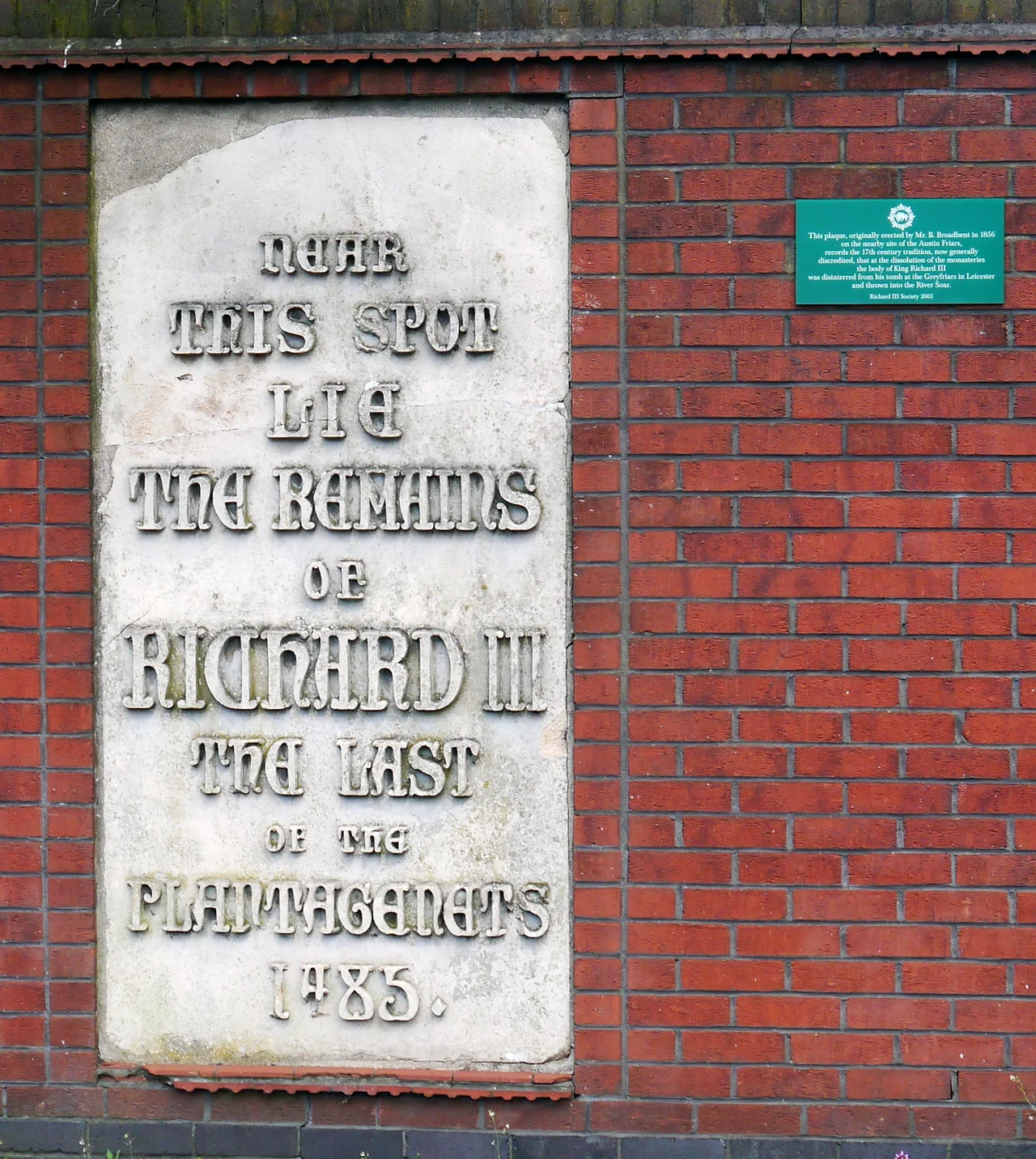

Exhumation and Reburial of Richard III
Philippa Langley walked into the Leicester City Council Social Services car park in 2004 and stopped. She had read the histories and the conjectured maps. She knew the rough position of the lost Greyfriars friary, where Richard III had been buried hastily by Franciscan monks after Bosworth in 1485. But standing on the asphalt she experienced something more pointed than reasoning - a near-physical certainty that the king lay beneath her feet, beneath a painted parking-space letter. Other people might have shrugged this off. Langley, a screenwriter and a member of the Richard III Society, spent the next eight years raising money, gathering archaeologists, fighting scepticism, and pushing for permission to dig. On 25 August 2012, the first day of excavation, a University of Leicester team broke ground. By the end of that day they had uncovered a human skeleton with a curved spine and a battle wound to the skull. The painted letter on the tarmac above the grave, the one Langley had stood on eight years earlier, was R.
A Hunch with a Trench Behind It
The dig that found Richard III was less a triumph of method than a triumph of stubbornness. Three trenches were cut across the car park; the first reached almost immediately into what turned out to be the choir of the dissolved friary church, the most likely place for a king to be buried. Within hours the team had bones. They left them in place while they finished the broader excavation. Radiocarbon dating placed the remains in the right period. The skeleton showed severe scoliosis - not the hunchback of Shakespearean caricature but the kind of curved spine that would have made the king's shoulders visibly uneven beneath his armour. There were ten wounds, eight to the head. Two of them, on the base and back of the skull, would have been quickly fatal. Mitochondrial DNA was sequenced from a tooth and compared with two living maternal-line descendants of Richard's sister Anne of York. The match held. On 4 February 2013 the University of Leicester announced the identification to a packed press conference and a watching world.
The Court Case Nobody Expected
What the archaeologists had not anticipated was the war over where to put him. York, on the basis of Richard's northern affinity and a contested claim that he had wished to be buried at York Minster, mounted a serious legal challenge to Leicester's plans for reinterment. The Plantagenet Alliance, a group of distant collateral descendants, sought judicial review. The case ran through the High Court in 2014. Three judges ultimately ruled that there was no legal basis to overturn the exhumation licence, which had specified Leicester Cathedral as the place of reburial. The judges observed - with the dryness that distinguished judges sometimes deploy in surreal cases - that 'since Richard III's death over 500 years ago, none of his collateral descendants can have any reasonable expectation of being consulted about his reburial.' Leicester would have its king.
March 2015, a Procession
The reinterment itself stretched across a full week in late March 2015 and was, by any measure, the strangest royal occasion in modern British history - a medieval king who had died at 32 in armour, mourned in a 21st-century city that had not existed in its current form when he was alive. On 22 March his coffin, built from English oak by Canadian cabinetmaker Michael Ibsen - one of the DNA-match descendants who had identified him - left the University of Leicester. The hearse drove out to Bosworth Field, paused at the place he died, and then made a slow procession back through Leicestershire villages where mourners had lined the road. Schoolchildren threw white roses. The cortege paused at Leicester's Bow Bridge, where his body had been thrown over a horse five centuries earlier on the way back from the battlefield. The actor Benedict Cumberbatch, a distant cousin via Richard's grandfather, read a poem at the cathedral service on 26 March. The Archbishop of Canterbury, Justin Welby, presided. The tomb is a raised limestone plinth with a deeply incised cross, set into the cathedral floor on a bed of Leicestershire soil.
Aftermath, Mostly Improbable
A few days after the burial, Leicester City Football Club began a winning streak that took them from the bottom of the Premier League to comfortably avoiding relegation. The following season they won the league at odds of 5,000 to 1. Mayor Peter Soulsby was not the only person in Leicester to draw a private connection between the timing of the two events. The novelist Michael Morpurgo did so explicitly in his 2016 children's book The Fox and the Ghost King, in which Richard's ghost promises the football team his help in return for being released from the car park grave. Philippa Langley's role in the discovery was dramatised in Stephen Frears's 2022 film The Lost King, with Sally Hawkins playing her. The University of Leicester was unhappy with the film's portrayal. Langley was unapologetic. The court case ended; the bones rest. The car park itself is no longer a car park: the discovery site sits beneath the King Richard III Visitor Centre, where a glass panel and a projected outline mark the place a Scottish screenwriter stood in 2004 and felt sure.
From the Air
The Greyfriars site and Leicester Cathedral lie within a single block of the medieval city centre, around 52.634°N, 1.136°W. From altitude, the cathedral's 220-foot spire is the most prominent landmark in central Leicester; the visitor centre is the smaller building immediately to its southwest. The Bow Bridge crossing of the River Soar lies about 0.4nm west. East Midlands Airport (EGNX) is approximately 15nm to the northwest. Bosworth Field, where Richard III died in 1485, lies 12nm west-southwest of the city.
Nearby Stories
- National Shell Filling Factory, Chilwell 1 km away
- Staffordshire Regiment Museum 2 km away
- Rutland Water 3.3 km away
- Grantham 4.4 km away
- Wellingborough 9.9 km away
- Croxden Abbey 11 km away
- Bordesley Abbey 14 km away
- Electric Railway Museum 17 km away