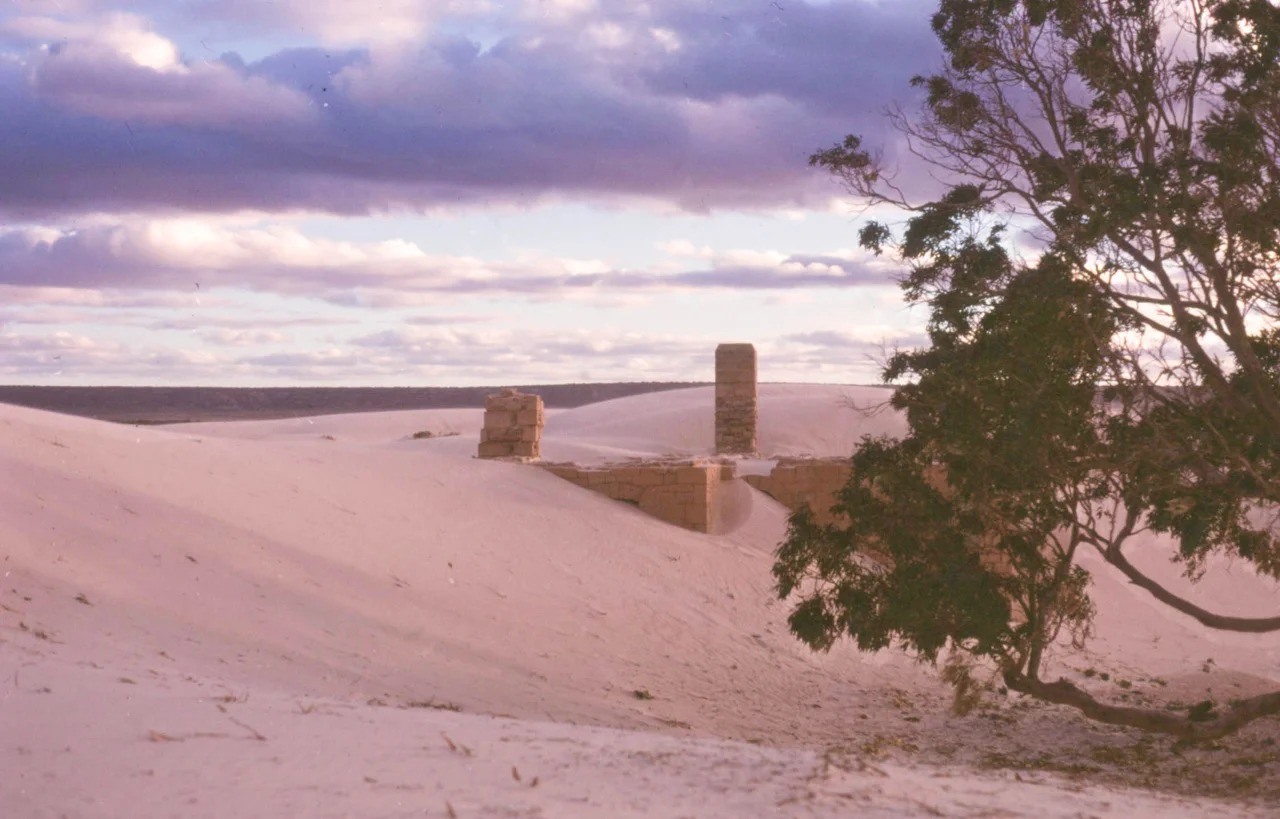

Eyre Telegraph Station
To reach it you must leave the highway and drop off the edge of the Nullarbor, easing a four-wheel drive down the escarpment and through soft sand dunes until a substantial limestone building appears where you least expect one: a wide-verandahed house with a corrugated-iron roof, standing alone in mallee scrub a stone's throw from the Southern Ocean. For thirty years messages racing between Adelaide and Albany passed through this remote room. Then the wires fell silent, and for half a century the Eyre Telegraph Station simply waited.
A Link in the Long Wire
The building dates to 1897, raised from local limestone to house a repeater station on the telegraph line strung along the coast of the Great Australian Bight between Adelaide and Albany. Telegraph signals weaken over distance, so repeater stations like this one received the faint clicks of Morse code and sent them onward, fresh and strong. It replaced a flimsier weatherboard structure that had stood since the line was first built in 1875 to 1877. A Telegraph Master and one or two assistants lived and worked here, tapping out the news of a young nation in one of the loneliest postings imaginable, where the nearest neighbours lay days away across the plain.
Where Eyre Found Water
The station stands close to a place that earned its name in desperation. In 1841 the explorer Edward John Eyre struggled along this coast on an overland crossing of some 3,200 kilometres, one of the most punishing journeys in the history of Australian exploration. Near here he found fresh water seeping at a spot now called Eyre's Sand Patch and rested for three weeks, the soak quite possibly saving his life. The telegraph station, the observatory it became, and the highway far above all carry Eyre's name. He passed through a country that nearly destroyed him; the maps have remembered him ever since.
Fifty Years of Silence
The station worked for half a century before history moved on without it. In 1927 the telegraph line was shifted some 150 kilometres north to follow the new Trans-Australian Railway, and the limestone house was abandoned to the wind and salt. For the next fifty years it decayed quietly, too remote to be looted, too solid to fall down. Its very isolation, and the shelter of the dunes against the Southern Ocean, kept it standing where lesser stations crumbled to nothing. A building can outlast the reason it was built, if it is lonely enough and made of the right stone.
A Haven for Birds and People
Rescue came in 1977, exactly fifty years after the silence began. Volunteers from the Royal Australasian Ornithologists Union, now BirdLife Australia, restored the old house with help from the Western Australian Department of Fisheries and Wildlife and the Post Office Historical Society, and turned it into the Eyre Bird Observatory, the first such observatory in Australia. It sits within the Nuytsland Nature Reserve, ringed by mallee woodland and dunes, and offers simple accommodation to those who make the rough journey in. The setting is extraordinary for birdlife: well over two hundred species have been recorded across this stretch of coast. A relay station for human messages became a place to listen, instead, for birds.
From the Air
The Eyre Telegraph Station lies at 32.23°S, 126.30°E on the remote south coast of Western Australia, below the Nullarbor escarpment within the Nuytsland Nature Reserve and roughly 49 km south of the Cocklebiddy roadhouse on the Eyre Highway. From the air look for the contrast between the pale limestone plateau and escarpment to the north and the belt of coastal sand dunes and Southern Ocean shoreline to the south; the station sits in the mallee and dunes near the water, accessible only by four-wheel drive. The nearest highway airstrips are at Cocklebiddy and Caiguna to the north-west. Expect strong, clear coastal light and high visibility, with sea breezes off the Great Australian Bight and the surf line as your most reliable landmark.
Nearby Stories
- Madura, Western Australia 14 km away
- Caiguna Airport 35 km away
- Madura Station 43 km away
- Arubiddy Station 48 km away
- Baxter Cliffs 100 km away
- Rawlinna Station 120 km away
- Point Culver 165 km away
- Great Australian Bight 294 km away