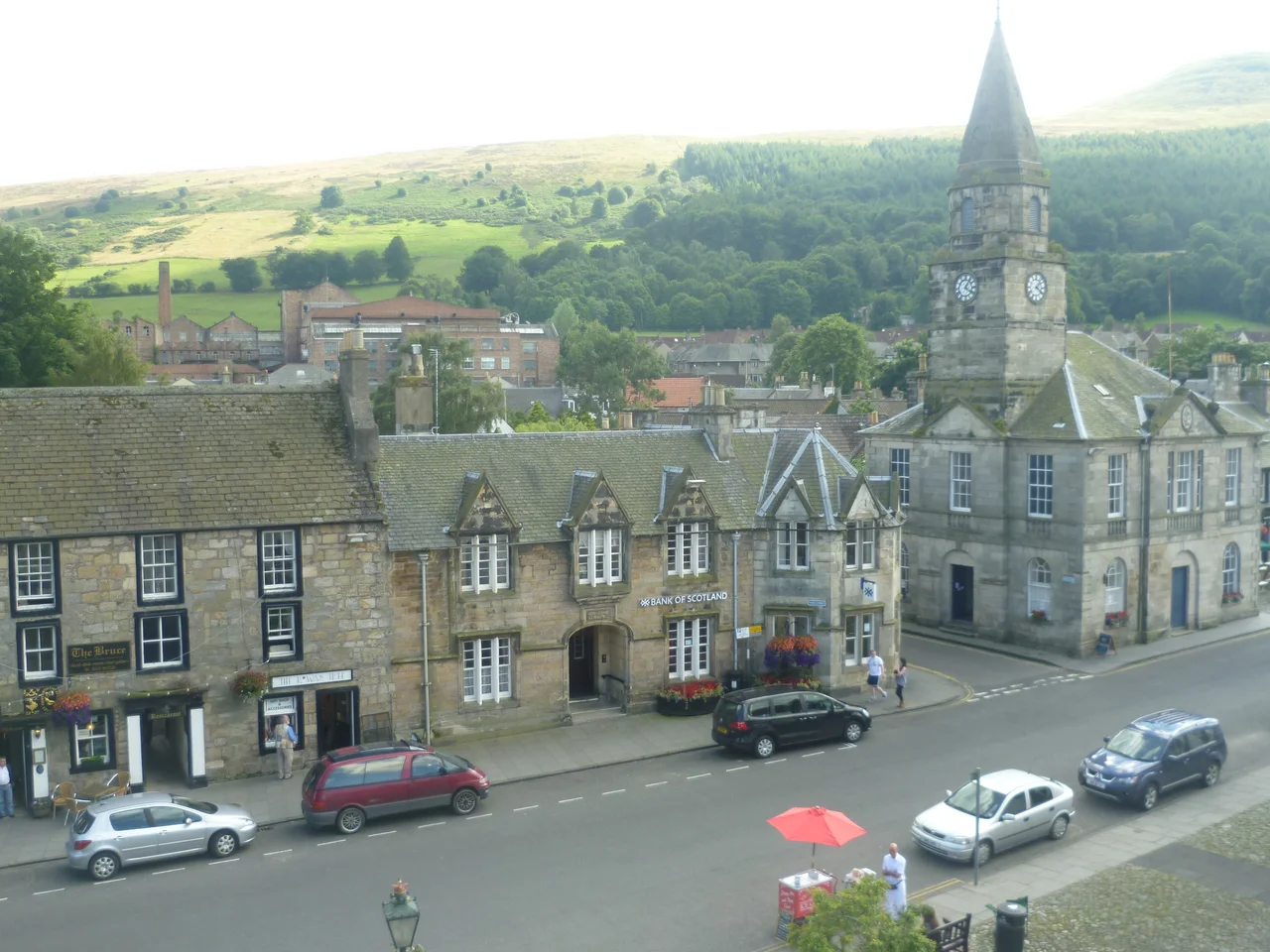

Falkland, Fife
James V of Scotland had a tennis court built in 1539. He played a game now called real tennis: an ancestor of modern lawn tennis, with sloped roofs and angled walls instead of a net, played on stone floors in courts that look more like rooms than fields. His court at Falkland Palace is still there. It is still being used by the Falkland Palace Royal Tennis Club. It is the oldest tennis court in the world that is still in active use, and the only active real tennis court anywhere without a roof. The village it sits in has just over a thousand residents. Almost five centuries later, you can still hear the ball thud against the same stones the king's racquet found.
Falleland and Kilgour
The name is older than it looks. The earliest forms, Falleland in 1128 and Falecklen in 1160, suggest Gaelic or Pictish roots. The second element is the Gaelic lann, meaning an enclosure. The first element is uncertain: it could be falach, hidden; failc, wash; or falc, heavy rain. Later folk etymologies tried to derive it from falcon land or folkland. These were wrong. In the Middle Ages the name Falkland applied only to the castle that had been raised here some time after 1160. The burgh and parish were known as Kilgour, which probably means the church or cell of Gabran. When King Malcolm IV donated the royal hunting estate to Duncan, Earl of Fife in 1160, the castle that replaced any earlier hunting lodge became the focal point of the settlement around it. Falkland Castle sits now under the grounds of the later Falkland Palace.
The Renaissance Palace
Falkland Palace, begun in 1500 by James IV, is generally considered the best example of French-influenced Renaissance architecture in Scotland. The kings came here to hunt in the surrounding forests of the Lomond Hills. Mary, Queen of Scots was a frequent visitor: as a child, as an adult, as a queen who loved the place. The palace had its own Roman Catholic chapel where mass was said. James V built the tennis court in 1539 and added Renaissance facades that imported the latest French taste into Fife. In July 1591 an African servant of Anne of Denmark was buried in the kirkyard at Kilgour. The presence of an African woman in the Scottish royal court of the 1590s, in a parish church record from a small Fife village, is one of those small surviving facts that complicates the standard story of who lived in early modern Scotland.
Fire and Neglect
In 1654, Oliver Cromwell's troops were occupying Falkland Palace. A fire broke out. It destroyed the East Range. The royal court never returned to Falkland after 1665. For nearly two centuries the palace and the village were neglected. Roofs collapsed. Stones were quarried for other buildings. Then, in the late nineteenth century, John, Marquess of Bute, inherited much of the land. He employed the architects John Kinross and Robert Weir Schultz to begin a long programme of restoration, both of the palace and of a considerable proportion of the village around it. Falkland became, eventually, Scotland's first conservation village. Today the palace and gardens are open to the public through the National Trust for Scotland. The village still has buildings with category-A listed status, including Brunton House, Moncrief House, the Town Hall, the House of Falkland, and the palace itself.
Inverness in Outlander
If parts of the High Street look familiar from a recent TV production, that may be because Falkland was used as the 1940s and 1740s town of Inverness in the series Outlander. The producers needed a Scottish burgh whose architecture had survived the twentieth century intact. Falkland's conservation status, the result of Bute's late-Victorian restoration, made it ideal. Tourists who arrive looking for Inverness instead find Falkland; the locals have learned to be patient with the disorientation. The Bruce Fountain in the centre of the village is one of the most-photographed spots. The streets curve as medieval streets do. Most of what you see is restored rather than original, but the restoration was careful, and the result is one of the best-preserved royal burghs in Scotland.
Johnny Cash's Cousins
Johnny Cash, the American country singer born in 1932 to a poor farming family in Arkansas, traced part of his paternal ancestry to this district of Fife. The Cash name in this area runs back centuries. When Cash and his daughter Rosanne researched the family lineage, the trail led here. Rosanne Cash headlined the 2010 edition of the Big Tent, an environmental festival held in the grounds of Falkland Estate, organised by the Falkland Centre for Stewardship. The Proclaimers headlined the 2012 edition, the last year the festival ran in that form. Since 2016 the village's main yearly event has been the Craft Symposium, which celebrates traditional craftsmanship through talks, workshops, and tours. The Falkland Cricket Club, founded in 1860, is the oldest in Fife. The St Margaret Pilgrim Journey, the long-distance walking route across Fife, now includes the parish church as a Destination Hub.
From the Air
Falkland sits at 56.25 deg N, 3.20 deg W, in central Fife at the foot of the Lomond Hills, twenty-two miles north of Edinburgh across the Firth of Forth. From the air, the Lomond Hills' twin peaks (West Lomond at 522 metres and East Lomond at 424 metres) are the dominant landmark to the north; Falkland Palace's gatehouse and gardens are the largest structure in the village. Edinburgh Airport (EGPH) is twenty-four miles south. The Forth bridges and the city of Dundee (about twenty miles northeast) are useful orientation references. Best viewed from 3,000 to 5,000 feet.
Nearby Stories
- Caldercruix 1.2 km away
- Cambuskenneth Abbey 5.3 km away
- Fingask Castle 5.4 km away
- Yester Castle 6.4 km away
- Battle of Rullion Green 7.5 km away
- Carnoustie Golf Links 9.3 km away
- Yellowcraig 11 km away
- Taymouth Castle 20 km away