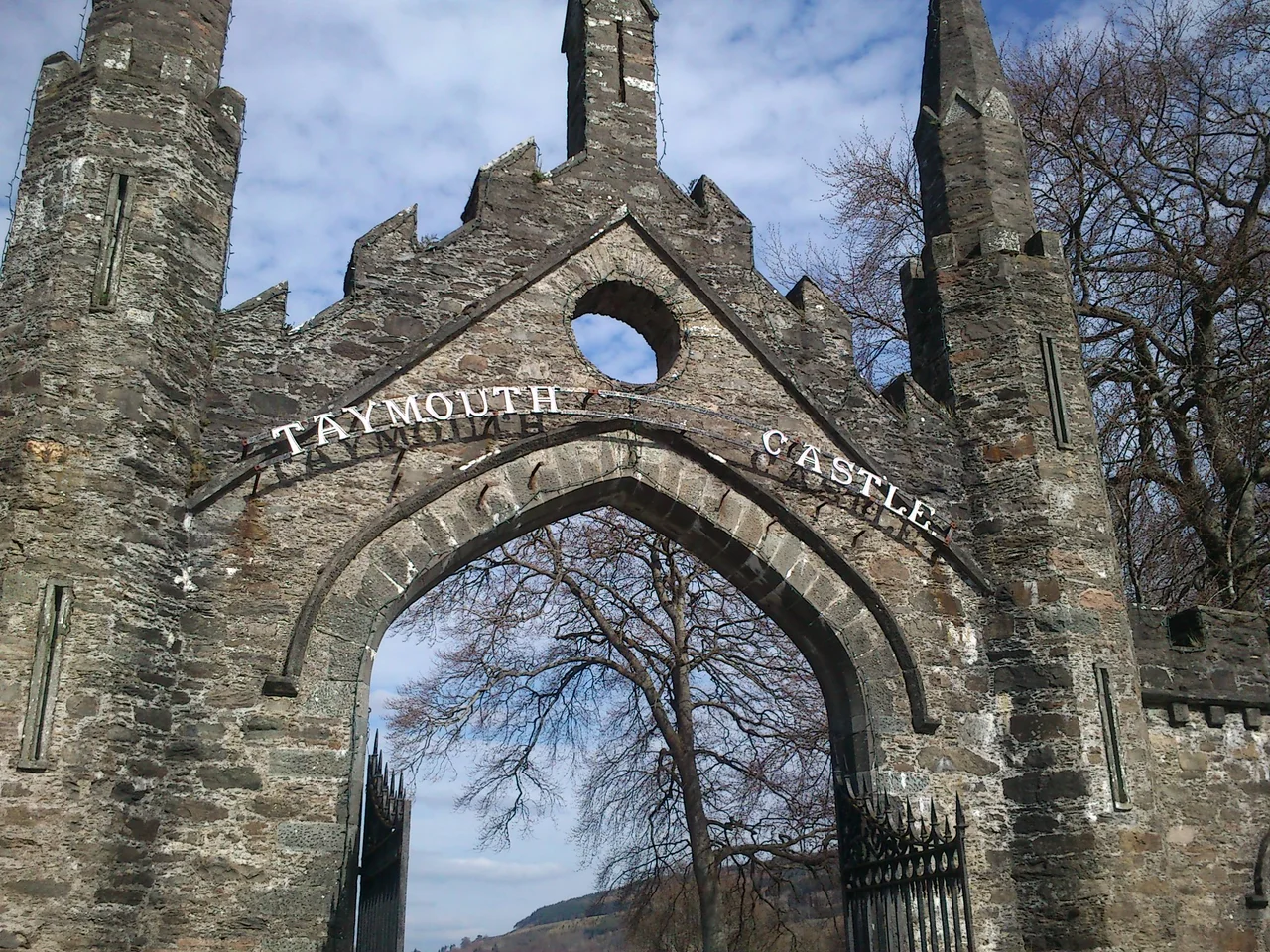

Taymouth Castle
In 1842 the young Queen Victoria was greeted at Taymouth Castle by over two hundred armed Highlanders and a royal salute from heavy guns. That night, fifty thousand lamps were lit on the slope outside the castle, arranged to spell out the words Welcome Victoria and Albert. Her host, the 2nd Marquess of Breadalbane, spent £60,000 on the three-day visit. Twenty-four years later, after her husband had died, Victoria came back anonymously and wrote in her journal that she gazed on the scene with deep inward emotion. The castle that produced this kind of theatre had taken centuries to build, and would spend the next century and a half being hospital, hotel, military training centre, and ruin in waiting.
The Campbell Inheritance
Taymouth stands on the site of Balloch Castle, built in 1552 by Sir Colin Campbell of Glenorchy, known as Grey Colin. According to legend, Grey Colin chose the spot in a dream that told him to build wherever he first heard a blackbird sing as he walked the Tay. His son Sir Duncan, nicknamed Black Duncan, was MP for Argyllshire, 1st Baronet Campbell of Nova Scotia, and was held responsible for getting most of the leaders of Clan Gregor killed or hanged after King James VI outlawed the entire MacGregor name in 1603. Black Duncan's beheading axe was kept on display in the castle until 1922. The early Campbell rulers were powerful, feared, and prepared to be unpleasant about it.
Slippery John and the Glencoe Massacre
John Campbell, 1st Earl of Breadalbane and Holland, inherited in 1677 and earned the nickname Slippery John. In 1692 he played a key role in arranging the Massacre of Glencoe, where soldiers under government orders murdered members of the MacDonald clan who had given them hospitality. He instructed a relative, Robert Campbell of Glenlyon, to carry the killings out. A government agent named Mackay later described Slippery John as having the gravity of a Spaniard, the cunning of a fox, the wisdom of a serpent, and the slipperiness of an eel. Once given £20,000 by King William III to bribe Highland chiefs into peace, he kept the money and brokered peace anyway, telling the auditors: the money is spent, the Highlands are at peace, and that is the only way of accounting among friends.
The Gothic Pile
In 1806 the 1st Marquess of Breadalbane demolished Balloch and began building Taymouth in its place. The architects were the Elliot brothers, working in neo-Gothic on a vast scale. Francis Bernasconi, then the most celebrated plasterworker in Britain, created the central staircase that connects all four storeys of the central tower. Ceilings were painted by Cornelius Dixon. The 2nd Marquess kept building, remodelling the west wing with James Gillespie Graham and interiors by A. W. N. Pugin, the architect best known for the interiors of the Palace of Westminster. Historic Scotland calls the west wing ceilings the finest of their period in the UK. The 2nd Marquess also reintroduced the capercaillie to Britain in 1837 and 1838, after the original Scottish population had gone extinct around 1785. He brought 28 birds from Sweden; the current British population descends from them.
Polish Hospital and Nuclear Bunker
From 1940 to 1948, Taymouth was the No. 1 Polish General Hospital, treating thousands of wounded Polish servicemen. After the battle of Monte Cassino in 1944, over two hundred Polish casualties arrived in a single influx. At its height the castle held 1,200 beds and 200 staff. After the Polish patients left, the castle became a Civil Defence training centre, complete with a mock blitzed village built and partially demolished for practical rescue training. Walls gaped open, timber beams were scorched with fire, roofs lay at drunken angles. Trainees were given advanced instruction in atomic, chemical, and biological warfare. From 1968 the castle was also one of the locations designated under plan PYTHON, the top secret scheme for continuity of government in the event of nuclear attack.
Empty, and Then Not
Taymouth went dark around 1982 and stayed that way for almost forty years. Madonna and Cher were both reported to be interested in buying it during the 1990s. In 1995 it was on the market for £5.5 million. Ownership passed through offshore companies and at one point appears to have been held by Ali Ibrahim Dabaiba, former chief of development under Muammar Gaddafi, in connection with what the post-Gaddafi Libyan government called theft of state funds. A Scottish attorney named Stephen Jones was eventually convicted of diverting money intended to purchase the castle. The Arizona-based Discovery Land Company finalised ownership in 2019 and completed restoration in November 2024, dividing the main structure into nine suites for shared ownership members of what is now a luxury private members' club.
From the Air
Located at roughly 56.59 N, 4.00 W in the heartland of the Grampian Mountains, on the south bank of the River Tay, about 1 mile from Loch Tay. The estate covers 450 acres. The village of Kenmore lies just south-west. Best viewed at 3,000-5,000 feet AGL; the castle's blue-grey stone, central tower, and the long avenues of lime trees on the river bank are unmistakable. Nearest major airports: Glasgow (EGPF) about 50 miles south-west, EGPN (Dundee) about 40 miles east, Edinburgh (EGPH) about 55 miles south-east.
Nearby Stories
- Doune 6.7 km away
- Ben Lomond 7.7 km away
- Lochleven Castle 9.4 km away
- Lochaber Narrow Gauge Railway 10 km away
- Scone Abbey 11 km away
- Battle of Dalrigh 12 km away
- Battle of Dalnaspidal 13 km away
- Lochnagar 26 km away