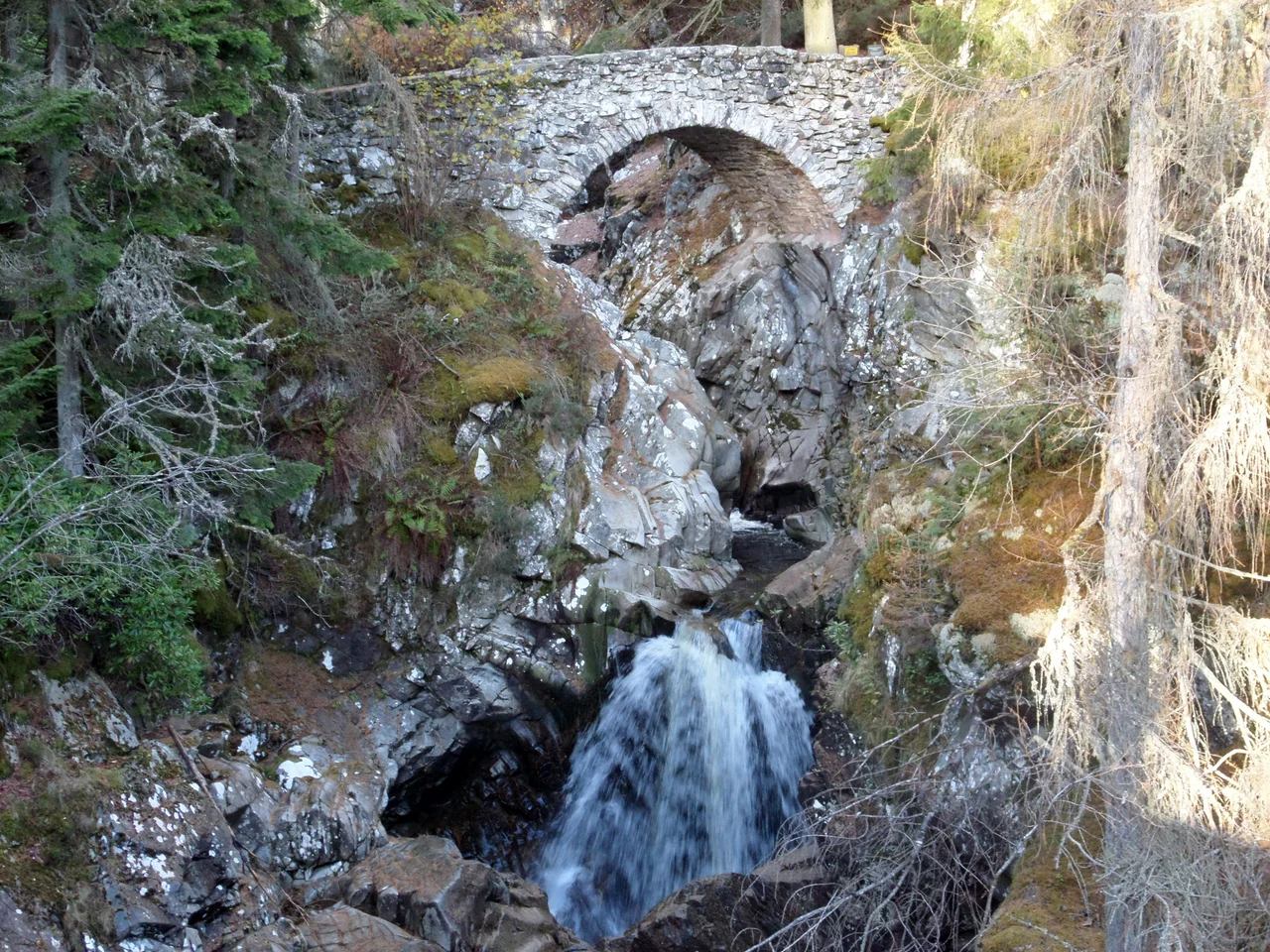

Falls of Bruar
In 1787 Robert Burns walked up the Bruar Water and was disappointed. The falls themselves were splendid, two large drops and a series of smaller ones in a tight gorge that the water had cut through harder and softer bands of rock for 10,000 years, since the glaciers had retreated. But the land around them was bare. Heather, peat, rough grass, nothing taller than knee-high. So Burns did the most Burns thing possible: he wrote a poem in the voice of the Bruar Water itself, begging the landowner to plant something. The Humble Petition of Bruar Water to the Noble Duke of Atholl was published, and in 1796, after Burns died, John Murray, 4th Duke of Atholl, picked up his copy and started planting. He did not stop at the falls. He planted over fifteen million trees across his estates during his lifetime, earning the nickname Planter John, and the entire wooded character of Highland Perthshire today is partly his legacy.
The Geology of the Drop
The Bruar Water tumbles through a narrow gorge cut into rocks that were pushed up some 500 million years ago when the geological forces that built the Scottish Highlands first folded the bedrock. The waters had nothing to work on until the last ice age ended around 10,000 years ago, when the glaciers retreated and exposed the rock to running water. Since then the Bruar has cut a meandering channel, exploiting the layering of the strata, picking out softer bands and leaving harder ones standing as outcrops and natural arches. The total drop of the falls is about 60 metres in a tight, narrow gorge that turns the water peat-brown from the moorland it drains. After heavy rain the falls thunder. In dry weather they trickle, particularly since the late 1940s when hydroelectric works upstream began extracting water that used to come straight over the rocks.
Burns and the Petition
Burns visited on his 1787 Highland tour, the same trip that took him through Aberfeldy and into the verses for The Birks of Aberfeldy. The Bruar disappointed him because of what it lacked. He wrote the petition poem as if the river were speaking directly to the duke: 'Would then my noble master please / To grant my highest wishes, / He'll shade my banks with tow'ring trees, / And bonnie spreading bushes.' Burns was not the only visitor to complain. William Gilpin, the picturesque clergyman who had visited in 1776, had also found the setting wanting. But Burns turned criticism into argument, and that argument moved a Duke. Almost ten years after the poem appeared, after Burns himself was dead at 37, the 4th Duke of Atholl began the planting that would transform the gorge. He started with 120,000 larches and Scots pines. He laid out the path that is still in use today, built the Lower and Upper Bridges as viewpoints, and constructed a series of huts and shelters along the route.
Planter John
John Murray, 4th Duke of Atholl, became known across Scotland as Planter John for the sheer volume of forestry he undertook. Over his lifetime he planted more than fifteen million trees across the Atholl estates. He was not a romantic about it. He believed planting should be both pleasing to the eye and profitable, and he chose species like larch precisely because they would yield commercial timber while looking handsome in the meantime. At the Falls of Bruar he was answering Burns directly, but he was also doing what made sense to a Highland landowner in the early 19th century: turning bare ground into productive forest. The huts he built proved less popular than the trees. William Wordsworth visited in 1815 and complained about the neat paths, in the way Wordsworth complained about most things on his tours. The huts gradually fell into disrepair. Only the partial remains of one stone hut can still be seen along the path.
The Forest Today
Most of the trees the 4th Duke planted were cut down during the Second World War, when Britain needed timber for everything from pit props to aircraft. After 1945 the planting was repeated, again with Scots pine but mixed this time with hybrid larch, fir, and spruce. Native broadleaves were allowed to colonise the banks of the burn, and now the conifer plantation is mixed with mountain ash, willow, aspen, and birch, the kind of varied woodland that a 21st-century forester would aim for from scratch. The walk from the car park up to the Lower Bridge near the natural arch, on to the Upper Bridge, and back down the opposite bank is now a standard stop for visitors driving the A9 between Pitlochry and Inverness. The House of Bruar shopping complex sits at the foot of the path, providing tartans, smoked salmon, and shortbread to the same tourist trade that 18th-century travellers like Burns helped invent. The poet who asked for trees has them. The river that complained of being too bare flows now under a canopy that did not exist when he visited.
From the Air
The Falls of Bruar lie at 56.78 degrees N, 3.93 degrees W in Glen Garry, about 8 miles northwest of Pitlochry in Perth and Kinross. Recommended viewing altitude 3,000 to 5,000 feet AGL. The A9 trunk road runs along the foot of the falls, with the House of Bruar visitor complex at the entrance. The narrow wooded gorge cuts north into the hills from the road. Nearest airport is Perth/Scone (EGPT) approximately 38 nm to the south-southeast. Dundee (EGPN) lies about 45 nm east-southeast. Inverness (EGPE) sits about 60 nm to the north. Highland terrain rises steeply on both sides; the Cairngorms lie to the east, the hills of Atholl to the north. Mountain weather is the default in this country; expect strong winds and rapid changes in visibility.
Nearby Stories
- Rannoch Railway Station 0.6 km away
- Huntingtower Castle 2.5 km away
- Comrie 6.6 km away
- Battle of Dalrigh 7.2 km away
- Braemar 9.4 km away
- Highland Folk Museum 14 km away
- Blairgowrie and Rattray 15 km away
- Inverness-shire 16 km away