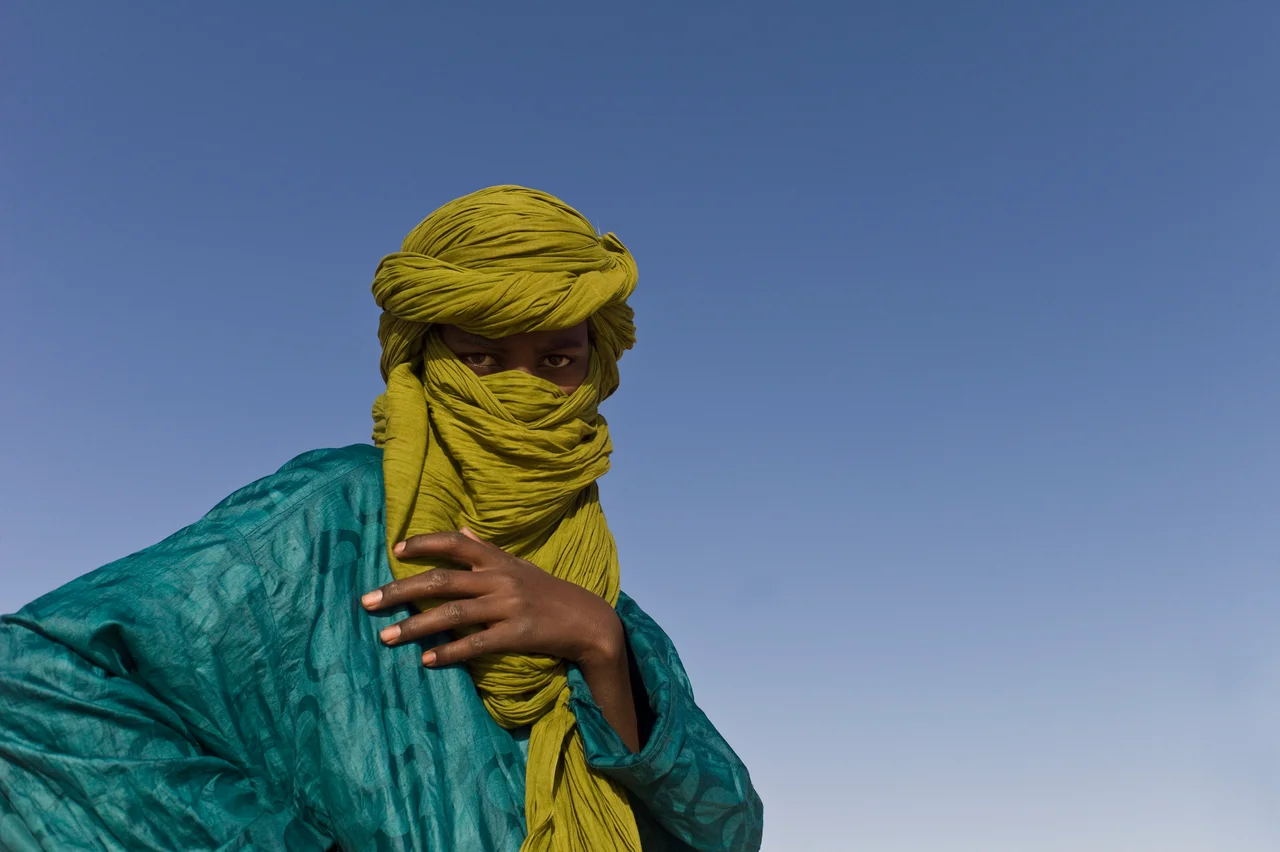

Festival au Désert
On a January night in 2003, Robert Plant - the voice of Led Zeppelin - stood on a makeshift stage in the sand outside Timbuktu and played to a crowd seated on dunes. He later called it one of the most humbling experiences of his life. There was no city for hundreds of miles, no skyline, only firelight and starlight and the hypnotic guitars of the desert. This was the Festival au Désert, and for one extraordinary decade it turned the emptiest edge of Mali into a meeting place for the world.
A Gathering in the Sand
The festival grew from something ancient. For generations, the Tuareg held seasonal gatherings - the Takoubelt near Kidal, the Temakannit near Timbuktu - where nomadic tribes met to trade music, settle disputes, and resolve conflicts through the old authority of song. In 2001, Manny Ansar reimagined that tradition for a new century. Ansar, a Tuareg man raised in a nomadic family, had earned a master's degree in international law and spent years in humanitarian work before he gave himself to music, managing the now-legendary band Tinariwen. The first festival, held at Tin Essako in January 2001, drew just 500 to 600 people. It was the first event of its kind in North Africa - and it would not stay small for long.
The Godfather of the Desert
After two years near Kidal, Ansar approached Ali Farka Touré, the Malian guitarist whose blues-soaked music had won him a global following. Touré embraced the idea immediately. He had always wanted, he said, to bring people home to his country - he just hadn't known how. Now he would be the festival's godfather. From 2003 to 2006 he played the closing concert every year, drawing his fans, the press, and the curious deep into the Sahara. Each year the crowd sang together: "Vive le Mali, vive la paix, vive la musique" - long live Mali, long live peace, long live music. Touré died in 2006, but the words outlived him, and so for a time did the festival he had blessed.
Where the World Came to Listen
From 2003 to 2009 the festival settled at Essakane, in the dunes north of Timbuktu, before moving to the city's outskirts as security tightened. Its lineups read like a map of the desert's musical reach. The 2003 edition - captured in the documentary Le Festival au Désert - brought together Tinariwen, the Malian diva Oumou Sangaré, the women's ensemble Tartit, Khaira Arby, the French band Lo'Jo who had helped organize it all, and Robert Plant with guitarist Justin Adams. Thousands made the journey across some of the harshest terrain on Earth to hear it. For the people of the region, the festival was not only a wonder but a livelihood - one of the largest sources of income the area had ever known.
The Music Falls Silent
In 2012, the desert turned dangerous. Islamist militants seized Timbuktu and much of northern Mali, banning music outright - an unthinkable cruelty in a culture where song carries memory, law, and identity. The festival was postponed, and it has not been held since. Its musicians became refugees; Tinariwen and others scattered abroad. But Ansar refused to let the idea die. In 2013 he launched the Caravane culturelle de la paix - a "cultural caravan for peace" - carrying the festival's spirit into exile, performing in Mali's safer cities, in Morocco, and in refugee camps in Burkina Faso, Niger, and Mauritania where displaced Malians now lived. That same year, the Festival au Désert won the international Freemuse Award for defending musical freedom. The dunes near Timbuktu are quiet now. The song they once held is still looking for a way home.
From the Air
The Festival au Désert was held at sites in northern Mali, centered near Essakane and Timbuktu at roughly 20.03°N, 3.20°W, on flat, dune-dotted Saharan terrain just below 300 meters elevation. The nearest airport is Timbuktu (GATB) to the southeast, with Gao (GAGO) farther east. From altitude the festival grounds appear as featureless desert - no permanent structures mark them - threaded by the Niger River well to the south. Desert visibility is typically excellent, though harmattan dust can reduce it sharply in winter months, the same season the festival was traditionally held. Note that northern Mali remains a conflict zone; this is a story of a place and a moment in time, not a current destination.