
El Djouf
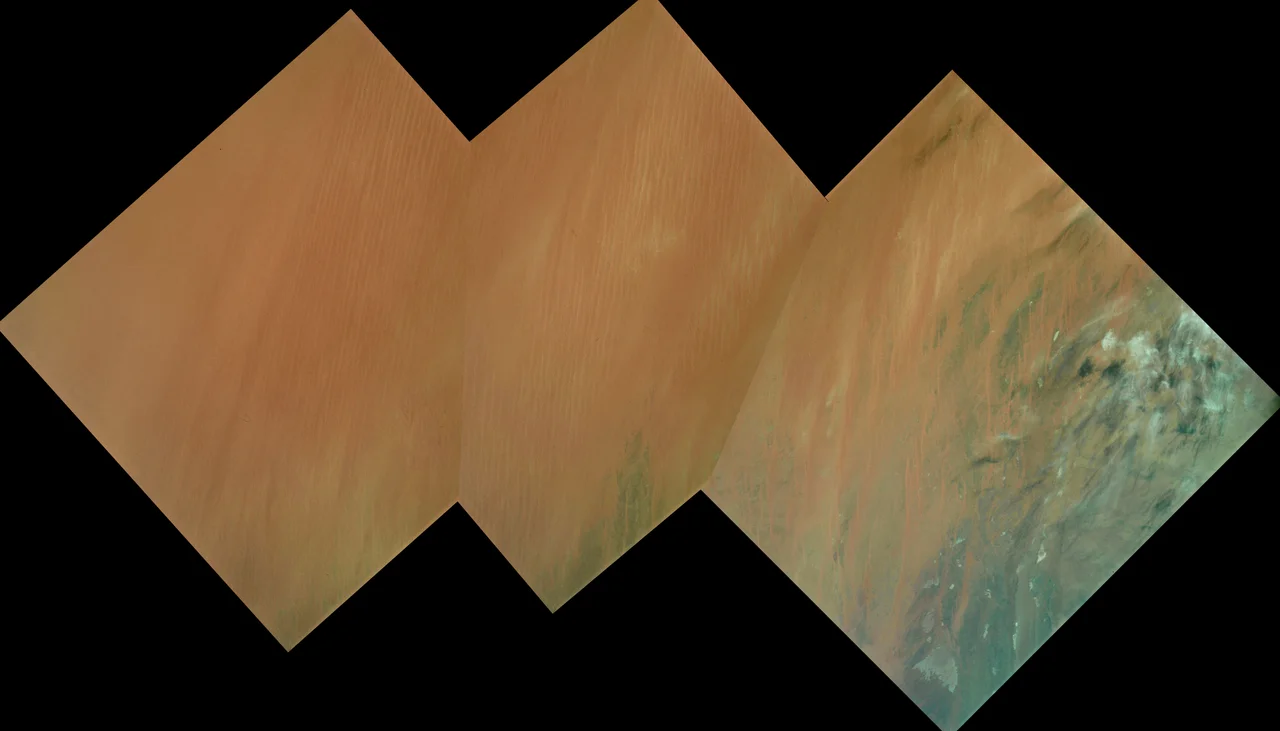
Its name means "the empty" - and the desert earns it. El Djouf is a vast quarter of the Sahara where Mali and Mauritania dissolve into one another beneath a horizon that never changes. From space, the Apollo astronauts photographed it as a study in two colors: rock outcrops to the east in western Mali, and an ocean of dunes to the west in eastern Mauritania. On the ground there is no such tidy division. There is only sand, salt, and a silence so complete that the wind sounds like an intruder.
The Empty Quarter
El Djouf is not a single landscape but a basin - a broad, shallow bowl in the earth's crust, the kind of structure geologists call a sedimentary basin. Over unimaginable spans of time, rock eroded from the surrounding plateaus and ridges, sliding downhill and settling here, layer upon patient layer. The same geological logic shaped the basins of Lake Chad and the great African rivers, the Congo and the Zambezi. But where those basins cradle water, El Djouf holds almost none. Sitting roughly 320 meters above sea level, it is a high, dry table where rainfall is a rumor. Dunes ripple across its Mauritanian flank; bare rock breaks its Malian edge. The emptiness is not absence. It is the landscape itself.
White Gold
Beneath this desert lies the thing that made it valuable: salt. On El Djouf's eastern fringe sits Taoudenni, where miners still cut salt by hand from the bed of an ancient dried lake, shaping it into heavy slabs. For centuries this was treasure. The azalai - the great camel caravans of the Tuareg - hauled the slabs roughly 660 kilometers south to Timbuktu, a journey of about three weeks across the open Sahara. In the twelfth century, the trade ran the other way too: salt from the desert was bartered, weight for weight, against gold from the empires of the south. Caravans of thousands of camels crossed this emptiness. A few still do, among the last working salt caravans on Earth.
A Visitor From Space
The desert keeps strange company. In the early 1990s, searchers in the Saharan borderlands found a meteorite - and not an ordinary one. It was a CR2 carbonaceous chondrite, among the rarest and most primitive material in the solar system, a fragment of rock essentially unchanged since the planets formed. Catalogued as El Djouf 001 after the desert region, it joined the Sahara's long tradition of yielding the unexpected. The Sahara is one of the best places on Earth to find meteorites: dark stones stand out against pale sand, and the dryness preserves them for millennia. Here, in the emptiest place imaginable, the sky occasionally delivers something four and a half billion years old.
The Scale of Nothing
What makes El Djouf unforgettable is exactly what it lacks. There is no skyline, no settlement, no relief from the immensity. The Tuareg and the Moors who have crossed it for generations read this terrain by signs invisible to outsiders: the firmness of the sand, the slant of a dune, the position of stars. To pass through El Djouf is to confront a fundamental fact - that most of the planet's land is not made for people, and that some places remain truly wild simply because they refuse to be otherwise. The emptiness that named the desert is also what protects it.
From the Air
El Djouf spans the Mali-Mauritania border, centered near 21.42°N, 6.67°W, at roughly 320 meters (1,050 ft) elevation. From altitude, the contrast is unmistakable: rippled dune fields to the west giving way to dark rock outcrops to the east, with no roads, towns, or vegetation to break the expanse. The Taoudenni salt-mining region lies to the southeast. Nearest aviation reference points are distant - Timbuktu (GATB) lies far to the south, and Atar (GQPA) in Mauritania to the west. Clear, stable desert air offers exceptional long-range visibility; midday heat haze and occasional dust (harmattan) can reduce it. Best viewed under low sun, when the dunes throw long shadows.
Nearby Stories
- Taoudenni 237 km away
- Taghaza 259 km away
- Festival au Désert 313 km away
- Tiris Zemmour 333 km away
- Dhar Tichitt 376 km away
- Tenoumer Crater 389 km away
- Oualata 426 km away
- Empire of Great Fulo 466 km away