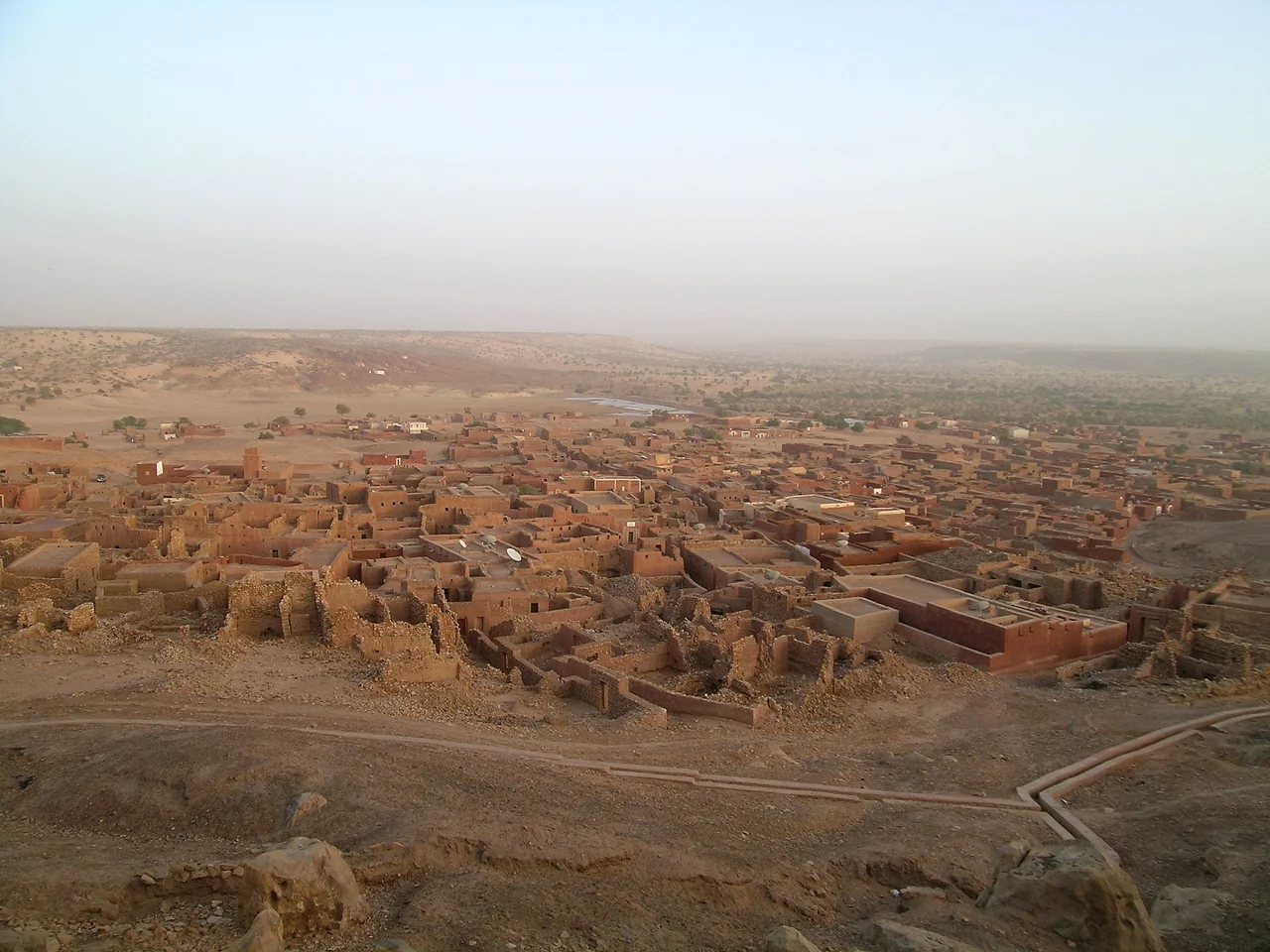

Oualata
In Oualata the walls are written on. Across the reddish earthen facades, the women of the town trace white and ochre patterns by hand: looping arabesques, geometric bands, motifs framing every door and window. Pass through one of those painted doorways and you may find a wooden chest holding manuscripts copied centuries ago, in a town that was once the southern gate of the Sahara. Oualata has been called the big sister of Timbuktu, and for a few medieval centuries it was richer.
The End of the Road
Oualata, also written Walata and known as Biru in old chronicles, stands at the eastern end of the Aoukar basin in southeast Mauritania. It rose because geography made it a destination. At the beginning of the 13th century it replaced Aoudaghost as the principal southern terminus of the trans-Saharan trade, the point where a great route from Sijilmasa, passing through the salt mines of Taghaza, finally ended. First part of the Ghana Empire and then, by the 14th century, of the Mali Empire, Oualata grew wealthy as a commercial and religious center, a place where gold, salt, books, and faith all changed hands. A French historian estimated the medieval town held two to three thousand people.
A Traveler's Wonder
In 1352 the Moroccan traveler Ibn Battuta crossed the desert and stopped here for about fifty days. He found the inhabitants Muslim, mostly Massufa Berbers, and he was honored and entertained, though he complained of the heat and the modest fare of mutton, dates, and watermelons grown in the palm shade. One thing genuinely surprised him: the respect and independence enjoyed by the women of Oualata, who moved and spoke with a freedom he had not seen elsewhere. That observation, recorded seven centuries ago, foreshadows the town's living tradition, in which women remain the keepers of its most visible art.
Painted by Hand
Oualata's fame today rests on its decorated houses. Built largely of earth rather than the bare stone of Tichit, the homes are finished by the town's women, who paint their facades and interiors with intricate patterns in white, red, and indigo drawn from natural pigments. The designs frame entrances and windows in flowing geometric and floral bands, a craft passed from mother to daughter across generations and unlike anything else in the Sahara. A 2007 documentary, En attendant les hommes, followed these muralists at work. Oualata was inscribed in 1996 as one of the four Ancient Ksour of Mauritania, recognized for exactly this kind of living vernacular beauty.
Libraries in the Sand
Behind the painted walls lies an inheritance of paper. Oualata's family libraries preserve ancient manuscripts of Quranic science, law, astronomy, and poetry, some reaching back to the 14th century, and the town keeps a manuscript museum displaying scrolls in fine calligraphy. These collections survived not in grand archives but in private homes, handed down and protected against heat, insects, and the encroaching desert; recent digitization projects have begun to copy them before they are lost. The town that history nearly forgot did not forget itself. Its decline began when Timbuktu drew away the trade after the 14th century, and Oualata slipped into a long quiet, but its words and its painted walls remained.
From the Air
Oualata lies at 17.30 degrees N, 7.02 degrees W, near the eastern edge of Mauritania in the Hodh Ech Chargui region, close to the Mali border. From above, the town is a cluster of reddish earthen buildings in a palm-dotted depression at the eastern end of the Aoukar basin, ringed by desert. The nearest major airfield is Néma (GQNF) to the west; Nouakchott (GQNO/GQNN) is far to the northwest on the coast. A viewing altitude of 2,500 to 4,000 feet AGL shows the compact painted town against the surrounding flats. Best visibility is outside the dusty harmattan season, in the long dry months.
Nearby Stories
- Néma 65 km away
- Koumbi Saleh 157 km away
- Ghana Empire 195 km away
- Dhar Tichitt 207 km away
- Lake Faguibine 255 km away
- Aoukar 284 km away
- Festival au Désert 428 km away