
Taoudenni
There is no shade. There are no trees, no spring, no village in the ordinary sense - only a wide white scar in the desert floor where an ancient lake dried up and left its salt behind. Taoudenni sits 664 kilometers north of Timbuktu, in the southern Tanezrouft, one of the harshest places on Earth. In July the air can reach nearly 48 degrees Celsius. And here, for centuries, men have done one of the most punishing jobs human beings have ever invented: they cut salt out of the ground with their hands.
The White Harvest
The work is brutally simple. A miner swings a crude axe and opens a pit roughly five meters square. He clears away a meter and a half of red clay, then peels off layers of poor salt until he reaches three good ones. From these he cuts slabs the size of a tabletop, each weighing around thirty kilograms, then tunnels sideways to chase the seam further. In a recent season some 350 teams worked the field - an experienced cutter and two laborers each, perhaps a thousand men in all. They live in huts built from the salt itself, the inferior blocks no buyer wants. They come in October and leave in April, fleeing the season when the heat turns the pits into ovens and only a handful of caretakers remain.
The Azalai
Once the slabs are cut, they have to cross the desert, and for that Taoudenni still relies on the camel. The salt caravans here - the azalai - are among the last of their kind anywhere in the Sahara. By camel the journey to Timbuktu runs about three weeks, each animal shouldering four or five slabs, the route bending through the lonely oasis of Araouane. The math of the trip is unforgiving: for every four slabs a camel carries, one goes to the miner and three to the camel's owner, so much of the desert's value is simply the cost of getting out of it. In the great years the numbers were staggering. The American anthropologist Horace Miner, who spent seven months in the town, reckoned the winter caravan of 1939-40 at more than four thousand camels and the season's output at thirty-five thousand slabs.
Salt Worth Its Weight
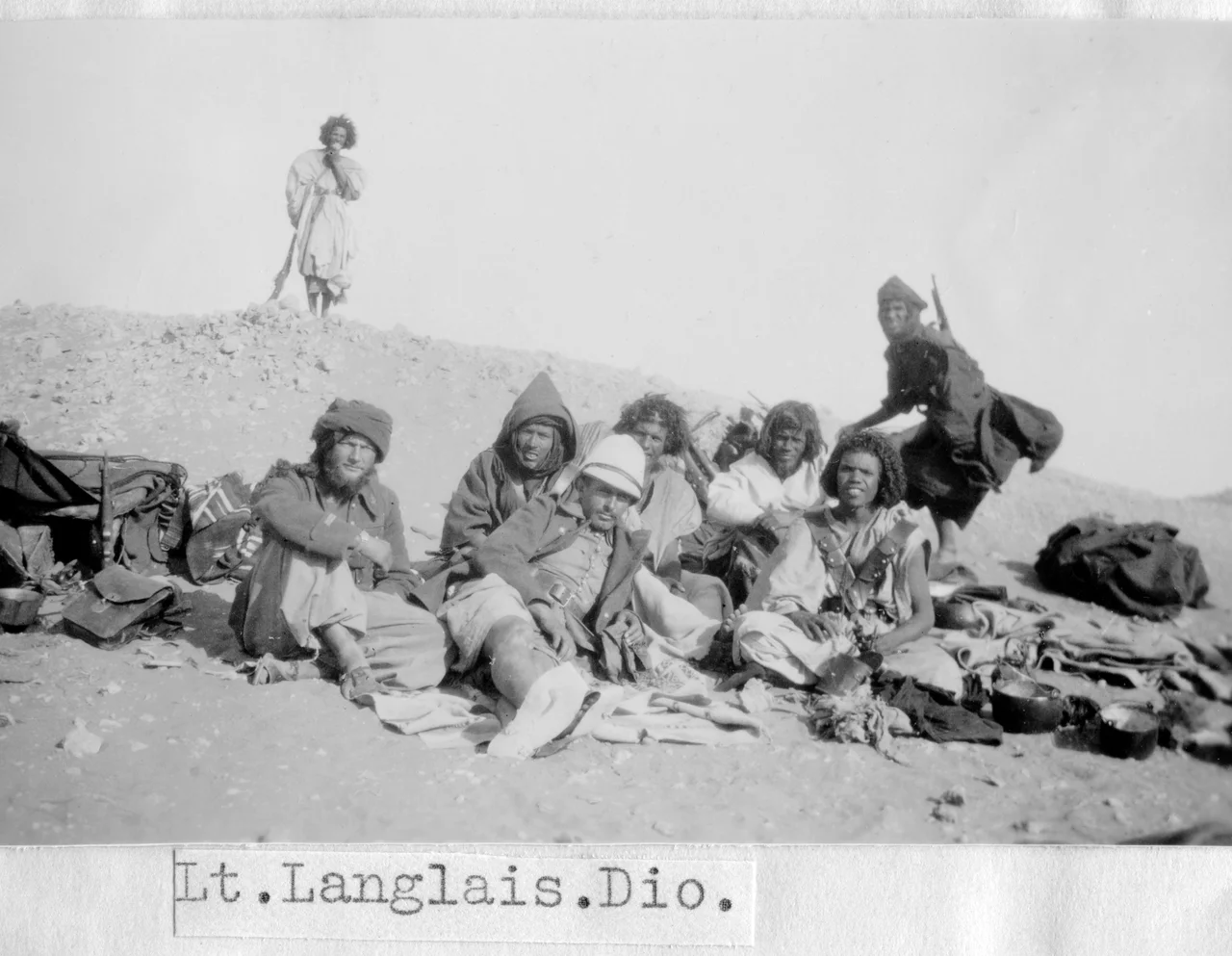
Taoudenni inherited a trade older than itself. When Moroccan forces overran the legendary mines of Taghaza in 1586, miners drifted south to 'Tawdani,' and a new white capital was born. For West Africa this salt was not a seasoning but a necessity - a mineral the body needs and the savanna could not supply - and for generations it moved north against gold coming the other way. That commerce was built, here as at Taghaza, on the backs of unfree labor, enslaved men who dug the pits so that others could grow rich on the exchange. The first outsider to describe the mines in detail was a French cavalryman, Edouard Cortier, who rode in with a camel-corps unit in 1906 and found a single building standing: the walled Ksar de Smida, whose ruins still mark the sand.
The Prison in the Pits
In 1969, under the regime of Moussa Traore, the Malian state found a new use for the worst place it could imagine. It built a prison at Taoudenni and sent political prisoners here to cut salt until they died. Many were former officials accused of plotting against the government - among them Yoro Diakite, who had briefly led the country after the 1968 coup, and the security and defense chiefs Tiecoro Bagayoko and Kissima Doukara. In the killing heat, worked beyond endurance, the prisoners died one after another. East of the ruined prison lies a cemetery of 140 graves; only about a dozen carry names. The prison closed in 1988, but those graves remain - a reminder that the cruelty of this place was not always an accident of geography. Sometimes it was the point.
The Hottest Ground
Even without its human history, Taoudenni would test the limits of survival. It lies more than a hundred and sixty kilometers from any settlement of size, in a region of unbroken sun - some 3,700 hours of it a year, with 84 percent of daylight hours cloudless. July highs peak near 47.9 degrees Celsius, one of the most extreme readings anywhere at this elevation, and even the coolest month averages around 27. Rain barely registers: a centimeter or two in a year, most of it arriving in a brief late-summer gasp. To stand here is to understand why salt, of all things, became as good as money - because almost nothing else could be made to live.
From the Air
Taoudenni lies at 22.63°N, 3.95°W, deep in northern Mali's Taoudenni basin. From altitude, look for the pale rectangular scar of the salt field and the thousands of excavated pits, which are visible on satellite imagery as distinct mining areas marching southwest across the depression. The nearest major waypoint is Timbuktu (Timbuktu Airport, GATB) some 664 km to the south. Expect cloudless skies, extreme surface heat, and excellent visibility nearly year-round; blowing dust is the main hazard.
Nearby Stories
- Taghaza 23 km away
- Erg Chech 215 km away
- El Djouf 239 km away
- Festival au Désert 257 km away
- Erg Iguidi 417 km away
- Tiris Zemmour 479 km away
- Gerboise Blanche 527 km away