
Ffestiniog Power Station
There is a particular moment, just after a popular television programme ends, when millions of British kettles switch on simultaneously and the national grid lurches. To absorb that surge, engineers in the 1950s went looking for a mountain. They found Llyn Stwlan, a glacial lake suspended in a cirque high above the Vale of Ffestiniog, and they used it to build the United Kingdom's first major pumped-storage power station. Commissioned in 1963, Ffestiniog can deliver 360 megawatts to the grid in under a minute - enough to keep the lights on across North Wales for hours.
A Mountain as a Battery
The principle is elegantly simple. Two reservoirs sit at different elevations: Llyn Stwlan in its glacier-carved bowl on Moelwyn Mawr, and Tanygrisiau Reservoir down in the valley. When the grid has surplus power overnight, pumps push water uphill, lifting it back into Stwlan against a head of more than three hundred metres. When demand spikes, gravity does the rest. Water plummets through pressure shafts and steel-lined tunnels to four Francis turbines coupled to 90-megawatt motor-generators. The whole station can pivot from idle to full output in sixty seconds. It pumps for six or seven hours through the night, then generates for around four hours during the day, smoothing out the rhythms of a country.
Engineered to Disappear
The North Wales Hydro-Electric Power Act of 1955 carried something unusual for its time: an amenity clause. The Central Electricity Generating Board was required to engage a landscape consultant from the very beginning, working with the National Parks Commission to fold the station into Snowdonia rather than impose it on the place. Perspective drawings of the project went on display at the Royal Academy of Arts in 1958. Nearly a million tons of excavated rock had to vanish. Rubble from the upper dam was simply sunk in the reservoir. The downstream face of the lower dam was buried under spoil, then profiled and covered with peat and native grasses. The outer walls of the powerhouse were faced with stone from a disused local quarry, tracked down with the help of retired quarrymen so the building would look as if it had grown out of the valley.
The Longest Lawsuit
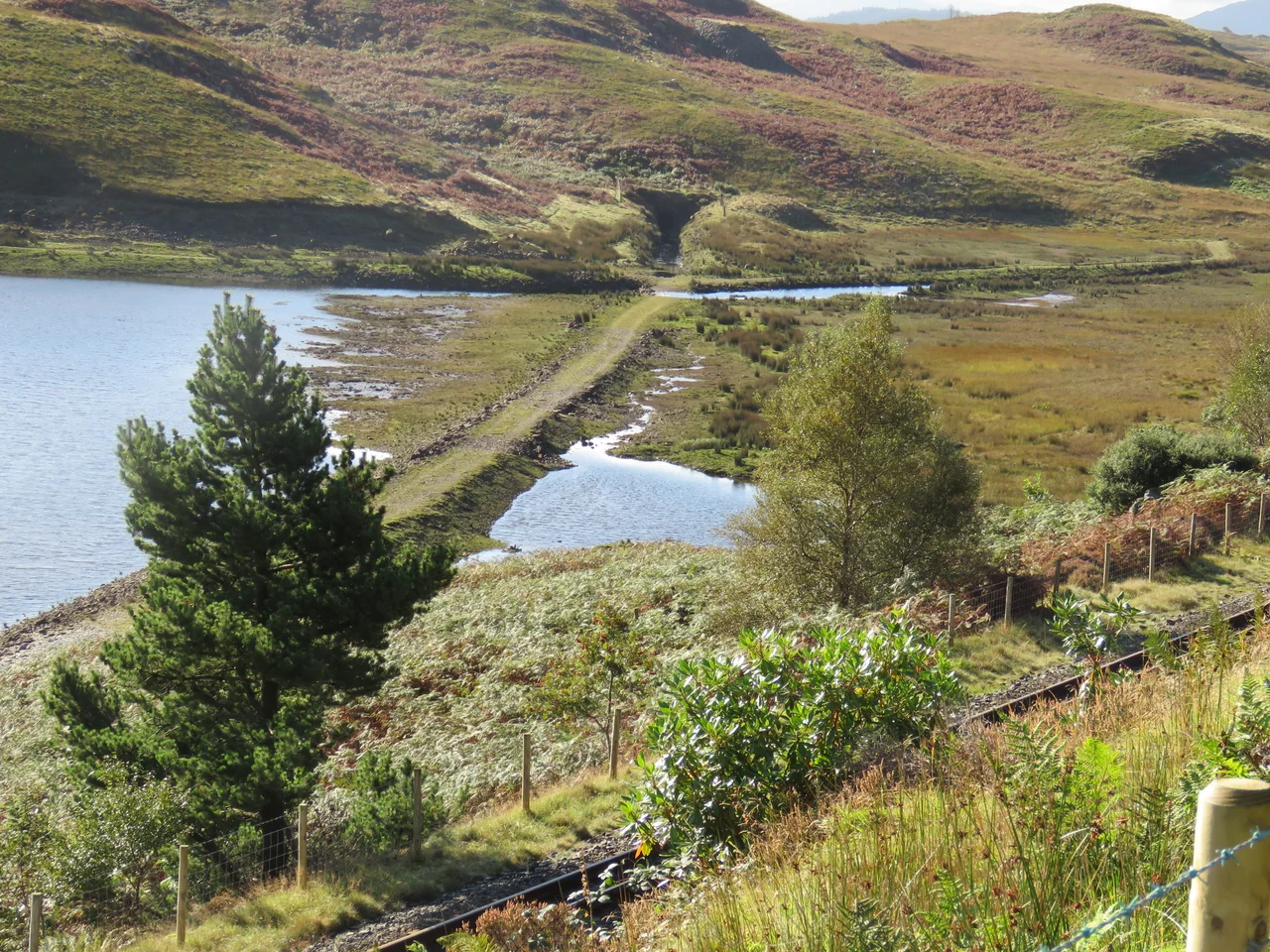
There was a casualty. Building the lower reservoir meant flooding a mile of the Ffestiniog Railway and the northern portal of its Moelwyn Tunnel. Restoration of the railway as a tourist line had only just begun in 1952, and dismissive officials wrote the volunteers off as old gentlemen and boys playing trains. The Festiniog Railway Company sued for compensation in 1956. The case ran on, and on, and on. By the time it was settled in 1972, sixteen and a half years later, it had become the longest case in British legal history. The eventual settlement, written up over fifteen dense pages, paid for a new route along the western side of the reservoir, a spiral climb at Dduallt, and a brand-new tunnel through the Moelwyn. Volunteers built most of it themselves.
Explosives Under the Mountain
There is a stranger chapter still. After the Second World War, the disused Croesor slate quarry on the far side of Moelwyn Mawr was leased to Cookes Explosives of Penrhyndeudraeth, who used its underground chambers to store propellants. In 1971 the CEGB realised that a detonation deep inside the mountain could threaten its two new dams. Both reservoirs were drained while Cookes removed roughly 250 tons of explosives a week, hauling them away by road or by rail from Blaenau Ffestiniog station to ICI Nobel works around the country. For months, an industrial chain extracted from one slate quarry what an industrial nation had quietly stored there since the war.
A Quiet Engine of the Grid
From the air, the power station scarcely declares itself. The valley still looks like an upland sheep landscape with two unusually clean lakes. Down in the engine hall, four vertical shafts run several storeys below the operating floor; the building extends as far down into the ground as it rises above it. There is no smoke, no plume of steam. Just a switchgear feeding 275 kilovolts into the National Grid nearby, on the site of the old Trawsfynydd nuclear station. The Vale of Ffestiniog has done industrial work for two centuries - slate, then explosives, now electrons - and Ffestiniog Power Station is the quietest worker of all.
From the Air
Located at 52.98 degrees north, 3.97 degrees west, in the eastern flank of Snowdonia. The upper reservoir Llyn Stwlan sits in a cirque on Moelwyn Mawr (770 m); the lower Tanygrisiau Reservoir lies in the valley below. From a cruising altitude of 4,000-6,000 ft AGL, look for two distinct lakes on a steep slope southwest of Blaenau Ffestiniog. Nearest airports: Caernarfon (EGCK) 22 nm northwest, RAF Valley (EGOV) 33 nm northwest, RAF Shawbury (EGOS) 60 nm east. Mountain weather is changeable; cloud often caps the Moelwyns.
Nearby Stories
- Barmouth 1.6 km away
- Beaumaris Castle 3.1 km away
- Trearddur Bay Lifeboat Station 3.9 km away
- Rhuddlan Castle 4.6 km away
- Tudweiliog 12 km away
- Battle of Maes Moydog 16 km away
- Ruthin Castle 19 km away
- HMS Whirlwind (R87) 51 km away