
Ffestiniog Railway
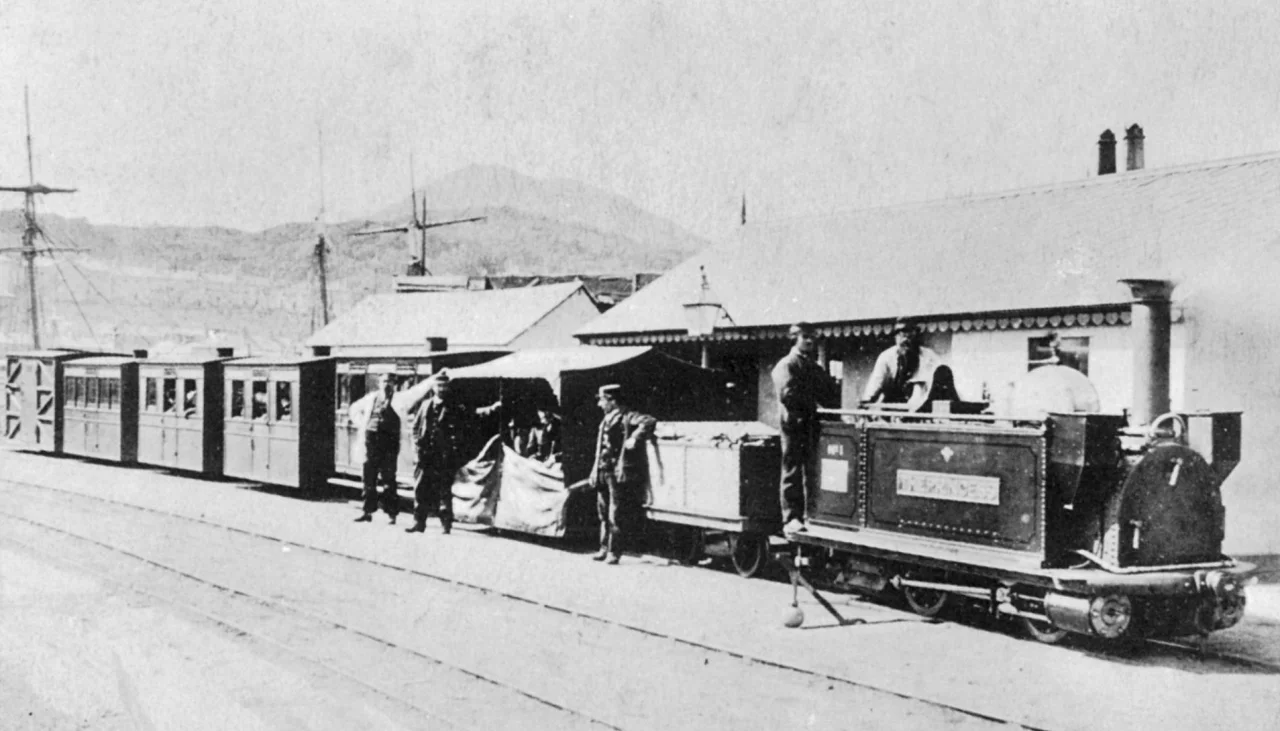
The line was built to roll downhill. Loaded slate wagons leaving the quarry terminus at Blaenau Ffestiniog could coast the entire thirteen and a half miles to Porthmadog harbour on gravity alone, with two brakesmen riding each train to keep it from running away. Horses, traveling in their own special dandy wagons, came along for the return trip. That was 1836. The Festiniog Railway Act had been passed by Parliament four years earlier, and the company it created is still in business today - the oldest surviving railway company in the world. Steam came in 1863. The horses, by then, had earned a long retirement.
A Railway Built on a Slope
Slate built Blaenau Ffestiniog, and getting it to the sea built the railway. Engineers laid the line at a continuous gradient of roughly one in eighty, using cuttings and embankments of dry-laid slate to follow the natural contours of the mountains. Up to six trains rolled downhill each day. The 1856 timetable, published by manager Charles Easton Spooner, gives departures from the Quarry Terminus at 7:30, 9:28, 11:16 and through the afternoon. Each train ran in up to four sections, each section a horse hauling eight empty wagons plus a single dandy. The full timetable could move 70,000 tons of dressed slate in a year. At passing loops, trains kept right, a habit the railway still observes.
The Double Fairlie
By 1860 the line was choking on its own success. The Blaenau quarries were producing more slate than gravity and horses could move. The directors went looking for steam locomotives small enough for a narrow-gauge railway, and in 1863 George England and Co. delivered Mountaineer, followed days later by The Princess. The early passenger carriages had a centre of gravity so low they were nicknamed bug boxes. In 1872 the railway introduced something genuinely new to the world: the first iron-framed bogie carriages anywhere. The same year saw the Double Fairlie - an articulated locomotive with two boilers and two power bogies, looking like two engines fused at the cab. They were built for tight curves and steep grades, and Ffestiniog still runs them. There is no other working public railway that does.
The Deviationists
Slate traffic faded after the First World War. Passenger services ended on 15 September 1939. Track and infrastructure decayed in the rain for fifteen years until railway enthusiast Alan Pegler, lent three thousand pounds by his father, bought the company in 1954. Then came an obstacle no Victorian engineer had anticipated. In the 1960s the Central Electricity Generating Board's new pumped-storage scheme flooded a mile of track north of the Moelwyn Tunnel. The railway had to climb around the new reservoir. From 1965 to 1978, a volunteer corps known as the Deviationists built two and a half miles of new line, including a 310-yard tunnel blasted through a granite spur by three Cornish tin mining engineers and a unique spiral that gains thirty-five feet of altitude in a single loop. It is the only spiral on any public railway in the United Kingdom.
Back to Blaenau
Trains reached Tanygrisiau in 1978. The final push to Blaenau Ffestiniog took another four years of work on derelict urban track, four collapsed footbridges, and a steel river bridge in need of complete replacement. On 25 May 1982 - the 150th anniversary of royal assent to the original act of Parliament - Ffestiniog trains rolled back into Blaenau. The Speaker of the House of Commons came to unveil a plaque the following spring. Within a few years the railway was carrying 200,000 passengers a year and had become the second most popular tourist attraction in Wales after Caernarfon Castle. Pegler stayed involved as president until his death in 2012.
The Cob
The first mile out of Porthmadog is not laid on ordinary ground at all. It runs along the top of the Cob, an embankment built between 1807 and 1811 by William Madocks to reclaim the Traeth Mawr from the sea. The railway uses a wayleave granted under the Portmadoc Harbour Act of 1821, which means it does not actually own the top of its own embankment. Walkers share the dyke; there is no fence between footpath and track. Across the estuary, the Welsh Highland Railway - rebuilt by the same company at huge effort - now meets the Ffestiniog at Porthmadog Harbour station. Occasional trains run the whole forty miles from Blaenau Ffestiniog to Caernarfon, through some of the finest mountain scenery in Britain, on a track gauge that fits neatly between a person's outstretched hands.
From the Air
The railway runs roughly east-west between Porthmadog (52.93 north, 4.13 west) on the coast and Blaenau Ffestiniog (52.99 north, 3.94 west) inland, climbing about 710 ft. From 3,000-5,000 ft AGL, the line is visible as a thin curve hugging the south side of the Vale of Ffestiniog, with the Cob a straight line across the Glaslyn estuary at the western end. Nearest airports: Caernarfon (EGCK) 18 nm north-northwest, RAF Valley (EGOV) 30 nm northwest. Mountain weather can be unpredictable; cloud often fills the valley.
Nearby Stories
- Barmouth 1.6 km away
- Beaumaris Castle 3.1 km away
- Trearddur Bay Lifeboat Station 3.9 km away
- Rhuddlan Castle 4.6 km away
- Tudweiliog 12 km away
- Battle of Maes Moydog 16 km away
- Ruthin Castle 19 km away
- HMS Whirlwind (R87) 51 km away